Introduction: Why Your Stories Matter as Much as Your Skills
Introduction: Why Your Stories Matter as Much as Your Skills
I joined Amazon as a software engineer nearly twenty years ago. In that time, I conducted nearly a thousand interviews across the full range of technical hiring, I became a Bar Raiser, and I trained thousands of people on how to conduct technical interviews. I've watched the interview process for our industry evolve from pure whiteboard coding and brain-teasers to today's mix of technical and behavioral assessments. I've seen technically strong candidates get rejected while others with similar technical skills received surprising offers.
The difference in hiring outcomes often came down to how well each candidate had told their stories about their experience.
I remember one particular occasion when I was interviewing two senior engineer candidates. Both of them had sailed through the coding problems and had delivered solid system design solutions. But when I asked each of them to recount a time when they had disagreed with their teams on a technical decision, their responses were revealing.
Candidate 1 described how he had presented the pros and cons for his position, and he articulated clearly why the others in his team had held opposing views. He disagreed with them, but he understood their reasoning.
Candidate 2 insisted that his solution was the only reasonable course of action. He claimed that his team was living in a fantasy world, and he used this disagreement to explain why he was leaving his company. You can imagine who got the offer.
Over the years, a problem has developed in that technical interviews have become the be-all and end-all in our industry. Online platforms offer endless practice problems. System design resources are everywhere. The technical bar remains high, but it has become more standardized and easier to prepare for.
This creates a challenge for companies. If most qualified candidates can clear the technical bar, how do companies identify which candidates will thrive in their specific environment, and at what level?
Many companies now recognize that the behavioral interview has become the critical differentiator. Google uses behavioral questions to evaluate "Googleyness". Meta aims to assess if candidates "Move Fast" and "Build Social Value." Microsoft looks for "Growth Mindset" in the stories that candidates tell them.
Those companies understand that technical excellence alone doesn't predict success. They need people who can handle ambiguity, influence without authority, learn from failures, and increase the effectiveness of those around them.
Most technical professionals will spend months grinding through coding problems and studying system design. Then they will spend maybe an hour thinking about behavioral questions. But such an imbalanced preparation can be costly. When the technical skills of candidates are comparable, behavioral interviews will often determine who gets the offer. Strong behavioral performances can tip the scales for candidates who are on the fence technically. On the other hand, poor behavioral performances filled with red flags can sink even those who ace the technical portions.
How you tell the story of your experience determines more than just whether you will get hired. It also helps determine at what level you will get hired. Getting down-leveled costs more than pride; it also affects your compensation, career trajectory, and daily work satisfaction. In US tech companies, the difference between mid- and senior levels can mean $100,000 per year or more. Even with strong performance, a promotion from a down-leveled position will typically take 18–36 months. During that time, you will have lost salary, stock appreciation, and bonuses, and the compounding effect of raises from a lower base will be smaller than if you had not been down-leveled.
But the financial hit is only part of the story. Being down-leveled attacks your professional identity. Your scope shrinks. You now have to contribute to projects you once would have led. The more interesting, impactful work goes to others. This frustration can affect your motivation and performance, making that eventual promotion even harder to achieve. Everyone wins when you get leveled correctly from the start.
Your ability to deliver impact in cooperation with others matters as much as your technical capabilities. Companies have learned that success requires more than implementing algorithms or designing systems. It also means working with other people to turn technical work into business results. This becomes especially true at senior levels and beyond, where behavioral competencies often matter more for leveling decisions than the ability to solve harder coding problems.
Behavioral interviews assess what you can do, based on what you've already done. When an interviewer asks you for examples to illustrate how you have dealt with ambiguous requirements, they want to know whether you can operate in the uncertain environments in which real technical work takes place. Interviewers are carefully evaluating how you work, how you make decisions, and whether you can actually deliver results.
This book will show you how to find the stories already sitting in your experience and how to tell them well. You'll learn what interviewers are listening for and how to frame your work at the level you're targeting. The work you put into this will pay off beyond interviews because the same thinking that makes you better at telling your story will make you better at doing your job.
The beautiful thing about behavioral interviews is that they reward genuine experience. You can't easily fake your way through them. They require you to reflect on your actual work, identify patterns in it, and communicate complex situations clearly. Incidentally, these are the same skills that make a person an effective technical professional.
Whether you're a software engineer, data scientist, product manager, or any other technical professional, your experiences contain powerful stories. The challenge is learning to spot them and tell them well.
Let's begin.
Steve Huynh Seattle, Washington February 2026
The Behavioral Interview Roadmap
The Behavioral Interview Roadmap
You've read the job description, and you match it almost perfectly. You have the technical skills they need, you've worked on similar problems, and your experience matches what they're looking for. You're confident you can handle the technical parts of the interview: the coding challenges, system design discussions, or domain-specific problems relevant to your role. But technical competence is only part of what companies evaluate. You also have to show them through behavioral interviews that you can deliver results, work effectively with others, and operate at the level they need you to. Even strong experience can be overlooked if you fail to communicate that experience clearly. A poorly delivered story can make you seem unqualified. How? Not because you lack the skills, but because the interviewer never saw them.
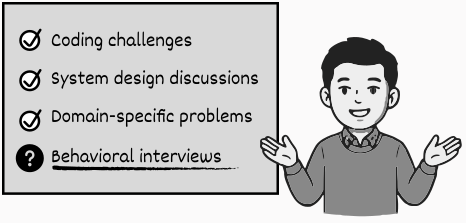
The goal of behavioral interview preparation is to perform at your best when it matters. Think of it less like training for a marathon and more like rehearsing for an important presentation. You want to be confident, clear, and authentic. What matters is turning your real experiences into concise, engaging stories and practicing them until they feel natural. The good news is you don’t need months of work, just focused preparation that helps you speak with ease when the time comes. And once you've prepared, future interviews will take much less effort.
Most people approach behavioral interviews the wrong way: backwards. They will wait until the day before the interview before scrambling to remember project details and practice answering questions, while also cramming for the other parts of the interview. They will develop their stories by writing large, dense paragraphs that are difficult to memorize and filled with corporate speak.
The result? Forgetting critical details. Meandering monologues that conceal important contributions. And responses so vague that the interviewers can't assess the candidate’s actual capability. If they're lucky, they’ll get an offer below their true level. If they're not, they’ll get nothing.
This chapter provides a roadmap for behavioral interview preparation and guides you on how to use this book. Whether you have months to prepare or an interview next week, you can adapt the roadmap to your timeline. Once you've built this foundation, you can focus your preparation on the other aspects of the interview process, knowing that your behavioral stories are ready to deliver when needed.
This book is organized into three parts:
Part I: The Framework teaches you how to identify, structure, and deliver behavioral stories. You'll learn what companies evaluate and how to tell your stories well. Part I ends with the essential questions, the ones every company asks and every candidate should prepare for.
Part II: The Competencies cover the specific behaviors that companies typically assess, from problem-solving and delivery to leadership and innovation. Each chapter includes level-appropriate examples and cultural variations.
The book concludes with Nailing the Interview, which covers delivery techniques and how to handle the unexpected, plus an afterword on applying these skills throughout your career.
The Three Pillars of Preparation
To prepare well for behavioral interviews, you will need to work on three main areas:
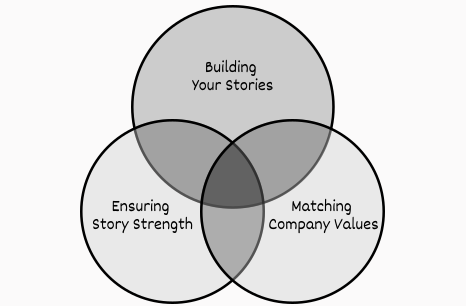
Building Your Stories means taking your raw experiences and turning them into clear stories. How do you identify your best examples, and how do you structure them so that they will be effective?
Ensuring Story Strength means crafting your stories to show the right competencies at the appropriate level for your target role. Junior-level stories don't get you senior-level offers, no matter how well you tell them.
Matching Company Values means understanding what your target company cares about and making sure your stories speak to those priorities. A story that impresses a startup might fall flat at an enterprise company.
These elements work together. It’s not enough to have great experiences if you can’t deliver them well. You won’t get the level of job you want if your stories miss their target level. And you can't simply ignore the values of a prospective employer.
To get an offer, all three of your pillars of preparation need to be strong. This roadmap shows you how to develop all three.
How Many Stories Do You Need?
The number of stories in your story bank depends on three factors: the questions everyone faces, your target company's values, and the level you're interviewing for.
Essential Questions (3-4 stories): Every company asks similar general questions. Chapter 4 covers these in detail. You'll always need stories for "Tell me about yourself," "Describe a project you're proud of," and "Why this company/role?" Most companies will also ask you to talk about your weaknesses, failures, or challenges that you’ve faced, so you will need to prepare for these types of questions, too.
Company-Specific Needs (4-10 stories): Different companies value different competencies. Chapters 5 to 13 discuss nine different competencies and how to tell their stories. Senior candidates interviewing at companies with strong cultures may need stories for all of them, whereas entry-level candidates at smaller companies might only have to focus on a few. Therefore, the individual target company will determine which competencies matter most in an interview.
The following is general guidance on the competencies to prioritize for different company types. These are examples to start your research, but note that your specific target company may value different or additional competencies:
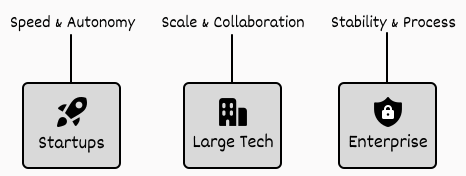
- Startups and high-growth companies emphasize speed and autonomy. At a minimum, focus on Initiative, Delivery, Innovation, and Learning. Research whether they also value Customer Focus or require specific technical knowledge.
- Large tech companies value scale and collaboration. Prepare for Problem Solving, Cross-team Leadership, and Trust and Conflict as core competencies. Many also emphasize Strategic Leadership, Innovation and Developing Others, especially for more senior roles.
- Traditional enterprises value stability and process. Emphasize Delivery, Trust, Customer Focus, and Developing Others as starting points. Some may also value Strategic Leadership for transformation initiatives.
Level Expectations: Your target level influences which competencies become essential and how many you need to cover:
- Entry level (4-6 competencies): Focus on Problem Solving, Delivery, and Learning as your core. Add one or two others that match the company culture, such as Initiative for startups or Customer Focus for product companies.
- Mid-level (5-7 competencies): Build on the entry-level foundation by adding Initiative and Trust and Conflict to show you can work independently and handle team dynamics. Include Customer Focus or Innovation, based on the role you're applying for.
- Senior level and beyond (7-10 competencies): Must show Strategic Leadership and Developing Others to demonstrate organizational impact. Add Innovation to show you can drive technical direction. Include all competencies relevant to your target company's culture and values.
These factors overlap significantly. A single strong story can answer an essential question, cover multiple competencies valued by your target company, and also show the appropriate scope for your level. Build stories that cover all three, then fill any gaps for your specific company.
Mining Your Experiences for Story-Worthy Moments
The best strategy for maximizing coverage is to recognize that major projects, for example, six-month projects, contain multiple stories. Most people approach interview preparation by listing their projects: "I did a database migration, I contributed to a recommendation system, I fixed a production issue." Then they try to force-fit these projects into whatever question gets asked. But this sort of approach leaves value on the table.
Instead, look at each significant project you’ve been involved in. You'll find several moments where you made a real difference. Each of them is its own story.
Consider a half-year database migration project. Instead of thinking "This is my database migration story," identify specific behavioral moments within it. For example:
- Week 2: You discovered the current system would not be able to handle the projected growth, and you had to build a compelling case for migration despite the skepticism of leadership.
- Month 1: Your team split over migration strategy. Half of them wanted a big-bang approach; the other half wanted incremental. You facilitated the decision process.
- Month 3: You invented a novel approach for zero-downtime migration that the company later adopted as standard practice.
- Month 4: Your lead engineer quit suddenly. You restructured the work to ensure the project would still hit the deadline.
- Month 5: You mentored a junior engineer through building a critical component, thus turning a risk into a chance to develop their skills
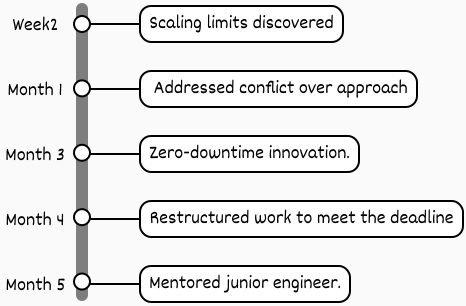
Each of these moments is a complete, standalone story. They're not five versions of "the database migration story"; they're five different stories about Problem Solving, Earning Trust, Innovation, Delivery, and Developing Others that happened during the same project. Some of the contextual details might appear in multiple stories, for example, the technical scope of the migration or the size of the team. But the decisions you highlight will make each story feel different.
Building Your Story Bank
Once you understand that each project contains multiple behavioral moments, you can extract stories from all your experiences. Here's how to build your complete story bank:
- Start with significant experiences from your recent work: major projects, challenging situations, role transitions, or important initiatives that spanned weeks or months.
- Identify the story-worthy moments within each experience. Look for times when you: Faced a decision that changed the direction of the project Solved a problem others couldn't crack Influenced a group to agree on the approach to a problem Delivered despite a major obstacle Learned something that changed how you work Stepped up beyond your defined role
- Use Part II as a reference. It provides detailed examples of what strong behavioral moments look like for each competency. Use these chapters to help identify similar moments in your own experiences.
- Develop each moment as its own story. Each story covers a single moment. Give brief context about the overall project, then zero in on the specific challenge, decision, or outcome. Chapter 3 (High-Signal Storytelling) shows you how to give a story an effective structure.
This way, you'll pull multiple stories from each major experience. A complex, multi-month project might give you three to four stories. A two-week critical incident might provide just one. However, the number of stories that come out will depend on how many key moments happened, not how long the project took.
Practice Natural Delivery. Your stories should be the start of a conversation, not a memorized monologue. You need to adapt the conversation based on follow-up questions and the interest of the interviewer. Chapter 3 (High Signal Storytelling) covers how to handle common follow-up questions. Chapter 14 (Nailing the Interview) covers delivery techniques and what to do when interviewers interrupt or redirect.
Ensuring Story Strength
Simply having stories isn't enough. They need to match the level you're targeting. A senior engineer who tells entry-level stories won't get far. A data scientist who focuses only on technical implementation will miss the chance to show they can think strategically.
The Four Dimensions
Every story you tell signals four key dimensions to an interviewer:
Scope: The breadth of your work and your specific role within it. Did you improve a single function, own an entire feature, or transform systems across teams? Make the scope of your work clear.
Contribution: What you specifically did, versus what happened around you. Use 'I' to describe your work. Companies want to see the line between what you did and what the team accomplished.
Impact: The results and value of your work, including your direct influence on outcomes. Can you quantify the improvements? Did you affect team productivity, product metrics, or business outcomes? Provide numbers, and explain how your actions created those results.
Difficulty: The complexity of the problems you solved and the decisions you made. Did you follow established patterns or create new approaches? Did you work within clear requirements or work through significant ambiguity? Explain your reasoning and any trade-offs you may have had to make.
Chapter 2 (What Companies Are Looking For) explores these dimensions in detail with level-appropriate examples from entry to senior and beyond. The key insight is that recruiters and interviewers use these signals to determine both whether to hire you and at what level.
Your story portfolio should include examples that hit your target level across multiple dimensions. This shows you can work at that level across different situations.
Matching Company Values
You already know which competencies matter for your target company type. But knowing the categories isn't enough, because you need to understand how your specific target company expresses those values and then make sure your stories speak that language.
Research Their Values
Go beyond the career page bullet points. Read employee blogs. Watch tech talks. Study their interview guides. Look for how they describe successful employees and what behaviors get rewarded. When they say "polite relentlessness" or "customer obsession," what does that mean in practice? The competency chapters in Part II include "Cultural Considerations" sections that explain how different company types express these values.
Identify Your Gaps
Map your current stories against their values. If they emphasize "thinking big" but your stories focus on incremental improvements, you have a gap. If they value "learning from failure" but you have only success stories, that's another gap you need to fill.
Fill What's Missing
Sometimes you’ll need to dig deeper for overlooked experiences. Check that side project: there might be an innovation story in it. That production incident: perhaps you could show how you learned from that failure.
Other times, you’ll need to reframe existing stories to highlight different aspects. For example, the same project can emphasize technical depth or customer impact depending on how you tell it.
The goal is to find real examples that show that your values match theirs. Obviously, every company wants to find and hire people who will succeed in their environment. Showing them that your values match theirs will increase your chances of success and, if you accept an offer, your subsequent enjoyment in the role. (And if your values genuinely clash with theirs? Don't fake it. You'd both be better off if you kept looking.)
As a reminder, everything in this book assumes you're telling true stories about real experiences. It can be tempting to embellish or invent, especially when you feel your real stories aren't impressive enough. Resist that urge. The techniques here help you find and present your genuine accomplishments clearly. Fabrications get exposed, and the consequences range from immediate rejection to career-ending termination. It’s simply not worth it.
How To Use This Book
This book is designed for both linear reading and quick reference. Your specific situation and timeline will determine the best approach for you to take.
If you have an interview next week: Focus on Chapter 3 (High-Signal Storytelling) and Chapter 4 (The Essential Questions) first. Chapter 3 teaches the framework you need to structure an effective story. Chapter 4 covers the questions every company asks. Then jump to Part II and skim the competency chapters most relevant to your target role and company. Focus on the example stories at your level, rather than reading every section. Finally, review Chapter 14 (Nailing the Interview) for tips on delivery. You won't have time for everything, but you can still build a solid foundation.
If you're actively interviewing with multiple companies: Work through Part I sequentially to understand the full preparation framework. Then use Part II as a reference, reading the relevant competency chapters based on what each company values. Keep notes on which stories work best for different company types. Chapter 14 (Nailing the Interview) covers delivery and how to handle unexpected situations, and the Afterword offers perspective on using these skills beyond interviews.
If you're planning ahead: Read the book straight through to understand the complete system. Part I gives you the framework and roadmap. Part II helps you understand what excellence looks like for each competency at different levels. Chapter 14 (Nailing the Interview) shows you how everything comes together and provides techniques for peak performance. Take time to complete all three pillars of preparation, and build a comprehensive story bank you can adapt for any opportunity.
If you're assessing your readiness: Start with Chapter 2 (What Companies Are Looking For) to understand how companies evaluate level and fit. Then sample stories from Part II at your target level. Can you tell similar stories with comparable scope and impact? If not, you'll know where to focus your preparation.
Your experiences contain powerful stories, and preparing them isn't just about landing offers. This book will help you find those stories, develop them, and tell them in a way that shows what you're capable of.
What Companies Are Looking For
What Companies Are Looking For
Technical skills alone don't determine your offer. Otherwise, those who can solve the coding and system design problems would get the same result. Instead, companies use behavioral interviews to answer two critical questions: Do you fit with both the role and the company? And if you do fit, at what level will you be most effective?
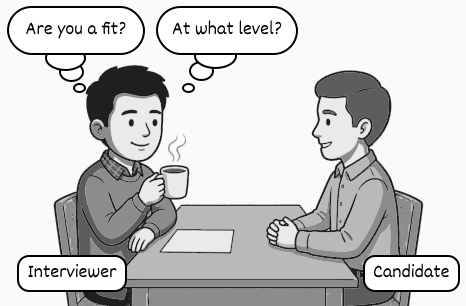
Get both right, and you will receive an offer at the appropriate level. Get the fit wrong, and you'll be rejected regardless of your skills. Get the level wrong, and you'll be either down-leveled or rejected for being underqualified.
This chapter explains how companies make their assessments of fit and level by analyzing the signals in your stories. Once you understand these dimensions, you'll pick better stories and signal the right level.
Understanding Fit: Role and Company
The primary consideration for any tech role is whether you have the technical skills to do the job. Companies will assess this mostly through the technical parts of the interview, for example, coding challenges, system design, or whatever technical evaluation matches your role. If you can't demonstrate the core technical capability, nothing else matters.
But technical skills alone don't predict success. Companies learned this the hard way by hiring smart people who couldn't work effectively in their environment. That's why behavioral interviews focus on two additional types of fit:
Role Fit: Can you handle the specific challenges and working conditions of this position? A backend role at a fast-growing startup requires different capabilities than a backend role at an established enterprise. The technical skills might be similar, but the role demands will be different.
Company Fit: Will you thrive in the environment in which this organization operates? This goes beyond surface-level culture. They are assessing whether your working style, decision-making approach, and values match with how the company gets things done.
How Companies Detect Fit Through Signals
Companies can't directly ask the question, "Would you fit here?" What candidate would torpedo their chance of success by answering with a “No”? Instead, companies look for signals in your stories that indicate alignment or misalignment.
Role Fit Signals emerge from how you describe handling situations similar to what the role requires:
- If the role requires working with ambiguous requirements, do your stories show comfort with uncertainty?
- If the position involves cross-team coordination, do you show an ability to cope with organizational complexity?
- If the job needs rapid iteration, do your examples show shipping quickly and adjusting based on feedback?
Company Fit Signals come from the choices you made and how you describe them:
- A company that values "bias for action" looks for stories that show you moving quickly despite incomplete information.
- An organization that prizes "customer obsession" wants to hear examples of you going deep to understand user needs.
- A place that emphasizes "radical transparency" seeks stories that show you sharing information openly, even when you’re uncomfortable.
The same story can send different signals to different companies. You spending three weeks perfecting a solution might demonstrate attention to quality at one company but analysis paralysis at another. Moving fast and fixing issues later demonstrates good judgment at a growth startup but recklessness at an established healthcare company.
Common “Mis-Fits”
Even a talented candidate will get rejected sometimes if they are not a good fit. The same behaviors that are positive at one company can signal poor fit at another.
Independence vs. Collaboration: This covers both how you work and how you make decisions. Some companies need people who pick up a problem, run with it, and come back with a solution. Others expect you to bring the team along at every step. These often go together: companies that want you to work solo also tend to want you to make calls on your own, and companies that want collaborative work also want group buy-in on decisions.
If every story you tell involves going off and building something alone, consensus-driven companies will worry you'll steamroll people or make choices that won't stick. Flip it around: if every story involves checking with the group before you act, companies that prize individual ownership will wonder whether you can make a decision without a meeting.
Speed vs. Thoroughness: Startups often need rapid experimentation, where you ship MVPs and iterate based on feedback, while companies in healthcare or finance require careful validation before any release. This tension also shows up in how teams think about code quality: some organizations will happily spend extra weeks on clean architecture, while others want a working solution on deadline even if the code needs cleanup later. Whereas stories about methodical testing might bore a startup, your "ship it and fix it" examples could terrify a medical device company.
Excellence vs. Pragmatism: Some organizations value technical excellence and clean architecture above all else. Others need pragmatic solutions that ship on deadline even if imperfect. Focusing on perfect code fails at deadline-driven companies, just as accepting technical debt everywhere fails at companies maintaining critical infrastructure.
Innovation vs. Stability: Some roles require creating new solutions and challenging existing approaches, while others need you to maintain and optimize proven systems. If you say that you’re constantly reinventing established processes, teams that value stability will not consider you a good fit. Conversely, stories that show you only follow existing patterns will disappoint teams that are looking for creative problem-solving.
Direct vs. Diplomatic: Some cultures prize radical candor and want you to say exactly what you think. Others value maintaining harmony and face-saving communication. If you are too blunt, you will not fit in well at a relationship-focused company. If you are not direct enough, you will not like working at a company that values "disagree and commit."
Data vs. Intuition: Some companies require data to justify every decision ("data-driven" cultures), while others trust experienced judgment and move on gut feel. Showing that you make decisions based on instinct does not impress analytical companies, and telling a company that values experienced judgment that you conduct three A/B tests to choose a button color will get you struck off their list.
Specialist vs. Generalist: Large companies often want deep experts who master one domain, while smaller companies need people who are comfortable wearing multiple hats. Know which sort of company you are walking into.
Once you understand fit, you can pick stories that match the company and the role.
The Four Dimensions That Determine Your Level
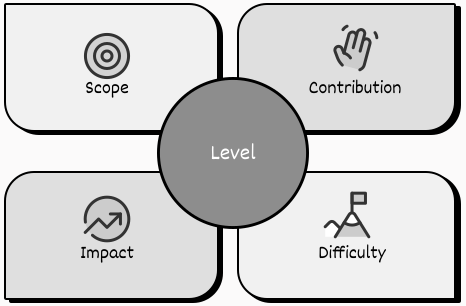
Companies assess your level through four dimensions that appear in every story you tell. Each dimension reveals different aspects of your capability. Together, they show the company where you operate most effectively.
Scope
Scope provides a measure of the number of people on your team and, extending outward as you advance, whose work was affected by your actions. The greater the number affected, the higher your level for this dimension.
Entry Level: Your work affects your own productivity and starts to help other team members. For example, you might improve how you handle assigned tasks or fix issues that were slowing down a few teammates.
Mid Level: Your work affects aspects of the team and shapes how it operates. You might redesign a process that changes a significant part of how your team works or solve problems that affect most of the team's effectiveness.
Senior Level: Your work directly impacts your entire team and is beginning to influence at least one other team. Perhaps you create solutions that change how your whole team operates and affect workflows in adjacent teams, or you solve problems that require coordination with other groups. You may also start collaborating more closely with product or design partners on your immediate team's work.
Staff Level: Your work directly impacts at least two teams and is beginning to have an influence on the broader division or organization. Examples of this include developing technical strategies that change how multiple teams make decisions and solving problems that require buy-in across several parts of engineering. Your influence extends beyond engineering into product, design, and program management as you shape solutions that affect how cross-functional partners work.
Principal Level: Your work affects many teams or changes how large parts of the organization operate. Perhaps you have created technical strategies that have influenced how dozens of teams make decisions. Or you have solved problems that cut across a large engineering organization. At this level, your influence regularly extends into business strategy, shaping decisions alongside product, design, program, and business leadership.
Contribution
Contribution captures what you did, not what happened around you. It is important to be precise about the line between "I" and "we." Companies will expect to see evidence of increasing leadership and ownership as you advance in your career.
Entry Level: You execute assigned work and are beginning to take ownership of small pieces. Examples: implementing solutions designed by others; fixing bugs in existing systems; taking full responsibility for well-defined features within larger projects.
Mid Level: You own complete solutions from problem to implementation while also guiding others. Perhaps you have identified issues, designed the approaches, implemented them, and you have verified that they work, and you have helped your teammates understand the reasons for your decisions.
Senior Level: You lead initiatives requiring coordination. You're expected to make progress even when the requirements are unclear or the path forward is uncertain. Examples of this include driving technical decisions for your team; mentoring others through complex problems; architecting solutions to be implemented by others; and ensuring quality work outcomes for many people.
Staff Level: You lead cross-team initiatives and establish technical direction, often in situations where the right approach isn't obvious and stakeholders have competing priorities. This could look like defining technical approaches that are adopted by multiple teams, creating systems that enable other teams to solve problems on their own, or driving agreement on complex technical decisions across several teams.
Principal Level: You create organizational capabilities and establish new ways of working. At this level, you're frequently operating in highly ambiguous environments where you must define the problem before you can solve it. You might define technical standards that guide dozens of teams, build systems that enable others to solve entire classes of problems, or transform how the organization approaches its hardest challenges.
Impact
Impact shows what changed for the better as a result of your work. Companies want to see that your work produced results worth the investment. Strong stories put numbers on the impact and connect technical wins to business or user outcomes.
Entry Level: You improve your personal productivity and are starting to help the team work better. Examples include reducing the time you spend on repetitive tasks, fixing issues that were slowing down teammates, or improving the quality of code in the areas you touch. Even simple measures matter at this level: time saved or bugs prevented.
Mid Level: You improve team effectiveness in specific areas and influence team-wide practices. Perhaps you reduced deployment times for specific workflows, eliminated categories of bugs in your domain, or you created tools that have made the team more productive in particular areas. You can quantify these improvements and connect them to broader outcomes like feature velocity or reliability.
Senior Level: You transform how your entire team works and are starting to have an impact beyond your team. For example, you might have introduced new workflows that changed your team's capabilities. Or perhaps you eliminated major sources of operational problems, or the improvements that you have created have been adopted by adjacent teams. Your impact extends beyond just engineering metrics to product outcomes, user experience, or operational costs.
Staff Level: You improve how multiple teams operate and drive organizational improvements. These sorts of impact come from achievements such as establishing practices that several teams adopt, solving infrastructure problems that were impeding multiple teams, or creating new capabilities that open up new types of work across teams. Your measurable impact can be tied to business metrics like revenue, customer retention, or time-to-market.
Principal Level: You create organizational capabilities and drive strategic changes. Impact at this level could come from establishing technical foundations that dozens of teams use to build upon, solving problems that were blocking major business initiatives, or creating leverage that compounds benefits across the company. Your impact is measured in business outcomes and strategic capability, not just technical improvements.
Difficulty
Difficulty reflects the complexity of problems you've tackled, the constraints you have faced, and the trade-offs you have managed. Under this category, solving easy problems with big impacts is less impressive than hard problems solved well.
Entry Level: You work on straightforward problems within established patterns. For example, you might face challenges learning new technologies or debugging unfamiliar code, but the path forward becomes clearer once you understand the problem or ask for help.
Mid Level: You work through challenges and obstacles in your work. The problems you tackle have more moving parts and less obvious solutions. These could be competing requirements or having to work through technical complexity you haven't seen before. Or perhaps you have had to manage dependencies within your team that affected your timeline or figure out solutions when the approach wasn't immediately obvious.
Senior Level: You manage constraints and make technical decisions with team-level architectural implications. The problems you solve involve multiple interacting systems and competing concerns. You might have to balance needs across multiple stakeholders with different priorities. Maybe you make architectural decisions that affect how your whole team works, or you have to work around technical limitations that require creative solutions, or solve problems that require you to address both technical and business factors.
Staff Level: You manage competing trade-offs across multiple teams while handling problems with significant technical and organizational complexity. Examples of difficulty at staff level include:
- Balancing different technical approaches when teams have genuinely conflicting needs.
- Creating solutions that affect how several teams work together.
- Making architectural decisions that have to work across diverse contexts.
- Getting teams to agree when the technically optimal solution differs for each team.
Principal Level: You handle fundamental trade-offs between competing organizational needs or solve problems where no clear solution exists. The complexity at this level often involves novel problems that lack established patterns or precedents. You might balance technical excellence against delivery speed at organizational scale; work within organizational constraints while maintaining technical integrity; create approaches for entire classes of problems the company hasn't solved before; or make decisions that affect company strategy and require executive buy-in.
What Each Level Looks Like
Here's how the same types of accomplishments look across each level. These aren't templates. They're meant to help you develop a sense for the difference between a mid-level story and a senior one. Compare adjacent levels and notice what actually changes as you move up and down.
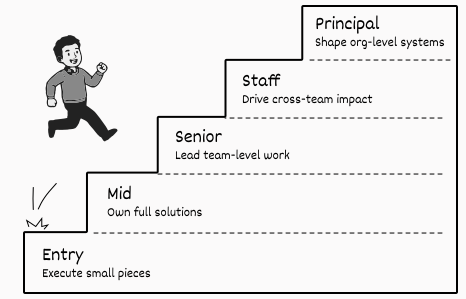
Entry Level Through the Four Dimensions
Story: Improved testing workflow
- Scope: My testing work, and three teammates who handled similar tasks
- Contribution: I wrote the scripts and documented the process
- Impact: Manual testing went from a 2-hour chore to 30 minutes
- Difficulty: Needed to learn our testing framework and understand how my teammates used it
Story: Fixed recurring production alerts
- Scope: My team's on-call rotation
- Contribution: I investigated the root cause of the alerts and implemented the fix
- Impact: Eliminated roughly 15 alerts per week that were waking people up
- Difficulty: Had to trace through unfamiliar code and test thoroughly to avoid breaking existing functionality
Story: Created onboarding documentation
- Scope: New people joining my team, and improving our documentation practices
- Contribution: I documented our setup process, ascertained the common issues, and worked with my manager to review accuracy
- Impact: New hires were productive in two days instead of a week, and my docs became the template that other teams copied
- Difficulty: Had to identify which parts were confusing and work with my manager to verify accuracy
Mid Level Through the Four Dimensions
Story: Redesigned deployment process
- Scope: My team's deployment workflow, and starting to influence the infrastructure team's approach
- Contribution: Redesign, implementation, and rollout
- Impact: Reduced deployment time from 3 hours to 15 minutes, enabling daily releases instead of weekly
- Difficulty: Had to balance speed with reliability, manage dependencies within the team during migration, and ensure nothing broke while rolling out changes
Story: Built automated performance testing
- Scope: All the backend services that my team maintained
- Contribution: Designed the framework and implemented the initial version
- Impact: Caught performance regressions before production; reduced incidents by about half
- Difficulty: Had to balance test coverage with execution time, figure out integration with existing CI/CD without clear documentation, and handle flaky tests
Story: Improved error handling across services
- Scope: My team's microservices, and influencing how we thought about observability
- Contribution: I owned the strategy, implemented it across our services, and documented the patterns
- Impact: Debugging that used to take hours now took minutes; customers saw fewer and shorter outages
- Difficulty: Had to balance detail with performance impact, coordinate changes across six services my team owned, and handle edge cases that weren't well documented
Senior Level Through the Four Dimensions
Story: Established shared component library
- Scope: My entire team and three other frontend teams
- Contribution: I drove the technical vision, built initial buy-in, and led implementation
- Impact: Less duplicate code, more visual consistency, and feature work that used to take three sprints started finishing in two
- Difficulty: Had to build consensus across teams with different needs, establish governance model, and migrate existing code
Story: Redesigned incident response process
- Scope: My team's on-call practices; and influencing two other engineering teams
- Contribution: Identified the problems, designed new workflows, and led adoption
- Impact: Recovery times dropped by half, and on-call pages fell about 60%. Engineers no longer dreaded their rotation
- Difficulty: Had to change the established practices my team relied on, balancing needs across different stakeholders and making architectural decisions about communication patterns between teams
Story: Architected service communication pattern
- Scope: My team's services and the two teams that integrated with us
- Contribution: Designed the architecture, led technical implementation, and ensured adoption
- Impact: Teams could deploy independently; reduced integration bugs by about 70%
- Difficulty: Required making architectural decisions that affected how all three teams would build features going forward, balancing different team constraints, and technical integration across systems with different patterns
Staff Level Through the Four Dimensions
Story: Created platform observability standards
- Scope: Three backend teams directly; influenced broader engineering organization
- Contribution: Defined the technical strategy, built the initial implementation, and drove adoption
- Impact: Reduced mean time to detect issues from 30 minutes to under 2 minutes; teams could debug on their own without waiting for the platform team
- Difficulty: Required hard trade-offs between standardization and team autonomy; teams had different observability needs based on their systems; had to create an approach that worked across diverse technical contexts
Story: Established API design framework
- Scope: Five product teams building customer-facing APIs
- Contribution: Led the technical design, built reference implementations, and created governance model
- Impact: Partners could integrate in half the time they used to, API-related support tickets dropped, and the APIs started to feel like one product instead of five
- Difficulty: Teams had directly conflicting requirements based on their different use cases; had to balance flexibility against consistency when both needs were valid; created framework that worked across internal and external APIs with different constraints
Story: Transformed deployment infrastructure
- Scope: Backend and infrastructure teams (about 40 engineers across 4 teams)
- Contribution: Designed the architecture; coordinated implementation across teams; drove organizational adoption
- Impact: Deploys went from 45 minutes to under 5 minutes, teams no longer had to wait on each other to ship, and reliability improved
- Difficulty: Each team had its own different deployment needs based on their system characteristics; required trade-offs between deployment speed and safety across different contexts; had to design architecture that worked for both monoliths and microservices
Principal Level Through the Four Dimensions
Story: Created engineering strategy for AI infrastructure
- Scope: All teams building AI-powered features (15+ teams)
- Contribution: Defined the technical strategy and built organizational support
- Impact: Enabled company to ship AI agents in days instead of weeks or months; this became a competitive advantage
- Difficulty: Required deep technical trade-offs between flexibility, security, and standardization; executive alignment; multi-quarter rollout
Story: Transformed how company handles data privacy
- Scope: Entire engineering organization and product teams
- Contribution: Established technical frameworks and governance model
- Impact: Achieved compliance requirements; enabled new markets; built trust with users
- Difficulty: Managed legal requirements and organizational constraints across product and legal teams; balanced product velocity with compliance at scale; required executive alignment on trade-offs between features and privacy
Story: Established technical fellowship program
- Scope: Senior and staff engineers across the company
- Contribution: Designed the program structure and mentored initial fellows
- Impact: Developed next generation of technical leaders; improved retention of senior talent
- Difficulty: Required working around organizational constraints around career development and compensation; built support from executive leadership; balanced program overhead with organizational value when no clear ROI metrics existed
Reading and Calibrating Your Own Level
Use these dimensions to check whether your stories match your target level. Most candidates either undersell their accomplishments or overstate their contributions. This section will help you find the more accurate middle ground.
Assessing Your Stories
Take your prepared stories and score them using this table:
Story Level Assessment Table
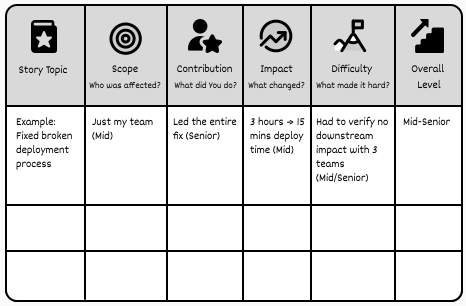
Scoring Guide:
- Entry: Individual/few teammates, executed/owned small pieces, personal/small group productivity, straightforward problems
- Mid: Team aspects, owned solutions/guided others, specific team improvements with emerging business connection, challenges with more moving parts and less obvious solutions
- Senior: Whole team + 1-2 other teams, led initiatives/mentored, transformed team + influenced others, including cross-functional partners, constraints and team-level architecture, progress despite unclear requirements
- Staff: 2-3+ teams directly, cross-team leadership, multi-team capabilities tied to business metrics, significant technical and organizational complexity, competing stakeholder priorities
- Principal: Multi-org/company-wide, strategic leadership alongside product/design/business partners, organizational capabilities measured in business outcomes, novel problems without established patterns, defining problems before solving them
Interpreting Your Results
If most stories cluster below your target level: You need to either find stronger examples from your experience, better articulate the scope and impact of your existing stories, or consider if you're targeting the right level. If your stories show mixed levels: This is normal, but ensure you have at least 2-3 stories solidly at your target level. Lead with those in interviews. A strong senior story followed by a solid mid-level story is fine. Three mid-level stories with senior-level framing is not.
If you're missing a dimension:
- Weak on Scope? Look for examples where your work affected multiple parties
- Weak on Impact? Find stories with quantified business outcomes
- Weak on Difficulty? Choose examples with appropriate challenges for your level, for example, obstacles and complexity for mid-level, constraints and architectural decisions for senior, fundamental trade-offs for staff and above
- Weak on Contribution? Find stories where you can clearly articulate your specific decisions and actions, not team outcomes.
You don't need every story to be at your target level, but you need enough of them to be at that level to show you can consistently operate there.
To be clear: you're selecting which experiences to share and which aspects to emphasize, not fabricating stories. If you pretend to have experiences you don't have, you'll either get rejected when follow-up questions reveal the truth or, worse, get hired into a role you can't actually do.
The same project can be told in a multitude of ways, all truthful. Your API redesign project could emphasize technical depth, customer impact, cross-team coordination, or fast delivery, and all four might be accurate.
Tailor your emphasis to what each role values, not your underlying experiences. If your experiences don't match with what a company values, that's useful information. Maybe this isn't the right role for you. Maybe you need to acquire those experiences before applying. Or maybe you simply need to look for a different culture to work in. Far better to know this before accepting an offer than discovering the mismatch after starting.
Common Mismatches
Watch for the following patterns, which can lead to down-leveling or rejection:
Junior Stories for Senior Roles: Focusing on individual task completion when interviewing for roles requiring team leadership. For example, saying, "I optimized our search query from 3 seconds to 200ms" without mentioning how you influenced the team's approach to performance, taught others the optimization techniques, and created monitoring to prevent future degradations.
Mid-Level Stories for Staff Roles: Focusing on single-team ownership when interviewing for roles requiring cross-team leadership. For example, saying, "I owned our team's entire deployment pipeline, and it was adopted by one other team." Have you got a story that describes how you built consensus across multiple teams or created systems that let other teams solve similar problems without your help?
Claiming Unearned Scope: For example, saying that you led the entire platform rebuild when, in fact, you built only one service within a larger effort. Or "I redesigned our service architecture" when all you did was design one of twelve services while the principal engineer made the architectural decisions. Interviewers will probe, and your overstated claims will destroy your credibility instantly.
All Impact, No Difficulty: Stories about important but uncomplicated work don't demonstrate senior-level problem-solving. "I added SSL certificates to our API endpoints, improving security for 100K users." Important? Yes. Difficult? No. You’re describing a straightforward implementation. For senior roles, you need to provide examples of working through constraints and making architectural decisions, not just executing important checklist items.
All Difficulty, No Impact: Deep technical work that didn't create meaningful outcomes hints at overengineering. Don’t tell them "I spent three months building a custom distributed cache with eventual consistency guarantees" without explaining why existing solutions wouldn't work or what business problem this solved. Complexity without purpose raises red flags.
Unclear Contribution: Using "we" throughout your story makes it impossible to assess your level. "We migrated to Kubernetes, and we reduced deployment time by 90%." Who made the decision? Who did the work? Who handled the problems? If you are not clear about your specific role, interviewers won’t be able to evaluate whether you drove the work or were just a participant.
Researching What Companies Really Value
You'll never have perfect information about what a specific company values, but a little focused research will often reveal surprising insights that most other candidates will miss. The difference between having even partial intelligence and going in blind can be whether or not you emphasize the right things in your stories.
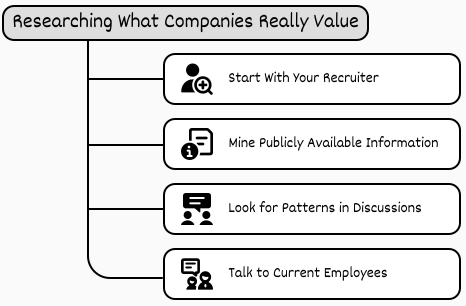
Start With Your Recruiter
Most candidates treat recruiters as gatekeepers to avoid, but if you do this, you will waste your best source of insider information. Recruiters want you to succeed, because their performance is based on the number of accepted offers received by the candidates they put forward. They have prep materials, they know the interviewers' focus areas, and they understand what they are looking for.
Ask your recruiter directly: "What should I know about this company's current challenges?" Or "What competencies matter most for this role?" Or "Can you share any interview prep materials?" Many recruiters have documents about interview format, team priorities, or even the specific behavioral competencies they evaluate. The questions that are used as examples in the prep materials have a high likelihood of being asked in the interviews.
Mine Publicly Available Information
When companies repeat certain words when describing job opportunities, they're telling you what matters. For example, a job posting that mentions "fast-paced" several times signals something different than one emphasizing compliance. Those words are there for a reason.
Where to dig:
- Engineering blogs: How do they describe their wins? What problems do they celebrate solving?
- Tech talks and conferences: What topics do their engineers present? Speed of delivery? Scale? Innovation?
- Open source contributions: What they choose to open source reveals their priorities. If they open source developer tools, this suggests they value community. If they are happy to make internal tools public, this shows transparency.
- Technical documentation: The existence of public API docs or technical guides (and the quality thereof) shows how they support both users and their own teams.
- Status pages and postmortems: Companies that publish detailed postmortems demonstrate that they value learning from failure. A company that shares their incident response processes likely has a strong operational culture.
Even companies without engineering blogs will leave traces. Product release patterns tell you about their development pace. Technology choices show their priorities: newer frameworks suggest a focus on innovation, whereas relying on proven technologies indicates they prefer stability.
Look for Patterns in Discussions
Glassdoor, Blind, and Reddit contain gold buried amongst rubble. Ignore the rubble (e.g., individual rants). Instead, look for patterns across multiple posts. If five different people mention "lots of process" or "no work-life balance" or "amazing learning culture," that's a pattern you will want to know about.
Pay attention to what people complain about and what they praise. Complaints about "too many meetings" may suggest the company has a collaborative, consensus-driven culture, or, alternatively, that productivity within the company is inhibited by an excessive number of meetings. Praise for "autonomy" indicates they trust their people to make decisions without checking in. Both types of comments reveal what behaviors the companies will reward.
Talk to Current Employees
If you know someone at the company, ask them directly what behaviors get rewarded and, conversely, what behaviors will cause people to struggle. Skip surface-level queries about culture, and ask specific questions:
- "When someone gets promoted here, what do they do to earn it?"
- "What behaviors get negative feedback?"
- "How does the team make decisions when there's disagreement?"
- "What surprised you most about working here?"
Current employees will tell you truths the company website never would. Perhaps they'll tell you that at their company, "customer obsession" really means checking usage data before writing code, or that "ownership" means being available to resolve production issues at two o’clock in the morning.
What You're Really Looking For
All this research serves one purpose: understanding what stories will resonate at your interview. Think of it as finding the real intersection between your experience and what they care about.
If research reveals they prize speed over perfection, then emphasize stories that tell how you shipped quickly and iterated. If they value technical depth, highlight examples of diving deep to understand root causes. If they care about collaboration, make sure your story focuses on cross-team work rather than solo accomplishments.
The research will also help you decide whether this company is the right place for you. If everything you learn suggests they value the kinds of behaviors you don't naturally demonstrate or don't want to develop, then perhaps you don’t need to pursue that particular role.
Putting It All Together
Companies aren't just evaluating whether you can do the job. They're also assessing whether you'll thrive in their specific environment and at what level you'll be most effective. These two dimensions determine not just whether you will get an offer, but also whether that offer will position you for success.
Understanding fit helps you know which of your experiences will connect most with what the company values. This small company needs someone who ships fast and figures things out alone. That enterprise needs someone who navigates processes and builds consensus. Neither is inherently better than the other. They're simply different environments that reward different approaches.
Understanding levels helps you position your stories appropriately. The same project can demonstrate entry-level execution, mid-level ownership, or senior-level leadership depending on your actual contribution and how you frame it. Get this wrong and you will either get rejected for overreaching or down-leveled for not properly communicating your capabilities.
The payoff is immediate. You'll pick better stories, focus on the right details, and make it easier for interviewers to see what you can do. You'll make better decisions about which roles actually match who you are and what you want to do. The goal isn't to get any offer. The goal is to get the right offer at the right level at the right company to ensure your success.
High-Signal Storytelling
High-Signal Storytelling
They're called behavioral questions for a reason. Interviewers aren't interested in the history of your company's product line or why your team chose the exact technology stack you used four years ago. They need to understand how you have behaved when facing the same types of challenges that exist at their company: how you hit deadlines despite challenges, investigate problems, make decisions, influence others, and create impact. Yet most candidates will instinctively tell project stories instead of behavioral stories.
This disconnect happens because of how we naturally talk about our work. When someone asks you about a challenge you overcame, your instinct is to explain the full situation so they understand how hard it was. You describe the company context, team dynamics, and technical constraints. By the time you reach your actual behaviors (your thought processes, decisions, and actions), these crucial signals are tangled up with everything else, making it hard for the interviewer to distinguish what you did from what happened around you.
Telling an interviewer a linear, project-based story instead of a behavioral story has real consequences. Strong candidates fail to get offers if their problem-solving abilities remain hidden in their stories. Experienced people get down-leveled because the evidence of their sound judgment was buried under project details. Your capabilities get lost when you get bogged down recounting events exactly as they happened.
This chapter introduces High-Signal Storytelling, a framework that puts your behaviors at the center of every story. You'll learn to structure responses that will make your contributions impossible to miss, and you'll understand what interviewers evaluate and how to deliver exactly those signals.
The framework also makes preparation surprisingly simple. Instead of memorizing lengthy narratives that can fall apart when you are under pressure, you'll build stories in clear layers that can adapt naturally to whatever direction the conversation takes. You'll walk into interviews knowing your stories will show exactly who you are as a technical professional.
The High-Signal Storytelling Pyramid
Behavioral interviews have a hard time constraint. You have 45 minutes to answer several questions through different stories. If you spend five minutes on context for a single story, you won’t be able to showcase fully what you’re capable of doing.
A good story structure does the following:
- Makes it easy for interviewers to capture the key points in their notes.
- Delivers your key behaviors and actions upfront and clearly, so they will be neither missed nor misunderstood.
- Takes a short time to establish, leaving room for natural conversation to flow wherever the interviewer wants to take it.
- Adapts to different interviewer interests without falling apart.
- Includes impact and results as part of the narrative, not saved for the very end.
Enter High-Signal Storytelling (HSS). HSS gives you all these things. Picture your response as a pyramid with three layers. You control the first two and build the third in real time based on the interviewer's follow-up questions and interests.
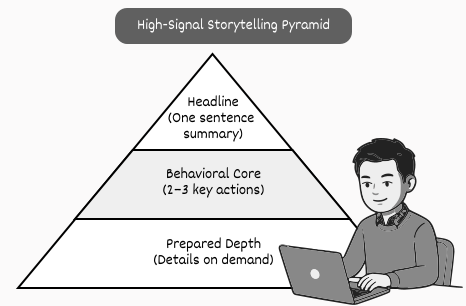
The structure mirrors what interviewers write in their notes and evaluations. When you tell a story, they don’t transcribe every word. They capture key points, as below:
Interviewer Note:
Question: Tell me about a time you were debugging an issue, and the cause wasn’t obvious.
Candidate identified that system processing delays were caused by database locks rather than network issues and fixed it by removing a problematic trigger, speeding up the system 16x.
Details:
- Candidate discovered database locks causing delays, not network issues, by adding detailed logging to isolate the problem
- Presented his findings to the team to keep them updated
- Redesigned update logic to avoid table locks
- The candidate needed to study up on the subject and worked with experts (DBAs) to ensure that the solution was solid.
- Reduced processing from 8 sec to 500ms
- Went from processing 100 requests per minute to over 1,000 (10x improvement)
Follow-up exploration:
- Discussed alternatives–candidate considered but rejected caching due to data consistency requirements
- Asked about discovery process–candidate noticed a pattern only affecting certain user types, used systematic isolation to rule out network
- Probed stakeholder management–candidate got buy-in by showing data on customer impact, worked with DBA team to build and test solution safely
Your pyramid structure maps directly to these notes. The headline gives them that one-line summary in the "Initial question and response" section. The behavioral core provides those bullet points about what you discovered, added, redesigned, and achieved, the evidence of your specific actions. The base fills in the details they capture in the "Follow-up exploration" section when they probe further.
The pyramid pulls your behaviors forward into a focused two-minute narrative. The interviewer doesn't have to dig through project descriptions to find what you did; it's right there.
After those two minutes, the conversation will likely flow wherever the interviewer wants to explore. Some will dive into technical details. Others will probe your stakeholder management. Some will want to understand what alternative approaches you considered or what you learned from the experience. By preparing for common follow-up categories (covered later in this chapter and throughout Part II), whatever direction the interview takes, you won’t be blindsided.
What you sacrifice with this approach is perfect chronological storytelling. You won't walk through events in exact order from beginning to end. But that's fine because the interviewers are evaluating you, not documenting project and team history. They need to understand your capabilities, not every twist and turn of everything that happened. If they want those exact details and the timeline, they'll ask. But if they don't ask, you can assume they got what they needed to evaluate you.
The HSS structure turns behavioral interviews into natural conversations. With targeted preparation for common follow-up directions, you'll be ready for wherever the discussion goes.
Let's look at each layer of the pyramid and how to build it.
The Peak: Your Headline
The peak of your pyramid is a single sentence that captures your entire story. Think of it as reverse-engineering the interviewer's notes. The goal is for the interviewer to write down your opening sentence almost verbatim. So when an interviewer asks about a time you debugged a non-obvious issue, you might say, "Let me tell you about when I discovered our system processing delays were caused by database locks, not the network issues everyone assumed, and fixed it by redesigning our update logic to avoid table locks, speeding up the system 16x.”
This headline does a lot of work. It confirms you understood the question, previews your specific contribution, and tells the interviewer where the story is going. This is called signposting, and it helps the interviewer follow your narrative. When they know your destination, they can focus on how you got there rather than wondering where you're going.
Creating effective headlines also lets you offer options when multiple stories could answer the question. For example, if asked about dealing with ambiguity, you might say: "I have two examples that could work here. I could tell you about designing a well-received recommendation system when we had no clear success metrics or about building a flexible data pipeline when the requirements changed weekly. Which sounds more relevant?" This puts the interviewer in control while also showing them you have many strong examples.
Your headline is not a summary of the project context or your company or team. In a sense, it's your whole story in one sentence, which acts as a preview of what you did that mattered.
After you deliver your headline, pause for a moment to give the interviewer a chance to digest it. This gives them the opportunity to respond if your story wasn't what they were looking for. If they don't respond, continue on to the behavioral core.
The Middle: Your Behavioral Core
The middle layer, your behavioral core, is where you show your behaviors by describing your specific thoughts and actions. Remember that these are behavioral questions, and companies want to evaluate how you think and act, not just what projects you’ve touched or technologies you’ve used.
With the behavioral core, you'll share 2 or 3 key moments that highlight what you did. Describing each moment follows a simple pattern: minimal context to understand the situation; your thought process or decision; the action you took; and what resulted. You'll also include impact and metrics here as part of your story. This gives a complete picture and all the key information the interviewer needs to evaluate you.
Here's what one key moment might sound like:
"Everyone blamed our upstream provider's API for the delays, since that's where the logs showed timeouts occurring. But I noticed the delays happened for only one segment of users, not all of them. That pattern made no sense for network issues, so I decided to investigate differently. I added detailed timing logs throughout our flow and discovered we were spending 8 seconds on a simple database query before even calling the API. Turns out, we had a trigger updating statistics that locked the table when clients had high transaction volume. I shared my findings with the team to keep them in the loop after confirming this with testing. I studied up on database locks and worked with the DBA team to redesign the statistics to update asynchronously. It was tricky to update production databases, and there was some nuance on how to verify the changes I rolled out. Processing time dropped from 8 seconds to 500ms and we went from processing 100 requests per minute to over 1,000."
Notice what's present and what's missing. Present: observation, reasoning, investigation method, discovery, learning, solution, and the measurable impact. Missing: your company's history, your team structure, the tech stack, meeting discussions about the problem, and what other people tried first.
This clear focus on behaviors is what separates strong responses from weak ones. You're showing how you worked, not just what you worked on.
The Base: Your Prepared Depth
The base contains everything you might need for follow-up questions but shouldn't volunteer up front. This includes technical implementation details, the dynamics of your extended team, additional context about the company or system, alternative approaches you considered, and the deeper lessons you learned.
Different interviewers will explore different parts of your base. A technical interviewer might ask, "What was the specific issue with the database trigger?" A manager might ask, "How did you get buy-in to modify a production database?" And a senior leader might ask, "How did you ensure that users weren’t disrupted and their data was safe?"
Prepare these details and have them ready, but let the interviewer guide you to what interests them. Having this base information ready allows you to follow the interviewer’s lead naturally instead of guessing what to include upfront.
How HSS Relates to STAR and CARL
You might already know STAR (Situation, Task, Action, Result) or CARL (Context, Action, Result, Learning). These frameworks have helped countless people structure their interview stories. They're not wrong approaches, but they can often lead to anti-patterns that can weaken your stories.
The biggest problem with STAR is that it treats all components equally. Most people spend too much time on Situation and Task, which are really just context. By the time they reach Action, the most important part that shows their behaviors, they've used up a significant amount of time on setup. The interviewer then has to do the work of connecting the initial context with your actions.
The Task component creates another issue. Not every story involves a clear task that you were assigned. What if you had identified a problem nobody had asked you to solve? What if your story is about you taking initiative beyond your assigned work? Forcing every story into the STAR framework by finding a “task” can make you appear passive, as if you will act only when given explicit assignments. This is also problematic for senior roles and above, where work doesn't come as assigned tasks.
CARL improves on STAR by dropping Task and adding Learning. But learning isn't always the right ending. Entry-level candidates might not experience profound learnings from every project. Sometimes, the impact and metrics matter more than what you’ve learned. Making learning a mandatory feature of your stories can lead to forced or generic insights, for example, "I learned that establishing communication with partners is important."
If you've already prepared STAR stories, you can readily transform them to HSS:
- Your Headline pulls the most important parts from Situation, Action, and Result.
- Your two-minute core story focuses on expanding Action by adding your thoughts and decisions.
- By default, Situation and Task will be minimized, but they can be fleshed out in your base if needed.
- Result becomes part of your core, not saved for the end.
- Learning moves to your base, ready to go if you are asked.
Understanding Signal vs. Noise
Your story core should be heavy on signals. In behavioral interviews, signal refers to evidence of your behaviors: how you investigated problems, how you interpreted situations, why you made specific decisions, what actions you took, and what impact you created. These behavioral signals are the specific data points interviewers need to evaluate you. Interviewers are trained to write your signals down in their notes and bring them up during the debrief when hiring decisions are being made.
Noise is everything else that makes your story longer without showing how you actually work. It happens when you pull base-layer details into your behavioral core story. You might think more context helps the interviewer understand, but it actually buries your signals under unnecessary information.
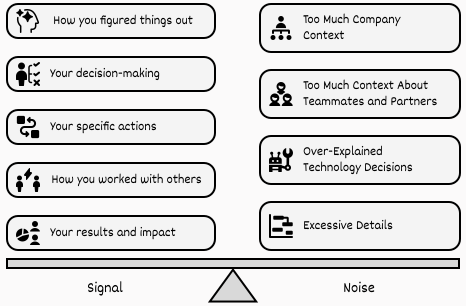
What Counts as Signal
Your primary signals are your thoughts, actions, and impact. These show interviewers how you actually work. For example:
How you figured things out: "I noticed the errors happened only during lunch hours, so I checked if it was load-related. When I saw low CPU usage during failures, I knew it wasn't a scaling issue."
Your decision-making: "I had to choose between a quick fix that would work for 6 months at the most or a redesign that would take longer but scale for the long term. I chose the redesign because our growth rate showed we'd hit the same problem again by Q3."
Your specific actions: "I built a prototype over the weekend to prove the async approach would work, then I convinced the team by showing a 10x performance improvement in testing."
How you worked with others: "I knew the backend team would resist large changes to their API, so I created a migration plan that let them update on their own schedule while we moved forward."
Your results and impact: "My solution reduced processing time from 30 seconds to 2 seconds and cut our infrastructure costs by 40%. Customer complaints about slow loading dropped to virtually zero."
Stories about behavioral moments such as these are what interviewers care about. Everything else is noise.
Recognizing Noise
Noise creeps in when you think the interviewer needs the full picture to appreciate your work. Here are the most common types of noise:
Too Much Company Context: "We were a Series B startup with 200 employees that had just pivoted from B2C to B2B..." The interviewer doesn't need your company's history to understand your skills.
Excessive Team Details: "My team had three senior engineers, two mid-level, and four juniors. We'd just lost our tech lead and hired two new grads. Plus, we worked with a remote team in Poland..." Unless these team changes are central to your story, skip the org chart and staffing updates.
Over-Explained Technology Decisions: "We used React because it had better community support than Vue, and we chose PostgreSQL over MySQL because..." Unless the technology choice demonstrates your judgment, just mention what you used.
Drawn-Out Timelines: "This started in January when we noticed issues. In February, we had several meetings about it. By March, we had formed teams and were investigating..." Compress the timeline unless the duration matters to your story.
The key test for signal is “Would an interviewer write this detail in their notes?” If not, it will likely not come up during the hiring debrief and make a difference to the outcome. For example, they'll write "Candidate identified root cause through systematic debugging," but not "Candidate's company used React." They'll discuss "They delivered despite significant attrition for critical roles," not "The senior engineers left because of a lack of competitive compensation."
If a detail won't make it to their notes or the debrief discussion, it's noise.
Just-In-Time Context
Instead of front-loading context, provide just enough information exactly when it is needed to understand your decisions. Compare these approaches:
Noise-Heavy Version: "Our e-commerce platform processed transactions for small businesses. We integrated with Stripe, PayPal, and Square to give merchants options. The platform was built on a microservices architecture with separate services for authentication, payments, inventory, and shipping. Each service had its own database. The payment service used Node.js and MongoDB because the previous architect believed in JavaScript everywhere. During Black Friday, which is our highest traffic day accounting for 20% of annual volume, the payment service started timing out..."
High-Signal Version: "Our payment service started timing out during Black Friday traffic. I discovered our MongoDB connection pool was too small for the 10x normal load. I increased the pool size and added automatic scaling based on queue depth, which fixed the immediate problem and would prevent future Black Friday crashes. I kicked off a separate initiative to investigate how to migrate off of Node and further increase throughput."
The second version provides context only when it helps the interviewer to better understand the decision. Black Friday explains the 10x load. MongoDB is named because it's relevant to the connection pool solution. The questionable technology is reframed from a judgment statement to an action taken. Everything else can wait for follow-up questions.
Red Flags to Avoid
Red flags are patterns in your storytelling that make interviewers question whether they should hire you at all. They raise concerns about your judgment, accountability, or self-awareness.
The red flags below are general patterns to avoid in any interview. Part II covers competency-specific red flags in each chapter. Remember that context matters; a positive signal in one situation might be a red flag in another. For example, "I worked alone for three weeks to think about this problem" could show deep focus and problem-solving at a company that values individual contribution. But at a company that emphasizes collaboration, the same story will raise concerns about your ability to work with others.
Lying or exaggerating: Saying "I led a team of 20 engineers" when you were actually a team member among 20 people will destroy your credibility instantly. Interviewers will often know more about your previous company than you might expect. They check references. Even small lies, for example, inflating metrics from "improved by 20%" to "improved by 5x" can end your candidacy if they are discovered. It’s best to avoid anything that would lead the interviewers to question your credibility.
Blaming others: "The project failed because my product managers gave unclear requirements and the other team didn’t deliver their part on time." Even if true, this shows you externalize problems rather than finding ways to succeed despite obstacles. Interviewers will worry that you'll blame their teams when things go wrong.
Being vague about your contribution: Using "we" throughout your story or saying "I was involved in" without specifying what you did raises suspicion. Interviewers will wonder if you're claiming credit for others' work or if you were just a passive participant. Be specific: "I designed the backend while a teammate built the UI."
Showing poor judgment: "I turned off all error reporting because 95% of them weren’t actual issues," or "I pushed the fix directly to production without testing because we were running late." These stories might show initiative, but they reveal concerning decision-making that could create bigger problems.
Dismissing processes: "I skipped the required code reviews because my teammates always found nits." This suggests to interviewers that you might be difficult to work with and might ignore their team's practices.
Lacking self-awareness: Telling a story where you were clearly in the wrong, but you present yourself as the hero. For example, describing how you "fixed" another team's systems without engaging with them first, then were surprised when they were upset about it. This shows you don't understand professional boundaries.
Complaining throughout: Even when describing challenges, constant negativity is a red flag. "The codebase was a disaster, my teammates were incompetent, the requirements made no sense..." Interviewers will picture you saying the same things about their company in six months.
These patterns damage your candidacy because when they detect them, interviewers will write notes like "Doesn't take accountability" or "Might not work well with our team" or "Shows questionable judgment." Those notes kill offers. Keep your stories focused on your positive contributions and professional growth, even when describing difficult situations.
Staying Professional About Negative Experiences
You might have worked in genuinely difficult situations. Maybe you had a toxic manager, dealt with impossible deadlines, or watched bad decisions destroy good products. These experiences are real, and you shouldn't pretend that everything was perfect. But how you describe these situations matters as much as what happened.
Being diplomatic about negative experiences shows maturity and professionalism, which are qualities that interviewers value. Here's how to be honest about challenges while staying professional:
Focus on facts, not emotions: Instead of "My manager was a micromanaging nightmare," try "My manager preferred daily check-ins and detailed status reports, even though we had a challenging deadline and it was taking time away from delivery." You're not lying. You're describing the situation objectively.
Acknowledge different perspectives: "The team prioritized shipping quickly, while I was concerned about technical debt. Both perspectives had merit, but in my opinion we needed better balance." This shows you understand trade-offs rather than seeing everything in black and white.
Own what you can control: Even in bad situations, focus on your response. "The requirements changed weekly, which was challenging. To reduce confusion, I started documenting each change and getting written confirmation." This shows adaptability rather than victimhood.
Find the learning: Every difficult situation offers lessons that make you stronger. "Working with limited resources taught me to be creative with solutions and to ruthlessly prioritize features that actually mattered to users."
Keep it brief: Don't dwell on the negative aspects. State the challenge matter-of-factly, then move quickly to how you handled it. The majority of your story should focus on your actions and their results, not the problems.
For example, instead of, "The codebase was a complete disaster with no documentation and no tests, and the previous developer was incompetent."
Try:
"I inherited a codebase with significant technical debt and limited documentation. I started by writing tests for critical paths and documenting as I learned the system. Within three months, we had 60% test coverage, and new team members could be onboarded in days instead of weeks."
Being diplomatic doesn't mean hiding critical information. If team dysfunction was central to your story, include it. Just describe it professionally. Your ability to discuss challenges objectively while focusing on solutions is itself a positive signal to interviewers.
Building Your Pyramid
Now that you understand the structure and signal, let's build each layer of your pyramid. You'll craft your headline, develop your two-minute behavioral core, and prepare depth for follow-up questions.
Crafting Your Headline
Your headline is the most important sentence of your story. In 10 to 15 seconds, you need to confirm you understood the question, preview your contribution, and create interest.
Start with a simple opener that signals you're about to tell a specific story:
- "Let me tell you about when I..."
- "Let me share how I..."
- "I'd like to describe when I..."
- "I've got a story about when I..."
Then include these elements:
- The problem or situation you faced.
- Your key action or decision.
- Why it mattered.
Entry-level example: "Let me tell you about when I discovered our automated tests were passing despite actual bugs, and I rebuilt our testing framework to catch real failures."
Mid-level example: "Let me share how I reduced our API response time from 3 seconds to 200ms by identifying that our caching strategy was actually making things worse."
Senior-level example: "I'd like to describe when I redesigned our real-time notification system to handle 10x traffic after discovering our polling approach wouldn't scale past 50k concurrent users."
Staff-level example: "Let me tell you about when I noticed three teams were building similar authentication solutions and led the effort to create a shared service that all 12 teams now use."
Principal-level example: "Let me share how I recognized our engineering organization was solving the same distributed systems problems differently across 30 teams and established a platform engineering group that fundamentally changed how we built software."
Notice how each headline immediately tells the interviewer what you did and why it mattered. The headline doesn't just signpost where your story is going; it sets the stakes and communicates your level through the scope and complexity of the problem you tackled.
Level alignment matters. If you swapped these headlines around, it would be obvious. Imagine an entry-level candidate saying they established a platform engineering group affecting 30 teams, or a principal engineer whose biggest story is about fixing test frameworks. That kind of mismatch tells the interviewer you either don't understand the role or don't have the experience for it.
Using Headlines to Offer Options
When several of your stories could answer the question, you can use your headlines to let the interviewer choose what interests them most. For example:
"I have two examples that could work here. I could tell you about when I had to debug a memory leak that only appeared after 72 hours of runtime, or about redesigning our data pipeline when we discovered our assumptions about data volume were off by 100x. Which would be more relevant?"
A headline like this shows that you have prepared well, and it gives the interviewer enough information to select the option they want based on what they're evaluating. It lets them drive the conversation toward their interests.
Building Your Behavioral Core
The Behavioral Core is the heart of High-Signal Storytelling. While your headline previews what you did, and your base contains supporting details, the core shows your behaviors through the specific actions you took. This is what interviewers evaluate: not what happened around you but what you specifically did, how you thought about problems, and what resulted from your actions.
Building your core involves three steps: listing your actions, selecting the most impactful ones, and structuring them to make your contribution clear.
Finding Your Actions
Start by listing every significant action you took during your experience. Don't filter yet. Just capture everything you did from start to finish.
Example: API Performance Story
- Noticed response times were inconsistent
- Measured actual response times across endpoints
- Profiled API traffic patterns
- Analyzed query logs
- Discovered three endpoints causing most load
- Researched caching approaches
- Implemented Redis caching for those endpoints
- Tested the caching solution
- Closed the loop with teammates and partners
- Monitored impact on response times
- Documented the caching strategy
This unfiltered list gives you raw material. Now figure out which actions mattered most.
Selecting Your Key Points
Review the list and rank your actions by their impact. Which actions created the most value? Which were critical to the outcome? Which best shows your capabilities?
Your highest-impact actions become your key points. Most stories need 2 to 3 key points to demonstrate a competency effectively. Fewer than two may not provide enough evidence. More than three will dilute the focus.
Sorting by Impact:
- Implemented Redis caching – This solved the problem (biggest impact)
- Discovered three endpoints causing most load – This enabled the right solution (critical insight)
- Profiled API traffic patterns – This revealed where to look (important investigation)
- Analyzed query logs – Confirmed the diagnosis
- Researched caching approaches – Standard technical work
- Closed the loop with teammates and partners – Minimum expectation for level
- Tested the solution – Validation step
- Monitored impact – Measurement
- Documented strategy – Helpful, but lower impact
For this story, the top three actions will become the key points. The first demonstrates the primary contribution. The next two show how you got there or what you did to ensure success.
Your key points for this story:
- Key Point 1: Implementing the targeted caching solution
- Key Point 2: Discovering which endpoints caused the problem
- Key Point 3: Profiling to understand the pattern
The order doesn't need to be chronological. You might lead with your biggest impact, even if it happened later in the timeline. What matters is that each point clearly shows what you did and why it mattered.
Structuring Your Key Points
Once you've identified your top actions, structure each one using this four-part framework:
- Minimal context: Just enough information for the moment to make sense. This is the immediate situation you faced. Think one or two sentences, maximum.
- Your thought process: Why did you approach the problem this way? What did you notice? What made you choose this direction?
- Your action: What you specifically did. Use "I" instead of "we" when describing your work. Be precise about your contribution versus what others handled.
- The result: What changed because of your action? Include numbers when you have them, but concrete outcomes matter more than precise metrics.
This structure makes each key point clear. The interviewer sees what you noticed, how you thought about it, what you did, and what happened.
Building Key Points: Step-by-Step Examples
Let's transform the top actions from the API performance story into structured key points.
Key Point 1 – Implemented targeted Redis caching:
Minimal context: Response times were slow and inconsistent across endpoints.
Thought process: Rather than caching everything, which would have added complexity and memory overhead, I focused on the specific queries hitting the database repeatedly.
Action: I implemented Redis caching for the three endpoints causing problems.
Result: Response times for those endpoints dropped from 3 seconds to 200ms, and customer complaints about slow page loads disappeared entirely.
Complete key point: "I implemented targeted Redis caching for the three endpoints causing problems. Rather than caching everything, which would have added complexity and memory overhead, I focused on the specific queries that were hitting the database repeatedly. Response times for those endpoints dropped from 3 seconds to 200ms, and customer complaints about slow page loads disappeared entirely."
Key Point 2 - Discovered three problematic endpoints:
Minimal context: We didn't know what was causing the slowdown.
Thought process: I suspected the problem related to how specific endpoints were designed, not the overall load.
Action: I analyzed which endpoints were making the most database calls and discovered three endpoints accounted for 80% of queries.
Result: This revealed we had a design problem, not a scale problem, which changed our entire approach.
Complete key point: "I discovered that three specific endpoints accounted for 80% of our database queries. These weren't the most-used endpoints, but they each made dozens of database calls per request because of how we'd structured the data relationships. This explained why adding general database capacity hadn't helped; we had a design problem, not a scale problem."
Key Point 3 - Profiled API calls:
Minimal context: Everyone assumed we needed more database capacity.
Thought process: The slowness wasn't uniform, which suggested the problem was specific to certain endpoints rather than general load.
Action: I profiled our actual API traffic to understand what was happening.
Result: This revealed the pattern, which allowed me to get to the solution.
Complete key point: "Everyone assumed we just needed more database capacity, but I profiled our actual API traffic to understand what was happening. I noticed the slowness wasn't uniform; some endpoints were fast, while others were painfully slow. This pattern made me think the problem was about how specific endpoints were structured, not overall load."
Key Point Examples by Level
Each example below shows how key points look at different career levels. Notice how scope, complexity, and impact scale while the four-part structure remains consistent.
Entry-Level Example:
"The team kept saying our tests were comprehensive since we had 90% coverage. But I noticed bugs were still reaching production. I ran the tests locally and saw they were all passing even when I deliberately broke the code. It turned out our mocks were returning success regardless of input. I rebuilt the testing framework to use actual test databases instead of mocks for integration tests. After the fix, our tests caught 15 real bugs in the first week."
Signals: Noticed a problem others accepted; investigated independently; made a technical improvement; measured the impact.
Mid-Level Example:
"Everyone assumed that adding more cache would speed things up, so we kept increasing cache sizes. But I noticed response times were getting worse with increased caching. I profiled the application and discovered we were caching computed results that were cheaper to calculate than to deserialize from cache. I removed caching for lightweight calculations and cached only expensive database aggregations. Response time dropped from 3 seconds to 200ms."
Signals: Questioned conventional wisdom; investigated counterintuitive behavior; made technical trade-offs; delivered significant improvement.
Senior-Level Example:
"Our notification system used polling every 5 seconds, which worked fine for our current 10K users. But when I modeled our growth projections, I realized we'd hit 50K users within 6 months and our polling approach would create 10 million requests per day. Instead of just scaling servers, I redesigned the system using WebSockets for real-time push notifications. The new architecture handled 500K concurrent connections in load testing with 90% less server resources."
Signals: Anticipated future problems; thought about systems at scale; made architectural decisions; demonstrated forward planning.
Staff-Level Example:
"I noticed the ordering, messaging, and analytics teams were each building their own authentication solutions. Each had slightly different requirements, but 80% of the functionality was identical. I mapped out all three implementations and identified the common core. Then I led a working group with leads from each team to design a shared authentication service that could handle all their specific needs through configuration. Getting three teams to agree on shared ownership was harder than the technical design, but now all 12 teams in the company use this service."
Signals: Spotted organizational inefficiency; drove cross-team coordination; solved both technical and people problems; created lasting organizational value.
Principal-Level Example:
"During architecture reviews, I kept seeing the same distributed systems problems solved differently by different teams. Rate limiting, circuit breakers, distributed tracing – everyone was reinventing these wheels. I analyzed 30 teams' codebases and found we were spending 40% of engineering time on these common problems. I proposed establishing a platform engineering group that would provide these capabilities as services. This required convincing the CTO to restructure how we funded teams and getting buy-in from 30 team leads who were protective of their autonomy. The platform team now provides core capabilities that let product teams focus on business logic instead of infrastructure."
Signals: Identified organizational problems across many teams; quantified the cost; drove strategic change; influenced at executive level.
Preparing Your Base
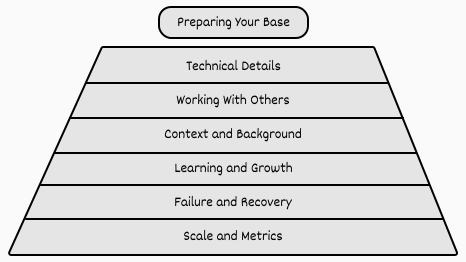
Different interviewers will explore different parts of your base depending on what matters for the roles they are aiming to fill.
Think of your base as organized shelves that you can pull information from when needed. You don't memorize exact answers. Instead, you prepare categories of information so you can respond naturally when questions arise. The chapters in Part II identify specific follow-up patterns for each behavioral competency, but the following six categories will cover most situations.
Technical Details
Be ready to explain implementation specifics, the alternative approaches you considered, and the technical trade-offs you made. When an interviewer asks, "How exactly did you implement that?" or "What other approaches did you evaluate?", you're drawing your answers from this part of your base.
For a story about optimizing a mobile app's startup time, your technical base might include: "I used iOS Instruments to profile the launch sequence and discovered we were loading all user preferences synchronously on the main thread. I moved preference loading to a background queue and implemented lazy loading for rarely used settings. I considered preloading preferences during the previous session's shutdown, but that would have slowed down app exit, and users often force-quit anyway."
Technical projects often have many details you could share. Provide them in neat layers rather than dumping everything at once. Start with the most relevant detail, then wait to see if the interviewer wants more depth. Sometimes you won't get an explicit question for the next layer. After answering, pause briefly. If they move on, you've given enough. If they seem to want more, you can ask, for example, "Should I go deeper into the implementation approach?"
Continuing the iOS example, your next layer might be: "The background loading used GCD with a concurrent queue limited to 3 threads to avoid overwhelming the system during startup. I wrapped each preference load in error handling so a single corrupted preference wouldn't crash the app. For lazy loading, I created a preference proxy that looked synchronous to calling code but actually loaded on first access, which let us refactor gradually without changing every call site."
Working With Others
Prepare to discuss how you got buy-in from stakeholders, handled disagreements, communicated complex ideas, and worked across team boundaries. When interviewers probe your collaboration approach, they're checking whether you'll work well in their organization.
Say your story is about redesigning an API: "The mobile team initially resisted because they'd have to update all their clients. I created a compatibility layer that let them migrate gradually over three months. I also ran a workshop showing how the new design would simplify their code. After I built a working example that reduced their auth logic from 200 lines to 40, they became advocates for the migration."
Collaborating with non-technical partners or teams outside your immediate organization becomes especially important at higher levels. Staff and principal roles require the ability to influence without authority across organizational boundaries.
Take the deployment story. You might add: "The biggest challenge was getting our legal and compliance teams comfortable with continuous deployment. They were used to reviewing changes quarterly. I invited their lead to observe our deployment process, showing how automated tests and gradual rollouts actually reduced risk compared to big-bang releases. I also created a dashboard from which they could see every production change with rollback capability. Once they understood the safety mechanisms, they became supporters and helped other teams adopt similar practices."
Context and Background
Have ready any relevant backstory about why problems existed, what had been tried before, or timeline and resource constraints. Most stories don't need this context up front, but it's useful when interviewers want to understand the full picture.
For a story about improving test reliability, your context might include: "The previous team had tried fixing flaky tests by adding retry logic, which just masked the problems. We'd also attempted to parallelize tests, but that had made race conditions worse. The company had a two-week sprint cycle, which meant we needed a solution that wouldn't block feature work."
Like technical details, context often has layers you can reveal progressively. Give the most relevant context first, then watch and listen for cues about whether the interviewer wants more depth. If they don't ask follow-up questions, you can check (e.g., "Would more background on why previous attempts failed be helpful?")
Building on the test reliability example, your next layer might explain: "The flaky tests dated back to when we had 50 tests. Nobody worried about a 2% failure rate with occasional reruns. By the time we had 2,000 tests, we were seeing 30-40 failures per run, and nobody could tell real bugs from flaky tests. The retry approach had been implemented by a contractor who had left before documenting which tests were known-flaky versus newly broken. The parallelization attempt exposed that tests were sharing global state and database fixtures, which had never been obvious in sequential runs."
Learning and Growth
Be prepared to share what you'd do differently now, how this changed your approach, and what patterns you recognized. Senior-level and above candidates should expect these questions. Entry- and mid-level candidates will benefit from having answers ready even if the questions are not always asked.
If a deployment went wrong, you might share: "I learned that gradual rollouts aren't enough if you can't automatically revert. Now I always implement feature flags with automatic kill switches tied to error rate monitoring. I've since used this approach for five major launches and have caught two issues within minutes of rollout, preventing customer impact. I also taught this pattern to three other teams through our engineering tech talks."
For very senior roles, perspective becomes the critical signal. Interviewers want to see if you extract lessons that apply broadly and change how organizations work, not just how you work individually.
For a story about system architecture decisions, you might add: "That experience taught me that technical debt isn't about code quality. It's about the gap between what the system needs to do now and what it was designed to do. I now start architecture discussions by identifying which assumptions will definitely change and which are stable. When I led the platform team's service mesh adoption, I designed for the assumption that our service count would grow 10x, but our core security model would stay constant. That lets us invest heavily in discovery and routing while keeping authentication simple. This perspective has helped me guide three other teams through similar build-versus-buy decisions."
Failure and Recovery
Be ready to discuss what went wrong initially, how you diagnosed the issues, and how you prevented similar problems. Interviewers will often probe failures because recovery reveals problem-solving skills and resilience. This category often dovetails with learning and growth, since failures typically generate the most powerful lessons.
Take a documentation system story: "My first version tried to auto-generate docs from code comments, but developers wrote comments for themselves, not end users. The generated docs were technically accurate but unusable. I realized I needed to separate code documentation from user documentation. I kept the auto-generation for API reference but built a separate system for user guides written by actual people. This took longer but produced documentation that people actually used."
When discussing failures, focus on your actions and what happened, rather than blaming others or getting defensive. Even when others contributed to the problem, keep your story centered on what you could control and what you learned.
For a story about a missed deadline, you might share: "We missed our Q3 launch because I underestimated how long the data migration would take. I'd tested with a 10GB sample, but production was 500GB with far more edge cases. Rather than point to the PM for not giving me production data access earlier, I should have pushed harder for realistic test data or built in more buffer time. Now I start every migration project by getting production data volume estimates and testing at 2x that scale. I also timebox my estimation research. If I don't have good data after two days of investigation, I multiply my best guess by 3x instead of pretending I have certainty."
Scale and Metrics
Have specific details ready about performance improvements, user or business impact, how you measured success, and what metrics you tracked. Even if you mentioned high-level numbers in your story, be ready to go deeper.
Exact numbers can be difficult to dig up, especially from previous roles. Precision matters less in interviews than giving the interviewer a sense of impact. Use rough baseline numbers and informal relative measures that convey scale without false accuracy. "Cut costs by about 60%" is better than "reduced monthly spending from 12,347to12,347 to 12,347to4,892," which sounds suspiciously precise for something you're recalling from memory.
Here's what that looks like for a data pipeline optimization: "The pipeline processed roughly 50 million events daily. Before optimization, the delay was around 8 seconds on average, though it could spike to 15 seconds during peak hours. After the changes, we got that down to about 1-2 seconds most of the time. Processing costs dropped from something like 12,000monthlytocloserto12,000 monthly to closer to 12,000monthlytocloserto4,000 or $5,000. The bigger impact was that downstream analytics teams could get insights within minutes instead of waiting a full day. Product managers went from discovering issues the next morning to catching them within an hour. We tracked throughput, latency, error rates, and costs. When latency went above 3 seconds, we got alerts so we could investigate before it became a problem."
These categories aren't rigid boundaries. A single follow-up might draw from multiple areas. If the interviewer asks, "Why did you choose that approach?" you might explain the technical reasoning (Technical Details), how it addressed stakeholder concerns (Working with Others), and why previous attempts failed (Context and Background). The preparation means you have all these pieces ready to weave together naturally to answer the interviewer’s questions.
The Essential Questions
The Essential Questions
While behavioral interviews test whether you have the skills covered in the other chapters of Part II, every interview will also include questions about you, your career, and your motivations. These questions might seem straightforward, but they can trip up candidates who haven't thought through how to answer them.
Your answers to most of these essential questions will differ significantly from your competency stories; they need shorter, more direct responses. Questions like "Tell me about yourself" or "Why this company?" will establish who you are and why you're sitting in front of the interviewers, but they won’t need to be backed up by extensive behavioral evidence, and they are not likely to attract many follow-up questions.
However, the project question ("Tell me about a project you're proud of") will need a longer response because it requires you to draw directly from your competency stories and use the HSS structure you've already built.
Think of these questions as the foundation for your behavioral stories. Before an interviewer can evaluate your problem-solving or leadership, they need to understand who you are, why you're here, and whether you can reflect on your own work. Get these right, and your competency stories will land better.
This chapter provides focused guidance for the six questions that you are likely to face in nearly every interview. Unlike competency questions, which have to be supported by detailed behavioral evidence, these six questions need clear, direct responses that build credibility and move the conversation forward. Your answers will set the stage for the behavioral stories that follow.
Let's tackle each question by looking at practical strategies you can use to adapt to your situation.
. Tell Me About Yourself
This opening question is commonly used as an icebreaker, and it shapes how the interviewer sees everything that follows. Interviewers use this question to understand your working experience and professional identity. From your brief response, they will form initial impressions about your communication skills, technical background, and professional maturity. A strong answer will generate positive momentum, but a weak one will have you working uphill for the rest of the conversation. While it may seem unfair that this question should carry so much weight, interviewers cannot help but size you up based on your answer. First impressions count.
The Power of Three Framework
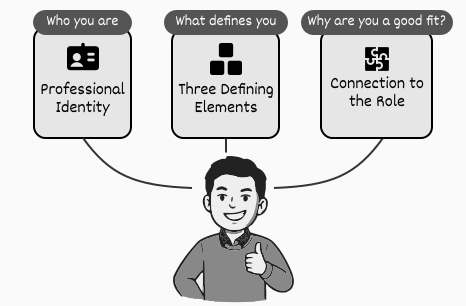
We suggest that you structure your response to three key elements that make you effective in your role. Here's the template:
- Professional Identity and Career Summary (2-3 sentences): Start with who you are and what you specialize in: "I'm a [role] who specializes in [specific capability]." Then provide an abbreviated work history with waypoints that show progression or context. Consider mentioning years of experience if it strengthens your narrative, though candidates with 15-20+ years would probably be better to focus on recent trajectory rather than total tenure. Highlight one or two significant companies, roles, or transitions that show your growth. For example, moving from a startup to a larger company, shifting from one domain to another, or progressing from individual contribution to leadership. You’re indicating your trajectory, not listing every job you’ve worked at, so keep this to no more than two or three companies.
- Three Defining Elements: Present three things that distinguish you in your role. For example: Technical specialties you've mastered Major accomplishments that showcase your impact Working approaches that set you apart Problems you're passionate about solving
- Connection to Role: End by explicitly linking these elements to the position for which you're being interviewed.
Example (Entry-Level):
Professional Identity and Career Summary: "I'm a software engineer who specializes in full-stack web development. I recently graduated with a degree in computer science. I spent the past year working as an intern at a SaaS company, where I contributed to both frontend and backend features."
Three Defining Elements:
- "I'm someone who picks up new technologies quickly. During my internship, I learned Vue and Go on the job and shipped three customer-facing features within my first six months."
- "I focus on writing clean, maintainable code. I've gotten positive feedback from senior engineers during code reviews for how I structure my code and write tests. I believe in doing things right the first time, rather than rushing to ship buggy features."
- "I also take initiative to improve team processes. For example, I noticed our deployment documentation was outdated, so I updated it and created video walkthroughs for new team members, which cut onboarding time in half."
Connection to role: "I'm excited about your junior engineer position because it focuses on building customer-facing features, which is where I want to develop my skills."
Example (Mid-Level):
Professional Identity and Career Summary: "I'm a data scientist who specializes in building ML models that actually make it to production. I've spent the last four years working in product analytics and machine learning, with a focus on customer behavior and personalization."
Three Defining Elements:
- "My background combines strong technical fundamentals with business understanding. I have a master's in statistics, but I spent my first two years in a product analyst role, which taught me to always start with the business problem before jumping to complex models."
- "I thrive in ambiguous environments where the path forward isn't clear. At my current company, I took on our customer churn prediction project when nobody knew where to start. I interviewed stakeholders, defined success metrics, and delivered a model that reduced churn by 15%."
- "I'm also someone who automates everything. When it comes to ML, I've built reusable pipelines and monitoring systems for our ML models because I believe good data science should be reproducible and maintainable."
Connection to role: "Your role excites me because you're looking for someone to help with your company's early-stage ML efforts, which is an area of work that is very well suited to my strengths."
Example (Senior Level):
Professional Identity and Career Summary: "I'm a backend engineer who specializes in building resilient distributed systems. I've spent the last eight years working on high-scale infrastructure, first at a fintech startup where we grew from 100K to 10M users, and now at TechCo, where I lead reliability efforts for our core processing platform."
Three Defining Elements:
- "Throughout my career, I've consistently transformed unreliable systems into solid infrastructure. At TechCo, I redesigned our processing system to handle 10x traffic while reducing failures from daily to monthly occurrences."
- "I'm good at bridging the gap between tech and product teams. I have a track record of translating complex technical constraints into terms product managers understand, which has helped us avoid costly architectural mistakes."
- "I'm also passionate about mentoring. I've developed three engineers from junior to senior level by working closely with them on hands-on projects."
Connection to role: "I'm hoping to continue this trend with your senior engineering role to help strengthen your infrastructure and grow your team."
Common Pitfalls
- Starting with personal biographical details unrelated to work (unless you are a recent grad and you’re discussing relevant academic background)
- Including other information unrelated to the role you're applying for
- Walking through your resume chronologically (i.e., job by job)
- Listing technologies without context (e.g., "I know Python, React, AWS...")
- Talking for more than 2 minutes
- Being either too modest or overselling yourself
- Diving into technical details
Pro Tips
- Write out your professional summary and the three elements you have selected, then practice until they flow naturally. Avoid corporate speech. This is you describing yourself, so do it your way.
- Practice your response from Chapter 14 (Nailing the Interview), using the Progressive Practice technique, since you’ll be answering this question a lot.
- Adjust the emphasis based on your audience. A recruiter is trying to qualify you for interviews. A technical interviewer is trying to determine whether or not you will fit well in their team.
- Consider adding a brief personal element at the end for connection. For example, "Outside of work, I contribute to open source projects focused on accessibility" or "I also volunteer teaching coding to high school students." Keep this brief and include it only if it's relevant or adds something valuable to the role.
- Focus on recent, relevant achievements that match the role you're applying for. Describe ancient accomplishments only if they're truly exceptional.
. Tell Me About a Project You're Proud Of / Most Complex / Technically Challenging
This question comes in different forms but appears in nearly every behavioral interview. Whether they ask about your proudest project, most complex work, or biggest technical challenge, they're giving you a chance to show your best work.
Choosing Your Story
Use this question to highlight what you want to be known for. Unlike more targeted competency questions that focus on specific situations, this one allows you to choose the story that shows you at your best.
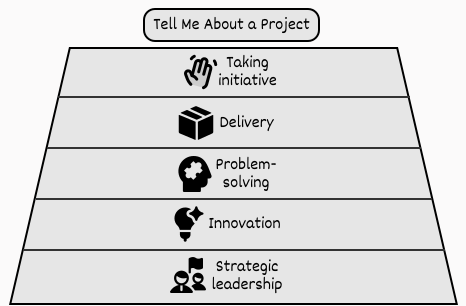
Draw from your competency stories in Part II. Depending on what you want to emphasize, you might choose:
- A taking initiative story that highlights your proactive approach (Chapter 5)
- A delivery story that shows you can ship under pressure (Chapter 6)
- A problem-solving story that shows technical depth (Chapter 7)
- An innovation story that shows creativity (Chapter 11)
- A strategic leadership story, if you're interviewing for a senior role (Chapter 13)
The slight variations in how interviewers ask this question can guide your choice. But whatever the variation, if you can tell a strong competency story that shows meaningful impact, you will be able to give them a solid answer.
Structure Your Response
Use the High-Signal Storytelling framework from Chapter 3 to structure your response to the “most proud/most complex/technically challenging” question. Start with a headline that establishes what made the project significant, then deliver your behavioral core to show how you approached the challenge, and be ready for follow-up questions. The HSS structure will ensure that your contributions stay front and center and won’t get lost amongst the details of the project.
Example (Mid-Level): Project You're Proud Of
Headline: "I'm most proud of building a real-time recommendation engine that increased user engagement by 40% after previous attempts had failed."
Behavioral Core:
"The challenge was that our batch processing approach created stale recommendations, but the obvious solution of switching to real-time processing would have required a complete rewrite of our data pipeline, which the team didn't have resources for.
I designed a hybrid approach that allowed us to keep the existing batch system, but with an added lightweight real-time layer that captured immediate user actions. The key decision was identifying which signals needed real-time processing versus batch processing. I analyzed user behavior patterns and found that 80% of engagement came from just three real-time signals, which meant we could get most of the benefit without the full infrastructure overhaul.
I built a prototype in two weeks using Redis for the real-time layer and demonstrated a 25% improvement in click-through rates. That convinced leadership to allocate resources for the full implementation. When we moved to production, though, our Redis memory usage grew much faster than my prototype projections because real user traffic had far more unique session keys than my test data accounted for.
I had to rework the key expiration strategy and add a memory ceiling before we could roll out past 10% of users. The final system increased engagement by 40% and now handles 50,000 requests per second."
At this point, stop and let the interviewer guide the conversation with follow-up questions about technical decisions, trade-offs, team dynamics, or whatever interests them most.
If Examples Don't Come Easily
Many people struggle to identify projects worth discussing because they undervalue their own work. However, what feels routine to you might represent significant complexity to others. The key is matching your projects to your target level: Would someone one level below your target role find this project challenging?
Consider these angles:
- Projects that required learning: Even if the technology feels familiar now, the learning curve that you scaled to acquire those valuable skills is an achievement worth talking about.
- "Boring" projects with hidden complexity: That CRUD app might have handled millions of records, required careful optimization to protect resources, or scaled across regions. Boring, perhaps, but by no means straightforward.
- Projects that prevented problems: Preventative work demonstrates mature engineering. For example, a monitoring system that was installed to head off potential problems might have prevented countless outages from occurring.
- Small scope, big impact: Don’t downplay your projects simply because they feel small. Look at their impact. A two-week project that has saved 20 hours per week has a tremendous impact over time.
Remember that the interviewer hasn't solved your problems. They're evaluating your approach to problems and your decision-making processes; they’re not necessarily comparing the work done with the latest research.
Common Pitfalls
- Spending your behavioral core on background context instead of describing your actions and decisions.
- Not distinguishing what you did from what your team did.
- Focusing only on technical complexity without discussing the impact of your work on the business.
- Choosing projects in which your role was unclear.
- Diving into implementation details up front instead of keeping them ready in your base
- Failing to prepare your base and thus being unable to answer follow-up questions with depth.
Pro Tips
- Prepare a strong headline that emphasizes a different aspect for each variant (proud/complex/challenging). Your behavioral core can stay largely the same.
- Keep your behavioral core to about two minutes, then let the interviewer guide you into your base.
- Practice identifying which details belong in your base versus your core.
- Match your project choice to the question variant: your “proud” story should emphasize impact; your “complex” story should emphasize technical depth and scope; and your “challenging” story should emphasize overcoming obstacles.
- Be honest about what made things difficult. Authenticity is more compelling than pretending everything was easy.
. Why This Company/Role?
This question tests to see if you've done your homework and have a real interest in the role beyond merely "I need a job." The way you answer is used to gauge your motivation, your likelihood of accepting an offer, and how long you might stay with the company if hired. A thoughtful answer shows you're serious and helps interviewers to picture you on their team.
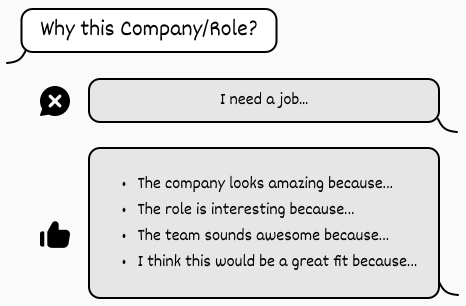
The Reality of Research
When you're applying broadly, perhaps to dozens of companies, deep research on each one isn't realistic. However, once you have an interview scheduled, the calculus changes completely. By the time someone sits down to ask you, "Why this company?" they will expect you to have invested the time to understand what they do and know why you want to be there. This is especially important in final rounds because a particularly strong answer could be what pushes you over the line and gets you an offer.
The research we're about to describe takes 1 to 2 hours. That's a serious investment, but it pays off. You'll stand out. Why? Because most candidates don't do this work. They will often just skim the “About” page and not much more, and then wing it.
Don't be most candidates.
Research the Team, Not Just the Company
Most companies hire for a specific team, not for general placement. This is your biggest opportunity to show genuine, informed interest. If you can have an informed discussion about the recent work undertaken by the team and the specific challenges they face, and you can provide a clear picture of what you could bring to the team, you’ll stand out immediately. How to find information:
LinkedIn research: Look up your interviewers and other members of their team. What are their backgrounds? What have they posted about recently? Understanding who you would be working with if you got the job will provide you with concrete connection points.
Team-specific content: Many engineering blogs tag posts by team or author. Search for posts that are written by your potential team members or that are about their domain. GitHub repositories will often show ownership information. Also, product release notes sometimes mention specific teams.
The team's product or domain: If you're interviewing for the infrastructure team, focus your research on their infrastructure, or the infrastructure landscape of that sector. If it's the mobile team, use their mobile app extensively and check their recent releases.
Recent launches or initiatives: Search for news about what the team has shipped recently. Check their roadmap if it's public. Was there a recent major launch? Look for conference talks given by members of the team.
When you can't find specific information: If you're struggling to find details about a specific team, think about what sorts of challenges teams like this would typically face. For example, backend teams usually deal with scaling, reliability, and performance issues. Data teams often work on pipeline reliability and data quality. Mobile teams focus on performance, device fragmentation, and app size. Security teams handle threat detection and compliance. Show you understand the domain by asking informed questions about how they handle those kinds of challenges.
When you can't identify the team: Ask your recruiter directly: "Which team will this role be with? What does that team own?" Most recruiters will tell you, and asking for this information will show them you care about the specifics.
Important exception: Some companies (for example, Google and Meta, historically) will hire into a general pool and place people after they clear interviews. In these cases, team-specific research isn't possible until the team-matching phase. If your recruiter tells you the company hires in this manner, then focus on the broader company and the types of problems you'd want to work on if you were to work there.
Research What Matters
You're at the interview stage now. (Congratulations!) Now, go deep. Here's how to research effectively:
Product Teams: Become a power user. Applying for the Android team? Download their app and use it daily for a week. Compare it to iOS and web versions. Check the release notes for the past six months. What features are they shipping? What bugs keep appearing? This level of research before an interview is impressive because almost nobody does it, and it gives you real talking points. For example, "I noticed your Android app handles offline mode differently from iOS. Was that due to a technical constraint or by design?"
Backend/Infrastructure/Platform Teams: Study their engineering blogs and conference talks. Look for postmortems. How do they handle failures? Check their open source contributions and tech stack choices. Job postings across teams can reveal technical directions. For example, if everyone needs Kubernetes experience, they're likely in the middle of a major migration.
B2B Companies: Sign up for a trial. Do a competitive analysis. What other companies offer similar services? Do they take the same approach as others or a radical approach?
Beyond the Obvious:
- GitHub: Languages they use, commit frequency, code quality, which teams own which repos.
- Publications and conference talks by their staff.
- HackerNews discussions about their technical decisions.
- Glassdoor reviews (read between the lines for signals about team culture).
- LinkedIn to see where employees come from and where they go.
What Do You Want?
Deep research will be effective only if you connect it to what you actually want. Before you begin, clarify your priorities, more than just getting any job and a paycheck. Knowing what matters to you will focus your research where it will be most useful to enable you to be authentic in your interview.
Technical Growth: What specific technologies or scale do you want to work with? Impact: Do you want direct user impact or foundational platform work? Do you want to be involved with the product and the business? Culture: What engineering practices matter to you? Code review standards? Testing practices? Deployment frequency? Domain: Does the problem space excite you beyond just the technical challenges?
By focusing your research in line with your priorities, you will be able to give real answers rather than generic ones.
Structuring Your Answer
Show the connection between your research, your experience, and why hiring you would be a win for you and them:
- Specific Research Insight: Lead with something specific that you have discovered about that company (e.g., their technical decisions, a product, or the work done by the team) that actually interests you.
- Your Relevant Experience: Connect their challenges to problems you've solved or that you want to solve. Show how your background makes you a good fit.
- Mutual Value: Explain what excites you and what you would bring to the company to address their needs.
Example (Mid-Level): Team-Focused
"I'm excited about joining the mobile infrastructure team specifically. I saw that your team shipped the new image-loading library last quarter. I read Marcus's blog post about how you reduced memory usage by 40% while improving load times. That kind of performance optimization is exactly what I've been focusing on.
At my current company, I led a similar effort to optimize our image pipeline. We were hitting OOM crashes on older Android devices, so I implemented a custom caching strategy with progressive loading. We reduced memory footprint by 35%, and crash rates dropped from 2% to 0.3%.
I noticed from your GitHub that you're now working on video streaming optimization. In my last project, I dealt with adaptive bitrate streaming across varying network conditions, so I have direct experience with the challenges you're facing. I'm excited about the possibility of bringing that knowledge to your team while also learning from your approach to mobile infrastructure at this scale."
Example (Mid-Level): Product-Focused
"I spent some time with your mobile app, and I noticed that you've been shipping performance improvements weekly; the release notes show a 40% faster startup time over three months. This caught my attention because I had just finished leading a similar performance optimization project that reduced our app's memory footprint by 30%.
Your September engineering blog post about using baseline profiles for Android startup optimization was fascinating. I've been using more traditional approaches, like lazy loading, so I'm excited about the idea of working with a team pushing these newer techniques.
What really draws me to this role is the scale challenge you mentioned in the job posting: optimizing for millions of daily active users across varying device capabilities. That's exactly the type of technical challenge I want to tackle next, and my experience optimizing apps for emerging markets where devices have limited resources would directly apply."
Example (Senior Level): Infrastructure-Focused
"Your postmortem about the service outage last quarter impressed me because of your transparent analysis and the improvements you implemented. The way you used chaos engineering to validate your fixes shows the kind of engineering maturity I value.
Your approach fits the direction I want to move in my career. At my current company, I introduced similar practices in the aftermath of a major incident, building our first chaos engineering framework and establishing a blame-free postmortem culture.
I see you're hiring multiple SREs, which suggests to me that you're serious about maintaining reliability as you scale. What excites me most is the challenge you have set yourselves of maintaining sub-100ms latency while expanding globally. I've dealt with similar requirements, and I know the complexities of data residency and regional failover. I'd love to contribute my experience and, at the same time, learn from your team's approach to these sorts of problems."
Common Pitfalls
- Doing only surface-level research (e.g., just reading the “About Us” page and not much more).
- Bestowing generic, gushing praise that the interviewers will probably suspect you give to all the companies you interview with (e.g., "You're a leader in your field; " "Everyone wants to work here; " "You're changing the world").
- Focusing only on what you would gain if you got the job, without showing what you would bring to the role. Saying only "This would be a great learning opportunity for me" will mark you as a taker rather than a contributor. Therefore, show both what excites you and what you would contribute.
- Simply reciting the job description back to them.
- Mentioning the perks you are looking forward to if you are offered the role, for example, free food, remote work, or a shorter commute.
- Admitting desperation and suggesting you'd take any job. Saying things like "I really need this job" or "I've been searching for months!" will make the interviewer question whether you actually want this role or you would take any role if it were offered to you. Show them that you want this specific job.
- Asking questions that will only get you positive answers straight from Marketing. Questions like "What's great about working here?" won't reveal real information. Instead, ask specific questions that will surface real insights to help you develop a fuller picture of the company.
Pro Tips
- Whenever possible, show the interviewer that you've researched the specific team, not just the company. This will likely differentiate you immediately from the other candidates.
- If you don't know which team you would be joining if you were to be offered the role, ask your recruiter before the interview the name of the team and the organization they are a part of.
- Research your interviewers on LinkedIn. Understanding their backgrounds will help you connect with them. Plus, that sort of research shows them you’re serious and that you've done your homework.
- Reference specific technical decisions they've made, not just their general tech stack.
- Ask informed questions that show deep understanding. Connect multiple sources of research (e.g., blog post + GitHub + product).
- Be curious. Real curiosity is obvious, and so is forced enthusiasm.
- Tailor your answer to your audience. Technical interviewers want to hear about technical challenges. Hiring managers are more interested in determining and ensuring team fit and impact.
- Show them you understand their business context. (Technical decisions make more sense when you understand business constraints.)
. Do You Have Any Questions for Me?
This question often comes at the end of an interview when you're tired, but it’s a critical opportunity, so make sure you take advantage of it. The research you did for "Why this company?" will naturally generate questions, so use them.
Never say, "No, I think you've covered everything." Always have some thoughtful questions ready to ask.
Why Your Questions Matter
Good questions do a lot for you. They show the interviewers you're serious about the role, they signal that you're evaluating them too, and if they're real questions, you'll get honest answers that will help you decide.
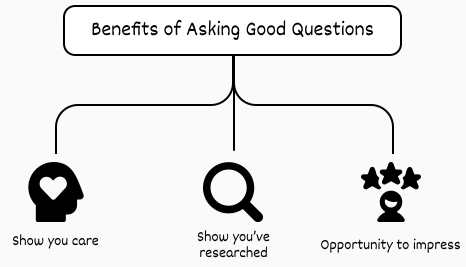
Tailoring Your Questions to Your Interviewer
Match your questions to the type of interviewer.
Recruiters or HR:
Save your questions about compensation, benefits, vacation, and process logistics for the recruiters. If you were to ask a team member these sorts of questions, they might think you are more interested in perks than work.
- "What does the interview process look like from here?"
- "What's the timeline for making a decision?"
- "Can you tell me more about the benefits package?"
- "What's the salary range for this role?"
- "How is performance evaluated here?"
- "What does the team structure look like?"
Members of technical teams:
These are the people who do the work daily. They can tell you what it's really like on the ground.
- "How often are you shipping new features versus addressing technical debt?" (The answer will indicate if you’ll be spending more time building or putting out fires.)
- "What kind of support does the team get to be successful?" (In other words, does management provide the necessary resources, or are you just expected to perform?)
- "How are technical decisions made on the team?" (The answer will indicate the level of autonomy the team has. Or the level of micromanagement.)
- "What tools or processes do you wish you could change?" (Are there pain points, and is there a willingness to address them?)
- If you know the team has released something recently: "I saw you launched [feature/product] last month. What did you learn from that launch?" (A question like this is impressive because it shows you did specific research on their team's work. Plus, everyone loves talking about their recent launches, especially if they were successful.)
Hiring managers:
Managers can speak to team direction, priorities, and how you might fit in.
- "If I were to be hired today, what would you assign me to?" (The answer will reveal their immediate priorities.)
- "How long has this role been open?" (Their answer will indicate their urgency. If the position has been open for a long time, that may raise a potential red flag.)
- "What does your onboarding process look like? How long is the expected ramp-up period?" (How they answer will show if they invest in the success of their new hires.)
- "How long have most team members been here?" (This question is aimed at understanding how stable the team is without being too direct about turnover)
Cross-functional partners (product managers, designers, data scientists):
These types of interviewers can tell you about collaboration and how engineering fits into the broader organization.
- "How does your team collaborate with Engineering?" (In other words, is there a true partnership, or is the relationship merely order-taking?)
- "What's your product roadmap process?" (Their answer will illustrate how decisions get made.)
- "How do you prioritize features?" (Their answer will suggest if there's a clear strategy or chaos.)
- "What's been harder than you expected in your role?" (This question will get honest insight about the challenges you could expect to face.)
- If they have a customer-facing product, ask specific questions about functionality that you're genuinely curious about. "I noticed your mobile app handles X differently from your web app. What drove that decision?" or "I was using your product and wondered why Y works this way. Is there a technical constraint, or did user feedback drive it?" If you have used their product and have thought deeply about it, asking questions like these will impress your interviewers.
Questions to Avoid
- Questions the answers to which can be found easily on their “About Us” page and which are likely to already have been discussed in the interview (e.g., "What does your company do?").
- Asking team members about salary, benefits, or perks. Save these for recruiters.
- Questions that show desperation, for example, “How did I do?”, "What are my chances?" or "How many other candidates are you interviewing?"
- Questions that will only get you marketing-type answers. Rather than asking, "What's great about working here?" ask something that is more likely to get you an honest, real answer (e.g., "What's been harder than expected?").
- Hypothetical questions about the distant future (e.g., "Where do you see the company in 10 years?")
Pro Tips
Prepare 5 to 7 questions before the interview. Some will be answered during the conversation. Having backups ready means you won’t be caught empty-handed at the end.
The more direct your questions are, the more revealing are likely to be the answers you get. Compare "How's the team culture?" (vague; deserves a vague answer) with "How often are you shipping new features versus addressing technical debt?" (specific; gets a specific answer).
Match your questions to the interview stage. Early rounds: focus on role and team. Later rounds: ask deeper questions about challenges, direction, and culture. Final rounds: ask questions that show you've been thinking about how you would contribute.
. What's Your Biggest Weakness?
This classic question has a reputation for catching candidates off guard. Interviewers will often ask it to assess your self-awareness, your honesty, and your willingness to improve. They want to see that you can evaluate yourself critically and will work actively on your weaknesses.
How to Answer This Question
Structure your answer in three parts:
- Select Real Weakness: Choose something honest that has impacted your work but that wouldn’t be a deal-breaker for this role. (If, however, your biggest weakness is something you genuinely struggle with and you know it would be a deal-breaker, then, in your mutual interests, you may need to reconsider your suitability for the role with this company.)
- Specific Context: Give a brief example of when this weakness affected you.
- Active Improvement: Focus on the concrete steps you're taking to address the weakness. This should form the bulk of your answer because what you're doing now matters more than the weakness itself.
Choosing the right weakness:
Pick an honest weakness, but not one that is so severe that it disqualifies you. Ideally, select a weakness that your peers or managers have identified, so that you can show your interviewer that you can receive feedback and act on it.
Think about the role's core requirements. For a backend engineer position, struggling with visual design would be fine, whereas for a frontend role, such a weakness would be concerning. For a junior individual contributor role, not being great at delegation is an acceptable weakness. However, if you are interviewing for a senior or lead role, that would be more problematic.
The best weaknesses to share fall into categories such as working style issues (e.g., moving too fast or too slow); communication gaps (e.g., not sharing updates proactively); skill development areas (e.g., presentations, documentation); or strengths taken too far (e.g., attention to detail morphing into perfectionism).
Providing specific context:
Describe a real situation where your weakness caused a problem. Did you miss a deadline because you focused too much on quality? Did you create extra work for others because you didn’t share updates proactively? Be specific. "Last quarter, I spent three days on an optimization that delayed our launch," rather than "Sometimes, I spend too long on things."
Keep this part brief; no more than one or two sentences. All you need to do is prove the weakness is real. The point is to identify the weakness and then set up for the improvement section.
Demonstrating active improvement:
This is where you show growth and self-awareness by describing the concrete actions you've taken to overcome your weakness. Good improvement strategies include:
Behavioral changes: "I now set time boxes for exploration," or "I schedule weekly check-ins with stakeholders."
Seeking help: "I asked my manager and peers to call me out whenever I get too deep in details," or "I found a mentor who's very accomplished at giving presentations."
Systems and processes: "I created a checklist for code reviews to ensure I cover common feedback," or "I have set myself a rule: if I'm stuck for a day, I will ask for help."
Skill development: "I took a technical writing course," or "I've been shadowing senior engineers during their design work."
Measurement: "I'm tracking how long I spend on tasks," or "I ask for feedback after delivering projects to see if I'm improving."
Show your recent progress if you can. For example, "Last month, I had my first PR without major feedback," or "My last document got positive feedback about clarity."
The improvement section should be 2 to 3 times longer than the description of your weakness. Interviewers care more about your trajectory of improvement than your starting point.
The Strength-as-Weakness Approach
Sometimes, a strength that we have can turn out to be detrimental in certain circumstances. Answering the “What is your biggest weakness?” question by talking about such a “strength/weakness” can be an effective approach, but only if that weakness is real and it has actually caused you problems in your work. Both examples given later in this section describe positive traits (thoroughness and wanting to be involved) that create problems when they are taken to the extreme.
The key to answering effectively in this manner is that you are able to describe the circumstances and the specific problems that your positive trait caused. For example, caring about quality isn't a weakness, but "I spent three days squeezing .01% more efficiency when we got the 99.99% benefit in one day" describes a real problem caused by taking thoroughness too far.
Good examples of this approach:
- Strength: "I’m quick to action" → Weakness: “I sometimes make snap decisions and act without first doing some research.”
- Strength: "I’m methodical and detail-oriented" → “Sometimes I move too slowly or I over-engineer solutions.”
- Strength: "I dive deep into problems" → “Occasionally I will lose sight of timelines or the bigger picture.”
Poor examples:
- "I care too much": this is just a humblebrag.
- "I'm too dedicated": not a real weakness.
- "I hold people to high standards": you're just describing a management skill.
What a Weak Answer Looks Like
The Humblebrag: "I work too hard," or "I care too much about quality."
Why it fails: A humblebragger never talks about a real weakness, because they want their audience to know how good they are at something. Using a humblebrag to answer the “greatest weakness” question is merely an attempt to disguise a strength as a weakness, and your interviewers will see right through it. It comes across as dishonest, and it suggests that you can't self-reflect.
The Fake Weakness: "I'm a perfectionist."
Why it fails: Admitting to perfectionism has become a cliché answer that means nothing. Everyone says it. It's vague, and just saying it doesn't demonstrate actual self-awareness unless you can give specifics about how it manifests and impacts your work.
The Vague Weakness With No Action: "I struggle with communication sometimes."
Why it fails: This sort of answer is too vague to be meaningful, and it gives no indication that you're working on your weakness. What kind of communication? In what situations? What are you doing about it? If you don’t provide that sort of information, you may come across as someone who doesn’t take growth seriously.
The Disqualifying Weakness: Developer: "I hate coding"; Management: "I'm not good with people."
Why it fails: If that is your weakness, why are you even applying?
Example (Entry-Level):
"I sometimes hesitate to ask for help when I'm stuck, thinking that I should be able to figure everything out on my own. During my internship, I spent three days debugging an issue that a senior engineer would likely have spotted in five minutes. By the time I asked for help, I was behind on my sprint commitments.
“I'm working on this by setting myself a time limit. If I'm stuck on something for more than a day without progress, I will reach out. I've also learned to prepare my questions better, documenting what I've tried and what I've ruled out, which means I can get help more easily and effectively. This has made me more productive, and the senior engineers appreciate that I'm no longer wasting time spinning my wheels."
Example (Mid-Level):
"I tend to dive deep into technical problems, but sometimes I can lose sight of broader timelines. For example, last quarter, I spent three extra days perfecting an optimization for a benefit nobody could have detected. The optimization was technically interesting, but it delayed our timeline.
“I'm actively working on this weakness now by setting explicit time boxes for exploration. Now I ask myself, ‘What’s the definition of “done” for this task?’ before diving deep. I also check in with my manager and peers when I'm unsure if additional optimization would be worth the time investment. This has helped me ship faster while still maintaining quality. I know now that I can always come back later to optimize when we know the optimization is necessary."
Example (Senior Level):
"I sometimes struggle to delegate technical work that I find interesting. As a senior engineer, I know I should prioritize design and unblocking others, but when there's a challenging problem, my first instinct is to solve it myself.
“This tendency of mine became clear to me when I was implementing an interesting load-balancing strategy while my junior teammates were stuck on tasks I could have helped them with. My manager pointed out that my 'help' was actually creating bottlenecks.
“I now use a simple rule: If someone else can do a job at least 80% as well as I can, I will delegate the work and mentor them through it. I schedule 'office hours' during which I will help others work through their problems instead of taking over. Last month, I guided a junior through implementing a simple but nuanced distributed lock mechanism. It took longer than if I had done it myself, but now they can handle similar problems independently."
If Examples Don't Come Easily
Self-reflection can be challenging, but if you look more deeply, you will be surprised at how many sources of insight you have. For each source given below, we'll show you both how to identify the weakness and how to frame your improvement.
Your recent performance reviews:
Look for patterns in the constructive feedback sections. Did your manager mention that you could be more proactive in sharing updates? That's communication. Did they suggest delegating more? That's a tendency to hold on to work.
How to show improvement: Reference the feedback directly and describe what you're doing about it. "My manager mentioned in my last review that I should communicate more proactively with stakeholders. Now I send weekly status updates to everyone affected by my projects, and I schedule check-ins before major milestones. My manager noted in our most recent one-on-one that the stakeholders on my projects have told her that they feel much more informed."
Multiple people have given you the same feedback:
If you've heard the same thing from different colleagues, teammates, or managers, that's a real pattern worth addressing.
How to show improvement: "I've received feedback from multiple code reviewers that my code needs more comments. I've started using a checklist during development. Before I submit any PR, I review it specifically for documentation. I also enlisted the help of a senior engineer to spot-check my last few PRs for comment quality, and they confirmed that I've improved significantly."
A mistake you made: Think about when a mistake you made led to something going wrong. What led to it? Did you miss edge cases in testing? Or perhaps you deployed without enough validation, or didn't consider the needs of all the stakeholders for a project.
How to show improvement: "I once deployed a change that broke our mobile app because I had tested only on desktop. Since then, my pre-deployment checklist has included a confirmation that testing has been conducted on all platforms. As a result, I haven't had a platform-specific bug make it to production in the last six months."
Skills that colleagues have but don't come naturally to you:
Maybe everyone around you is good at making quick decisions, whereas you have to deliberate before coming to your decisions. Perhaps you’re the only one on your team who hates networking. Or they are all consummate professionals when it comes to presenting, and you are most definitely not.
How to show improvement: "My colleagues are all much better at giving presentations than I am. I tend to get nervous and lose my train of thought. I joined Toastmasters three months ago, and I have been volunteering to present at team meetings. My last two presentations have gone much more smoothly than usual, and I'm becoming much more comfortable speaking in front of groups."
Times you've been frustrated with your own performance:
What about your work bothers you? When do you feel like you're not performing at your best?
How to show improvement: "I would always be frustrated when projects took me longer to complete than I had estimated. I realized that I was consistently overoptimistic about timelines. Now I track my estimates versus actuals in a spreadsheet, and I've learned to add a buffer for unknowns. My last three estimates were within 10% of the actual time taken, versus being off by 100% before that."
Pro Tips
- Choose something you're actively working to improve.
- Show self-awareness without self-deprecation or humblebragging.
- Focus on the improvement journey, not the weakness itself.
- Pick weaknesses that won't disqualify you from the role.
- Give them examples of your recent progress.
. Why Are You Looking? / Why Did You Leave? / Resume Gaps
These questions come in different forms, but they serve the same purpose: understanding your motivations and checking for red flags. Interviewers want to know that you’ve made a deliberate decision to move. If you’re fleeing problems you created, that is a red flag. If you badmouth your previous employers, if there are patterns of instability in your resume, or if your story doesn't add up, these are red flags, too.
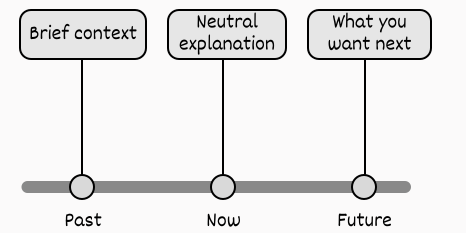
The Core Principle: You Don't Have to Share Specifics
Many candidates don't realize that you don't have to give interviewers detailed explanations of what went wrong. If a job ended badly, "It wasn't a good fit for me" is sufficient, and it’s true. You don't need to disclose that you were fired or asked to leave, or that you were put on a performance improvement plan. Keep your answers brief, professional, and forward-looking.
If you've made it as far as an interview, this means that any gaps or short tenures recorded on your resume were obviously not disqualifying in the eyes of the company. They will have looked at your background and decided to talk with you, anyway. Therefore, don't apologize excessively or volunteer unnecessary details for any such “blips” in your resume. Answer the question briefly, then move on to what you're looking for in your next role.
Why Are You Looking for a New Role?
Structure your answer simply: brief context, if needed; what you're looking for; and why you believe this opportunity fits. Keep it somewhere between 30 seconds and a minute.
Voluntary Departures:
When you're choosing to leave, frame your answer to what you're moving toward, not what you're leaving behind. Even if your current situation is terrible, focus on the opportunity ahead.
Good reasons to share:
- Growth: "I want more technical challenges and responsibility than my current role offers."
- Learning: "I want to work with distributed systems at scale, which my current company doesn't have."
- Impact: "I want more direct user impact," or "I want to work on foundational infrastructure."
- Company stage: "I'm ready to move from a startup to a more established company with better processes," or the reverse.
- Technical environment: "I'm looking for a stronger engineering culture with better practices around code review and testing."
Even if you hate working there, keep your description of your current role neutral or slightly positive. Don't trash your employer. Even if you were leaving a toxic workplace, it’s important to frame it positively and future-facing: “I want to work for a company that is proud of their supportive culture, and I've heard good things about yours.”
Example (Mid-Level, Voluntary):
"I've been at my current company for three years and have grown a lot, but I'm ready for more responsibility. I've been leading small projects, but I want to own larger initiatives from design through launch. When I saw that this role focuses on leading cross-team projects, that's exactly the growth I want. The scale you're operating at is also appealing. I want to work on problems that affect millions of users."
Layoffs:
Being laid off is not your fault, and it carries no shame, especially in tech, where it is common. There is no need to be defensive or to overexplain. Be direct and factual, add brief context if it helps, then pivot to what you're seeking.
Example (Any Level, Layoff):
"I was laid off in March when my company eliminated the entire platform engineering team as part of a broader restructuring. Since then, I've been selective about my next move. I want to join a team that's investing in infrastructure for the long term, which is what drew me to this role. Your commitment to building a strong platform team is exactly what I'm looking for."
An answer like this is clear and professional. State it matter-of-factly, then move on.
When It Wasn't a Good Fit:
If you were fired, asked to leave, or it ended badly for any reason, tell them, "It wasn't a good fit." If pressed for details, you can add one sentence about what you learned, but don't volunteer information.
"The role wasn't a good fit. I learned that I work best in environments with clear technical direction and mentorship, which is why I'm excited about this team's structure."
That's it. Don't explain why it wasn't a good fit unless you are directly asked.
Example (Any Level, Not a Good Fit):
"My last role wasn't the right fit. The work ended up being very different from what was described during the interview. I learned from that experience that I need to ask more detailed questions at interviews about the actual day-to-day work I would be doing. That's why I've been so thorough in learning about this role. Based on our conversations, the focus on backend systems work aligns well with what I want to do."
Resume Gaps
Address any questions about gaps in your resume briefly and then move on. One or two sentences are usually enough.
Common scenarios:
Job search after layoff (3-6 months): "I was laid off, and I have decided to be very selective about my next role. I want [specific things]."
Caregiving: "I took time off to care for a family member. I'm ready to return now, and I’m excited to dive back in."
Health: "I took time off for health reasons. Now I'm looking forward to getting back to work."
Retraining or career transition: "I spent time transitioning from [X] to [Y]. I completed [courses/bootcamp] and built [projects] to develop my skills in this area."
Sabbatical: "I took a planned break to [travel/recharge/pursue a personal project]. I'm refreshed and ready for my next challenge."
Notice the pattern: One sentence explaining the gap, an optional sentence about staying current or what you did, then a forward-looking statement.
Example (Any Level, Gap):
"I took eight months off to care for my sick mother. During that time, I stayed current by contributing to open source projects and taking a course on system design. I'm ready to return now and excited about this opportunity to work on large-scale infrastructure."
Short Tenures and Job-Hopping
One Short Tenure: A single short stint is easy to explain and not a red flag. "It wasn't a good fit" works perfectly here. Show what you learned from that short period of employment.
Example (Any Level, One Short Tenure): "I was at that company for eight months. It wasn't a good fit. The role was much more focused on maintenance than building new systems, which wasn't what I was looking for. I learned I need to be clearer about the type of work during interviews. This role's focus on building new services is exactly what I want."
Multiple Short Stints: If your resume shows multiple short tenures, you will need to give more explanation, but remember: if you're being interviewed, that aspect of your resume didn’t stop them from asking you to an interview. Frame it as a sequence of circumstances, not a pattern of behavior. Show that you've learned what you need and that you are now looking for stability.
Good explanations combine different legitimate reasons. For example:
- First role: a learning experience about fit.
- Second role: layoff or company instability.
- Third role: an opportunity that was hard to pass up.
The key is showing that these moves resulted from different situations, not the same mistake repeated. Then emphasize that you want a long-term position.
Example (Any Level, Multiple Short Tenures):
"I know my resume shows three roles in four years. The first was a learning experience; at that stage in my career, I didn't realize how important company culture was to me, and I made a mistake choosing a role purely for the technology. The second ended when the company pivoted and eliminated the entire product team. The third was a startup opportunity that was difficult to turn down, but working there taught me that I valued stability more than I realized. I'm specifically looking for a long-term position now, which is why I've been selective. This role checks the boxes for what I need: an established company, a strong engineering culture, and work I'm excited about."
How to Handle This
- Keep your answer to 30 to 60 seconds. You don't need to explain everything that went wrong, and you don't need to fill the silence with more detail.
- Don't badmouth previous managers, colleagues, or companies, even if they were terrible. If you had issues with management or colleagues, neutral phrases like "differences in working style" or "different approaches to problem-solving" acknowledge the mismatch without assigning blame.
- Don't over-share or get defensive. If a job ended badly, "It wasn't a good fit" is sufficient, and it's true. You don't need to apologize for gaps or short tenures – if you're being interviewed, those weren't disqualifying.
- Your story needs to be consistent with what references might say, so don't fabricate. But you also don't owe them every detail. Focus on what you learned and what you want next. Statements like "I learned I need X" show growth. End by connecting to this opportunity – explain why the role you're interviewing for fits what you want.
Pro Tips
Prepare your story once and keep it consistent across all interviewers at the company. Inconsistent stories raise red flags. Practice your answer until it feels natural and you can deliver it the same way every time.
Practice giving brief answers without feeling compelled to elaborate. Get comfortable with proffering "It wasn't a good fit" or "differences in working style" and then moving on. You don't need to fill the silence with more explanation.
If you're still bitter about a previous employer, work through those feelings before interviewing. Negativity can come through in your tone and body language, even when your words are professional. Process those feelings with friends or a therapist first, so you can discuss the situation neutrally.
Taking Initiative
Taking Initiative
When John, a senior backend engineer, noticed his company’s authorization service was experiencing intermittent failures during periods of peak loads, he could have simply logged a ticket with the service owner and moved on to his next task. After all, the failures weren't directly impacting his team's features, and he had plenty of assigned work to complete. But something about the pattern of failures nagged at John: the failures were predictable, as they occurred only under specific load conditions.
When he found some free time, John decided to investigate. He set up a test environment, and when he replicated the production load patterns, he discovered a race condition in the connection pooling logic. The bug manifested only when a particular combination of authentication requests hit the system simultaneously.
John showed the service team what he had found, and he suggested a possible solution. He did this collaboratively, not as someone intent on swooping in to fix their code. The service owner appreciated both John’s detective work and his respectful approach. Together, John and the service team designed a fix using a lock-free algorithm. Then they validated the fix with load testing simulating the identified failure scenarios. They followed this up by implementing monitoring that would catch similar issues before they could affect users.
Beyond simply the technical fix, John's initiative strengthened cross-team relationships. By investing time to understand a problem that wasn't affecting his team and approaching the owners collaboratively, he showed the kind of initiative that builds organizational trust. Other engineers began following this pattern, thus creating a culture in which people take action to help each other across team boundaries rather than simply filing a ticket and waiting for the next one.
What Does It Mean To Take Initiative?
Taking Initiative involves identifying problems, inefficiencies, or opportunities on your own and taking action without explicit direction. For example, it could mean going beyond your assigned tasks to understand the bigger picture and anticipate future challenges, and then proposing improvements before those problems hit.
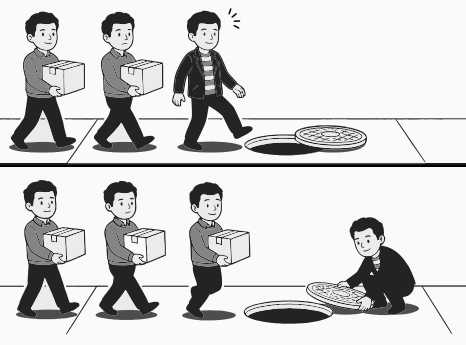
A person with initiative asks clarifying questions to avoid building the wrong thing. They spot potential issues before they become critical problems, and they take action to develop solutions that aren’t yet on anyone else’s radar. This behavior can occur across all tech roles. For example, a data scientist identifies patterns in user behavior that nobody asked them to analyze, a product manager researches competitor features without being prompted, or a backend engineer refactors shared code that they can see will lead to a bottleneck before a problem is reported.
Big tech companies have codified this competency into their core values and hiring practices. Amazon calls it "Bias for Action." They value people who understand that speed matters in business and will act despite the presence of ambiguous information. Netflix's "Freedom and Responsibility" culture explicitly encourages and expects employees to make decisions and take action without waiting for approval. Stripe looks for people who "move with urgency and focus" and solve problems before they're asked. These companies understand that waiting for direction or perfect information can lead to missed opportunities. And, more often than not, small problems will become big ones if they are not acted upon early and urgently.
The Essence of Taking Initiative
Whatever the workplace, you will always have moments when you see something broken, but it isn't your problem. What you do next defines initiative, or not. You could ignore it, log a ticket, mention it in standup, or just work around it like everyone else has been doing for weeks, months, or years. Or you could decide to fix the problem, even though you didn’t have to. Initiative lives in the choice you make to extend beyond your assigned responsibilities.
There is often a critical tension to manage when deciding to take initiative. You need to judge if it would be okay to act independently or whether it would be better to seek permission first. Initiative without this judgment leads to chaos. On one hand, imagine what would happen if everyone simply fixed what they thought was broken without coordinating their actions with anyone else. But, on the other hand, if everybody had to wait for permission before doing anything, that would result in stagnation.
Good initiative means discerning which problems you can and should solve independently, while respecting boundaries and priorities.
Initiative differs from the concept of ownership, but the two are often conflated. Whereas ownership means taking responsibility for outcomes within one’s assigned scope, a person with initiative identifies work outside their immediate area of work and chooses to do it.
You can have strong ownership of your assigned projects and do your job perfectly without ever exercising initiative. But if you solve a problem you don't own, for example, you fix issues with software that belong to different teams, that’s initiative.
Cultural and Organizational Considerations
How an organization values and expresses initiative will depend on its context and the constraints within which it operates. Some companies see initiative as essential for success, while others prefer that their employees stay within defined boundaries.
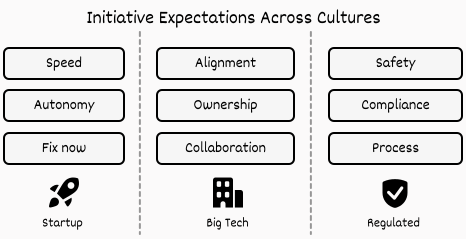
Cultural Background Considerations: Cultural backgrounds affect how people view initiative. In some countries, doing work beyond what you're explicitly asked to do can be seen as overstepping or disrespectful to authority. If you come from a culture that places greater value on following instructions precisely and you are more comfortable working in that manner, you might need to reframe your experiences through related competencies such as Delivery or Problem-Solving that show value within assigned work.
Startups and High-Growth Companies: Initiative isn't just valued in these types of companies, it's also expected. If you cannot show an ability to use your initiative, that is a red flag. Startups and companies in high-growth mode need people who are happy wearing multiple hats and who will identify and fix whatever problems are blocking progress without waiting for permission. The risk tolerance in these work environments is high, as it's better to fix something imperfectly than leave it broken.
Large Tech Companies: These companies value employees who take initiative in identifying areas where ownership is lacking, but they also want employees who will do the right thing. They want people who seek to improve systems and processes but who also respect existing ownership. Initiative in a large tech company usually boils down to knowing when you should build consensus to develop solutions and when it’s acceptable to go it alone. The most valued skill is knowing how to improve things without breaking what's already working, even when the org chart makes that hard to do.
Traditional Enterprises and Regulated Industries: These types of organizations approach initiatives more carefully. They value people who can identify opportunities for improvement but will work through the proper channels to implement solutions. Initiative might mean formally proposing process improvements or building proofs-of-concept that show value before seeking broader changes. The priority is reducing risk and making sure that any changes that are introduced won't disrupt critical systems or processes.
Consultancies and Agencies: Initiative in consultancies and agencies means identifying ways to add value beyond the stated scope of engagement. Examples of this sort of initiative include delivering more than what was expected in targeted areas, documenting patterns that will help the client after you leave, or building tools that will make their future work easier.
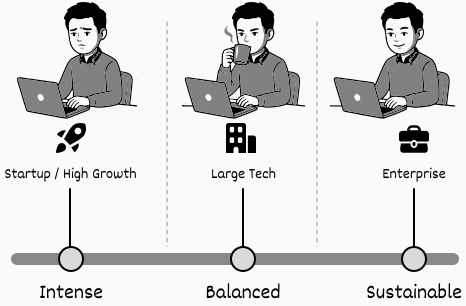
The Work Hours Question: A Matching Perspective
A common question that many candidates struggle with is whether they should talk about working nights and weekends. The answer for you will depend on whether this reflects your actual work style and the type of culture you're targeting.
Some companies, particularly startups and high-growth organizations, actively seek people who will go all out when they encounter important problems. Those types of companies value intense dedication, and they view regularly working extra hours as a sign of commitment and passion. On the other hand, companies that prioritize sustainable work practices will tend to view regular overtime as a red flag, potentially indicative of poor planning, slow execution, or an inability to set boundaries.
Neither approach is inherently right or wrong. They're simply different cultures and approaches to working that suit different people. Some professionals thrive on periods of intense work, and they will see their willingness to work nights and weekends as a competitive advantage. Others establish boundaries around work hours, whether due to personal values, family responsibilities, or simply knowing what maintains their long-term effectiveness. Both types can be excellent employees in environments that are right for them.
If you regularly work extra hours on projects and view this as a strength: Be explicit about it in your stories. Frame it as a deliberate choice that reflects your commitment and work style. Companies that value this will see it as a strong positive signal. Companies that don't value it are probably not places where you'd thrive anyway, so it's better to learn this before you decide to apply, or at the very latest, during the interview process.
If you prefer strong boundaries: Frame your answer to the initiative question around your ability to select the “right” problems to solve and your habit of working effectively and efficiently within normal hours. Emphasize how you regularly identify high-impact problems that don't require heroic effort to solve. If you have worked extra hours, be clear that it was a rare exception during a genuine crisis and not your regular pattern.
If you occasionally work extra hours during critical situations: Frame these instances clearly as deliberate responses to specific circumstances, not as your default approach. Explain what made the situation critical and why extra time was the right choice.
The worst outcome is accepting a role at a company whose expectations don't match your work style. Use your stories to show how you actually approach work, and let companies self-select based on whether that fits their culture.
Related Competencies
Initiative vs. Delivery: These competencies complement each other while focusing on different aspects of performance. Initiative is about choosing to work on unassigned problems, for example, deciding to fix an issue of your own accord. Delivery means successfully completing work despite the presence of obstacles; for example, you make a fix that unblocks critical workstreams.
Initiative vs. Problem-Solving: A person who is good at problem-solving has the ability to fix complex issues through investigation and analysis. Initiative is about choosing which problems to solve without being asked. Your manager might assign you a tricky performance bug (problem-solving), or you might notice that performance is degrading and decide to investigate the problem without being asked (initiative leading to problem-solving). Many stories combine both qualities (e.g., you take the initiative to investigate a problem, then you apply your skills to fix it).
Interview Questions
Interviewers approach the question of initiative from multiple angles to understand whether or not you actively identify and pursue opportunities beyond your assigned tasks. They want to distinguish between someone who works hard only on tasks they are given (good) and someone who also finds new problems to solve (even better).
While interviewers may explore all these angles, you should focus your preparation on two critical areas: (1) identifying unassigned problems, and (2) deciding to fix them if appropriate. These core signals matter the most. If you're struggling to find examples covering every category below, prioritize stories that clearly show you spotting opportunities nobody asked you to pursue and choose to take them on after judging that it would be appropriate for you to do so. The other categories support these core signals, but it is not essential to include them in your story if your primary examples are strong.
Going Above and Beyond
- "Tell me about a time you went above and beyond your assigned responsibilities."
- "Describe a situation where you took on something significant outside your area of responsibility."
- "Give me an example of work you did that nobody asked you to do."
These questions directly probe whether you choose to do more than is required of you. Interviewers want to know if you typically spot and pursue opportunities or only act when and where directed. Good stories are clear about what was assigned to you versus what you chose to take on, and why you decided to step outside your lane.
Spotting Problems Early
- "Tell me about a time you identified and solved a problem before others noticed it."
- "Describe a situation where you prevented an issue from becoming a major problem."
- "How do you spot risks or opportunities that aren't on anyone else's radar?"
The interviewers want to see if you notice problems early and act on them. They're also testing how you balance such work with your assigned responsibilities. Good answers are the ones that describe finding time during lighter sprint weeks, negotiating with your manager to allocate capacity, or identifying quick wins that don't require significant time investment. How you frame extra hours matters, and what works depends on the culture you're seeking (see previous section: The Work Hours Question). The key is authenticity: better to find a company that values your actual work style than to hide it and end up in a poor cultural fit. Strong stories will tell of how you spot early warning signs, make smart decisions about when to invest time, and fix things before they get worse.
Making Things Better
- "Give me an example of a process, system, or product you improved without being asked."
- "Tell me about something you improved even though it was working adequately."
- "Describe a time when you anticipated future growth or change and prepared a solution to accommodate it."
- "Give me an example of when you fixed something before it became a problem."
Interviewers will evaluate whether you look for ways to improve things or tend to accept the status quo. Strong responses show you questioning why things work the way they do and investing the effort to create improvements, even if the existing solutions are functional.
Acting Independently
- "Describe a time when you made a decision independently and informed your manager afterward."
- "Have you ever started a project without first receiving formal approval or resources?"
- "Give me an example of when you took action despite unclear requirements."
These kinds of questions are posed to probe your judgment about when to act independently versus when to seek guidance. Note that "acting independently" doesn't mean hiding what you're doing or making important decisions in isolation. Strong answers show you taking action while keeping stakeholders informed, not necessarily asking for permission at every step, but also not surprising people with major changes. This distinction is important because good initiative builds trust through transparency.
Taking Smart Risks
- "Tell me about a calculated risk you took on unassigned work."
- "Describe a time when your initiative didn't work out as planned."
- "How do you decide whether or not to pursue an opportunity nobody has asked for?"
These questions examine how you evaluate whether or not unassigned work is worth pursuing. Interviewers want evidence that you will think through the implications before acting and will learn from both successes and failures in taking initiative.
Key Signals
When evaluating your strengths in relation to initiative, interviewers will look for evidence that you will act on identifying and addressing unassigned problems rather than doing the work you’re given and nothing more. The strongest candidates show a pattern of finding opportunities and acting on them with good judgment.
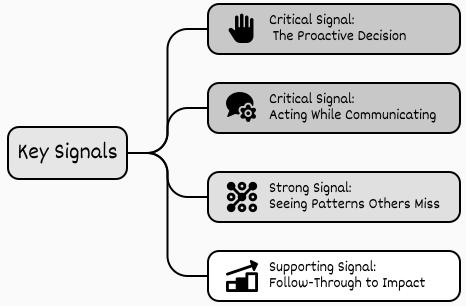
Critical Signal: The Proactive Decision
The moment you consciously choose to act on an unassigned problem or opportunity defines initiative. The heart of it is recognizing that something needs attention and deciding to be the person who addresses it. Strong stories will capture this decision point explicitly. For example, "I noticed X happening and realized that Y would soon cause trouble if the problem wasn’t addressed now. Although it wasn't my responsibility, I decided to investigate, because Z." The critical element is showing you made a deliberate choice to go beyond your assigned scope, not that you stumbled into extra work or were “voluntold” to help.
Critical Signal: Acting While Communicating
Taking initiative doesn't mean working in isolation or asking permission at every step. You might tell your manager, "I noticed this issue affecting three teams and I'm investigating the root cause this week," rather than asking them, "Should I look into this?" When making decisions that affect others, or when touching shared systems, you communicate your plans to the affected people while you are already working on the solution (e.g., "I'm building a fix for the race condition. I will share a demo with you on Friday.") This approach shows you employing initiative through action and, at the same time, building trust through transparency.
Strong Signal: Seeing Patterns Others Miss
People with strong initiative look past the obvious. They notice recurring pain points, anticipate bottlenecks, and spot patterns others miss. Examples include identifying systemic issues by analyzing isolated incidents, recognizing when small inefficiencies compound into major problems, and spotting opportunities in adjacent areas that could benefit your team.
Supporting Signal: Follow-Through to Impact
Many people notice problems, but not many will fix them without being asked. Communicating this signal shows the interviewers that you push through obstacles, find resources, and influence others to adopt your solutions, and that you are comfortable doing this without formal authority or assignment. The key is that you drive these initiatives to completion; you don’t just raise them as questions for others to solve. When you identify a problem that you can tackle, you own it through to impact, although you may involve others strategically along the way. You measure the results and you iterate based on feedback.
Red Flags
In this book, we use Red Flags to denote serious issues that will significantly damage your candidacy and Yellow Flags for concerning patterns that will weaken your examples.
Many candidates hurt their chances by confusing related behaviors. If you understand these common mistakes, it will help you focus your stories on what’s important.
Red Flag: Working Hard on Assigned Tasks
If you mistake hard work for initiative, your stories will tell the interviewers that you don't understand what they’re looking for. Doing assigned tasks really well is good performance, not initiative. Working nights and weekends on your assigned project doesn't demonstrate initiative; it shows diligence and commitment.
Note: This flag is about confusing hard work with initiative, not about working extra hours per se. If you regularly work nights and weekends on unassigned problems that you identify and choose to pursue, that's genuine initiative. But don’t mistake "I worked really hard on my assigned project" for "I proactively took on unassigned work." Whether unassigned work happens during regular hours or extra hours is a separate question of cultural fit.
Initiative means finding and fixing problems nobody asked you to solve. Therefore, focus only on work you chose to take on, not work you did exceptionally well.
Yellow Flag: Acting Without Thinking
Tackling work without considering why it hasn't already been assigned suggests poor judgment. Maybe another team owns it for good reasons. Perhaps your manager skipped over it due to other priorities. Or the work needed context that you don't have. Good initiative stories show you thinking through these factors first because they show that you understand not only technical matters but also how organizations work.
Yellow Flag: Missing the "Why" Behind Your Initiative
Starting your story with what you did without first explaining why you chose to act can make your exercising of initiative seem random. Interviewers can't assess your judgment about unassigned work if they don't understand what motivated you to take it on. Therefore, take the time in your story to describe how and why the specific problem caught your attention: what patterns you saw; why nobody else was addressing the problem; and what would happen if you didn't act. Supplying this context will show that you choose your battles wisely, rather than randomly taking on extra work.
Yellow Flag: Playing the Lone Hero
Telling a story that has you single-handedly identifying and solving everything will likely raise eyebrows, because a story like that misses how exercising initiative typically succeeds in organizations. Stories that focus only on individual action will suggest to interviewers that you may have a tendency to pursue pet projects without considering organizational needs. Even self-directed work needs buy-in. You need to obtain validation that the problem indeed exists, get input on potential solutions, and you may need to influence others to adopt the solution you develop. Show how you took action while keeping it aligned with what the organization actually needed.
Yellow Flag: Being Vague About Value
Saying that your self-directed work "helped the team" without proving its worth will make your interviewers wonder whether your initiative created real value or just kept you busy. They need to hear evidence that your choosing to work on an unassigned problem was the right decision. Include specific outcomes. How much time did you save by preventing future problems? What errors were avoided? Did your colleagues adopt your solution? Providing such concrete results will help to justify why your taking initiative was better than focusing only on your assigned work.
The examples below show initiative at different levels. The scope gets bigger as you go up, but the pattern is the same: spot something unassigned, choose to act, and follow through.
Example Stories by Level
Entry-Level Example: Automation Initiative
Question: "Tell me about a time you went above and beyond your assigned responsibilities."
Headline: "Earlier this year, I automated our release verification process after noticing our team spent hours on manual checks. My solution reduced deployment time from 3 hours to 10 minutes."
Key Point 1: "Every release required someone to manually verify 15 different API endpoints and check database migrations. Our whole team rotated this duty, and it took about 3 hours each time. After doing these checks a few times, I realized we were wasting engineering time on something a computer could do. Even though I was hired to work on the frontend, I decided to build an automation tool during a lighter sprint because I saw how much time it was wasting across the team."
Key Point 2: "Before diving in, I checked with my tech lead about spending time on this automation. I showed him my rough calculations of time saved and asked if it was okay to work on this during our lighter sprint week. He was actually thrilled someone was thinking about developer productivity. I also checked with our DevOps team since the tool would interact with our deployment pipeline. They gave me guidelines about which systems I could safely automate versus what needed to stay manual for security reasons. This upfront agreement meant I didn't waste time building something that wouldn't be allowed in production."
Key Point 3: "I spent a week building a verification script. But I didn't stop at basic functionality. I added clear error messages, handled edge cases for flaky services, and created documentation so anyone could run it. When I showed it to my manager, I showed data from our last five deployments. We'd spent 15 hours on manual checks that my tool could complete in 10 minutes. The team adopted it immediately."
Landing: "My automation tool saved about 12 hours of engineering time per week and made deployments less stressful. The team started deploying more frequently since the overhead was gone. I now constantly scan for repetitive tasks that waste engineering time, but I always check with stakeholders before automating anything that touches shared systems."
Mid-Level Example: Performance Investigation
Question: "Give me an example of work you did that nobody asked you to do."
Headline: "Here’s one. A couple of months ago, I investigated dashboard performance during a customer demo and discovered query problems that would have likely cost us major deals with bigger clients." Key Point 1: "During a sales demo, I noticed our analytics dashboard took 30 seconds to load for a prospect with lots of data. Sales smoothly talked through the delay, but I knew this customer had 10x more data than our typical clients. We had 5 similar large deals coming through our pipeline. Even though performance optimization wasn't on anyone's radar, we had a huge backlog of feature requests. I decided to investigate because I could see this becoming a deal-breaker for bigger customers."
Key Point 2: "First, I spent a few hours investigating on my own to understand the scope of the problem. Once I confirmed the performance would be completely unacceptable for larger customers, I had to decide how to proceed. I could have just optimized the queries myself, but this touched our core analytics engine, which was owned by another team. So I put together a one-page analysis showing the performance cliff we would most likely hit with larger customers and scheduled time with both my manager and the analytics team lead. They were grateful I'd done the initial investigation and immediately made it a priority."
Key Point 3: "My manager said she appreciated that I'd gathered data before escalating, but she initially stated that the backlog was more important. She changed her mind after I simulated that the page load time would spike to 5 minutes with just 50% more data. With official support, I spent a week building a proof-of-concept that added intelligent caching. I worked closely with the analytics team to ensure my changes aligned with their architecture. Load time dropped from a projected 5 minutes to 8 seconds. Because I'd involved the right people early, we could implement it properly without territorial conflicts."
Landing: "The optimized dashboard eliminated a potential roadblock for larger deals. We went on to close three major contracts worth about $2M total, whose evaluation criteria specifically included performance. Now I always do initial investigations to scope problems before escalating, but I involve the stakeholders before making changes to shared systems."
Senior-Level Example: Cross-Team Monitoring System
Question: "Describe a situation where you took on something significant outside your area of responsibility."
Headline: "Okay, this is a good one. Last year, I fixed our team's production monitoring issues in a way that ended up helping other teams with similar problems."
Key Point 1: "Our team was averaging a production incident per week, and every debugging session started with 30 minutes of hunting through logs. As team lead, I was responsible for improving our operational efficiency. I started by focusing on our immediate needs, but as I talked to other team leads, I realized the commerce team and data team were fighting the same monitoring problems. I decided to build our solution in a way that could potentially help others, too."
Key Point 2: "As a senior engineer, I had autonomy to improve our team's monitoring without asking permission. But when I realized the solution could help others, I had to be careful about expansion. I built our team's monitoring first, proving it worked with real results. Then, instead of just pushing our solution on other teams, I presented our approach at the engineering all-hands and invited interested teams to a follow-up discussion. Three team leads attended, and we collaboratively adapted the framework for their needs. This opt-in approach meant teams felt ownership rather than having a solution forced on them."
Key Point 3: "I made the monitoring components reusable and documented our patterns. When the commerce team lead asked how we'd improved our incident response time, I offered to help them adopt similar monitoring. Because I'd designed the original dashboard to be reusable, they could implement a plug-in in about an hour rather than building theirs from scratch. By positioning it as sharing rather than prescribing a solution, I achieved enthusiastic adoption. Each team made their own improvements, which we incorporated back into the shared framework."
Landing: "Our team's incident response time dropped from 45 minutes to about 15. Within four months, three other teams had adopted similar monitoring approaches, and their response times improved as well. "
Staff-Level Example: Service Resilience Patterns
Question: "Tell me about a time you identified and solved a problem before others noticed it."
Headline: "Probably my best example was when I discovered failure patterns in our search service that revealed broader resilience issues across our platform."
Key Point 1: "While investigating why our search index query latency had degraded during a recent incident, I noticed something concerning. The root cause was a slowdown in our user service, but the search service had made things worse by aggressively retrying failed requests. I dug into our data and found this same pattern in 70% of major outages. Small problems in one service triggered cascade failures of others. Nobody was looking at this pattern because each team focused only on their own services."
Key Point 2: "At the staff level, I had broad autonomy to identify and solve platform-wide issues. But resilience patterns would require every team to change their services, and I knew that asking 20 teams to each implement circuit breakers and retry budgets individually would take a year and produce 20 inconsistent implementations. So after proving the fixes worked in the search service, I took a different approach. I partnered with our platform infrastructure team and proposed that we build these resilience patterns directly into our shared service framework. If we got it right, teams would get circuit breakers, jitter, retry budgets, and graceful degradation by default just by upgrading to the latest framework version, without code changes or big forced migration projects that needed to be prioritized."
Key Point 3: "The platform team and I spent three weeks building the resilience layer into the framework. The tricky part was getting the defaults right, because if you’re too aggressive on circuit breaking, you'll cut off healthy traffic. Too lenient, and you won’t prevent cascading failures. We tested against recordings of our five worst outages to calibrate the thresholds. Then we rolled it out to the search service and the commerce service as early adopters. When the next incident hit, both services degraded gracefully instead of amplifying the failure. That gave us the confidence to ship the new framework version org-wide."
Landing: "Over six months, seven teams implemented these resilience patterns, and cascade failures dropped by about 80%. What used to be platform-wide outages now only manifests as isolated service degradations. Now I systematically review our incident data every quarter, looking for patterns that cross team boundaries."
If Examples Don't Come Easily
Think about the last time you saw something working adequately but inefficiently and decided to improve it. Such moments of choosing to make things better when nobody asked often make the best subjects of initiative stories.
Look for the exercising of initiative in the margins of your assigned work. If you have ever automated a task that wasn't broken but was inefficient, that was an initiative, even if it only saved 30 minutes a week. Have you ever written documentation simply because you got tired of answering the same questions? Initiative again. Identifying and solving unassigned problems. Have you ever refactored code during a feature implementation because you saw a better pattern? If the refactoring went beyond the feature requirements, you guessed it: initiative.
Reflection Questions:
Use these prompts to identify examples of initiative from your experience. You don't need examples for every question. Two or three strong stories covering different aspects of initiative will serve you well in interviews.
- When have you noticed something inefficient and fixed it without being asked?
- What recurring problems have you solved that weren't technically your responsibility?
- Have you created tools, templates, or automations for tasks that were functional but tedious?
- When did you improve documentation, runbooks, or processes beyond project requirements?
- What knowledge gaps have you identified and filled before they caused problems?
- Have you streamlined communication between teams that weren't coordinating well?
- When have you researched new methods or tools that could help your team work better?
- What manual processes have you improved even though nobody has complained about them?
- Have you identified and fixed data quality issues before they began to impact decisions?
- When did you create resources that helped others onboard or work more effectively?
Key Takeaways
Initiative means identifying and acting on unassigned work, not just doing your given tasks well. It requires making an intentional choice to extend what you’re doing beyond requirements, regardless of the scale of impact. The strongest candidates in an interview will show good judgment about when to act alone versus involving others.
An interview is the means by which you (and the company) try to determine whether you would be a good match. Use your initiative story to signal your authentic work style, and you will increase your chances of finding companies where you'll thrive.
Strong Initiative Stories Include:
- A clear moment when you chose to act on something unassigned.
- Evidence that you thought through why the work hadn’t already been assigned.
- Appropriate judgment about when to act independently vs. seeking permission.
- Specific outcomes that justified your taking on unassigned work.
- Learning about when and how to take initiative in the future.
Avoid These Traps:
- Don't confuse working hard on assigned tasks with taking initiative.
- Don't present acting without thinking as initiative. Show them your judgment.
- Don't focus only on your individual actions. Show how you involved others appropriately.
- Don't be vague about the value that was created. Include the specific outcomes.
- Don't confuse natural growth with initiative. Show your specific contribution beyond what would have happened anyway.
Delivery
Delivery
When Will spotted the third weekly status update showing that their payment migration was behind schedule, he felt his stomach drop. Twenty million transactions flowed through their aging system every day, and their biggest enterprise client had made it clear they'd be upset if the new fraud detection wasn't ready by quarter end. The team kept arguing about the perfect architecture while their deadline got closer. Will watched another design meeting spiral into theoretical debates and realized that they were planning themselves into failure.
Will came up with a different approach. Instead of migrating everything at once, why not move just the fraud detection first? He built a working prototype that proved they could route 10 percent of transactions through the new system without touching the stable parts. When he presented the plan with a live demo and detailed timeline showing how they could deliver what the client wanted in three weeks, his team green-lighted it.
His approach worked. They hit the deadline, the incremental rollout caught the problems that a big migration would have missed, and the fraud detection immediately started protecting customer transactions. The architecture debates continued for months more, but the client was happy. Will had found a way to ship what mattered when it mattered.
What Does it Mean to Deliver?
Delivery means getting working solutions into the hands of users. It consistently ships valuable software to tight deadlines despite obstacles and changing requirements. Strong delivery means handling technical constraints, coordinating with people who depend on your work, and making smart trade-offs to get things done.
Many people can solve technical puzzles, but delivery distinguishes those who can successfully ship working solutions. The product manager who coordinates six teams to launch on schedule demonstrates delivery; the ML engineer who deploys models reliably at scale, exhibiting stronger delivery than someone who only trains models to impressive accuracy metrics; and the site reliability engineer (SRE) who implements system improvements without disrupting millions of users; all these examples exemplify delivery under real-world constraints.
Unused code helps no one. Meta has a core value of “Move Fast”. Spotify's "Think it, build it, ship it, tweak it" culture emphasizes rapid delivery and continuous iteration based on user feedback. Uber looks for engineers who demonstrate "toe-stepping" (moving fast to deliver, even if it means challenging the status quo). These companies all believe the same thing: shipping reliable results under real-world constraints matters more than building perfect solutions that arrive too late or not at all.
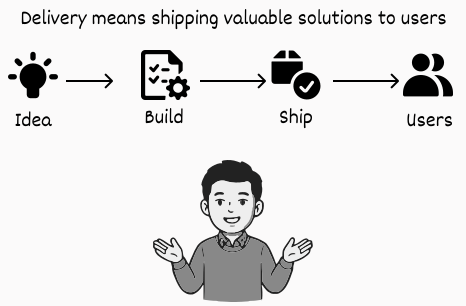
The Essence of Delivery
Every organization has people with ideas, but there are far fewer people who can turn those ideas into a working technology that benefits users. Delivery separates dreamers from shippers.
The critical tension in delivery lies in the balancing of competing demands. A perfect solution delivered too late is useless. Poor-quality, quick solutions that break in production waste everyone's time. Good delivery means finding that sweet spot: valuable work shipped on time without creating excessive future problems, and discerning which shortcuts are safe to take and which aspects of quality are non-negotiable.
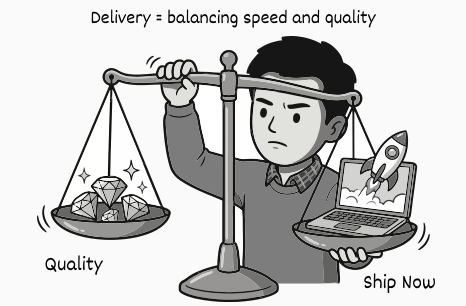
Delivery differs from simply completing tasks. If you can complete your assigned work on schedule when everything goes smoothly, that is basic competence. Delivery is completion despite shifting requirements and unforeseen obstacles that throw the best-laid plans out the window. The “shipper” doesn’t give up but adapts to the conditions that arise. For example, a mobile engineer who lands critical features despite discovering flaky behavior from an SDK; a technical program manager who coordinates releases while managing conflicting demands from partner teams; or a QA engineer ships quality releases despite compressed timelines and last-second feature requests.
Delivery also involves managing expectations and maintaining trust. Strong delivery includes communicating to partners early when plans have to change. You might have to propose an unexpected alternative. You might not deliver exactly what was first envisioned, but if you can still deliver something valuable that moves the organization forward, you will maintain your credibility.
Cultural and Organizational Considerations
How one organization defines and values delivery will vary significantly from another, depending on its priorities and the constraints present due to the type of work it does. Some companies prize speed above all else; others emphasize reliability.
Startups and High-Growth Companies: Delivery for these types of organizations means shipping fast and iterating based on feedback by default. Therefore, they value people who can find creative solutions to ship minimum viable products quickly. The saying, “The perfect is the enemy of the good”, often attributed to Voltaire, applies in this sort of environment. Teams need professionals who can identify the core value proposition and deliver it without getting bogged down in edge cases. Risk tolerance is high because not shipping is worse than shipping imperfectly.
Large Tech Companies: These companies value delivery that scales reliably across millions of users. They want people who can work through complex dependencies and coordinate across multiple teams. Delivery here means understanding how your work fits into larger systems and ensuring smooth integration. The challenge is maintaining velocity while meeting quality bars and process requirements.
Traditional Enterprises: These organizations value predictable and stable delivery. They value professionals who can meet deadlines working within established processes, for example, managing approval chains and compliance requirements without losing momentum. Success in this kind of environment comes from understanding how to work the system rather than fighting it.
Regulated Industries: Delivery in finance, healthcare, or government means shipping within strict constraints. These organizations need people who can both deliver value and maintain compliance. The major skill of this sort of work is finding ways to move quickly within regulatory boundaries, often by deeply understanding which requirements are truly blocking versus those that merely appear to be blocking but aren't. For example, while you may be legally barred from logging user PII (Personally Identifiable Information) for debugging, you can likely unblock the release by implementing a hashing strategy that anonymizes the data while still preserving the error patterns needed to fix bugs.
Agencies and Consultancies: Delivery in an agency or consultancy means meeting your clients’ deadlines and managing scope creep. These organizations value professionals who can ship quality work within fixed budgets and agreed timelines. Success here requires clear communication about trade-offs, and people who can produce creative solutions that maximize value within the constraints of budget and time will be rewarded.
Related Competencies
Delivery vs. Taking Initiative: These competencies work together, but they focus on different aspects. Taking on unassigned work means nothing if you can't ship it successfully. Delivery requires additional skills beyond taking initiative: you have to manage dependencies, you have deadlines to meet, and you also have to deal with the messy realities of production systems. Even if you are an expert at noticing problems that would be worth fixing through initiative projects, it’s not delivery if you can’t ship working solutions for them. Initiative gets you started; delivery gets you finished.
Delivery vs. Problem-Solving: Problem-solving focuses on finding the right technical approach to challenges. Delivery encompasses the entire journey from solution to production. An effective problem-solver might devise an elegant caching strategy that reduces database load significantly. Someone with strong delivery skills ensures that the solution gets implemented, tested, deployed, monitored, and refined based on actual performance. Many people excel at solving problems in theory, but they struggle with the practical complexities of delivering the solutions.
Delivery vs. Strategic Leadership: While strategic thinking focuses on identifying long-term opportunities and driving organizational change, delivery emphasizes executing and shipping work despite obstacles. You might have a vision for transforming how your company handles data (strategic thinking), but strong delivery skills are needed to ship the incremental changes that would realize that vision. A vision without delivery remains just that: a vision. On the other hand, delivery without vision might solve today's problem, but it may miss tomorrow's opportunity.
Interview Questions
Interviewers explore delivery from various angles to understand whether you can consistently ship valuable work despite the presence of problems. They want to see if you can push through challenges to get things done or if you tend to get stuck when conditions aren't ideal.
Meeting Deadlines and Constraints
- "Tell me about a time you delivered an important project under tight constraints."
- "Describe a project you delivered against a challenging deadline."
- "Give me an example of delivering something when the available resources were limited."
These questions test whether you can maintain momentum and quality when conditions aren’t optimal. "Tight constraints" typically refers to limited resources (budget, people, or technical skills). "Challenging deadlines" focuses on projects where time is not on your side. Your interviewers use these questions to assess if you can find creative ways to deliver value despite difficulties, rather than using them as excuses for non-delivery. Good stories show you making smart trade-offs and finding ways to ship on time without sacrificing what really matters.
Juggling Multiple Priorities
- "Give me an example of your managing competing priorities that affected delivery."
- "How do you handle multiple projects with conflicting deadlines?"
- "Tell me about delivering work during periods when everything feels urgent."
Interviewers want to understand how good you are at making decisions when everything seems important. They're checking to see if you can assess what truly needs to ship first and if you can communicate those choices effectively. Strong examples in your stories show clear prioritization and you delivering the right things in the right order.
Pushing Through Obstacles
- "Tell me about a time when you encountered significant obstacles during a project."
- "Describe an example of how you handled unexpected challenges that threatened a deadline."
- "Give me an example of your delivering despite major blockers."
Unlike constraints (which are limitations that are known from the start), obstacles are unexpected problems that emerge during execution. This type of question tests for persistence and creative problem-solving when things go wrong. They show whether you treat obstacles as problems to be solved or as valid reasons to stop. While no candidate will explicitly say, "I let obstacles stop me," weaker candidates often spend their time justifying why the project failed or stalled (e.g., "The requirements changed too quickly, so we couldn't hit our target"). In contrast, strong delivery stories focus on the pivot, like showing how you adjusted the plan to ensure something of value still shipped despite the interference.
Balancing Speed and Quality
- "Give an example of when you had to balance quality with delivery speed."
- "Have you ever had to make trade-offs to ship on time?"
- "Describe a situation where you had to decide what was good enough to ship."
This line of questioning seeks to assess your judgment about what shortcuts can be taken if necessary and what is essential. Do you have a feel for which aspects of quality will directly impact users and which ones can be addressed later? Tell them stories that highlight your considered decisions about minimum viable quality. (Reckless corner-cutting is a weakness for you to work on.)
Managing Delivery Expectations
- "How have you managed stakeholder expectations during a challenging delivery?"
- "Give me an example of your communicating delivery risks or delays to leadership."
- "Have you ever had to deliver bad news about a project timeline?"
These questions are designed to test your ability to maintain trust when things become difficult. The interviewers want to know if you will communicate proactively about risks and setbacks. These questions become more important at mid-level and above. Entry-level engineers typically work within their teams and aren't expected to manage broader stakeholder relationships independently. Strong answers will show you setting realistic expectations with your stakeholders early in a project. Do you maintain your credibility by communicating difficult news directly without sugar-coating the risks? When rollbacks aren't possible or the risks are high, stakeholders will value a person who will give them clear information that will enable them to make good decisions.
Key Signals
When they are trying to assess your capability to deliver, interviewers will look for evidence that you can consistently carry out and complete meaningful work despite the presence of friction and setbacks. The strongest candidates in this area will be able to show they can cope with complexity and maintain momentum toward valuable outcomes.
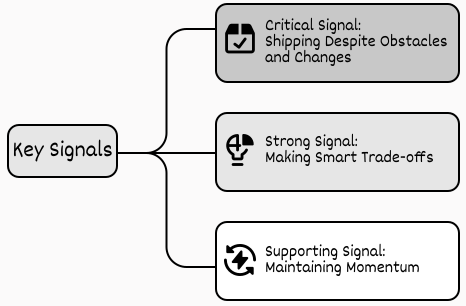
Critical Signal: Shipping Despite Obstacles and Changes
Effective delivery requires managing dependencies that break, requirements that change, and technical challenges that crop up. Strong delivery stories will describe the obstacles you had and then proceed to give the specifics of how you worked around them to ship. The key is showing that blockers may slow you down, but they won't stop you. You find alternative approaches and workarounds, or you negotiate scope changes. You are laser-focused on delivering value on time. Thus, you are quick to recognize when a plan is no longer workable, and you loop in everyone affected before switching to a new approach. The strongest candidates will show they can maintain momentum even when obstacles appear and when plans need to be tweaked.
Strong Signal: Making Smart Trade-offs
Delivery often requires choosing between competing goods, for example, perfect code versus meeting deadlines or full feature sets versus shipping something useful now. Good examples of wise trade-offs will show how you identify which are the essential things and which ones can wait. You should be able to show how you protect critical functionality while letting go of some of the “nice-to-haves” when necessary.
Supporting Signal: Maintaining Momentum
Strong delivery is shown when a person catches issues early before they become blockers and structures their work to enable steady progress. That way, last-minute scrambles are avoided. Stakeholders are kept in the loop throughout the process, so there are no surprises for them.
Red Flags
We use Red Flags for serious issues that will significantly damage your candidacy and Yellow Flags for concerning patterns that will weaken your examples.
Many candidates undermine their delivery stories by focusing on the wrong aspects or revealing concerning patterns.
Red Flag: Blaming Others for Delivery Problems
Blaming stakeholders, other teams, or dependencies for delivery failures signals that you don't own outcomes. Every project has blockers, difficult stakeholders, and teams that don't deliver on time because that's the normal operating environment. When interviewers hear blame, they imagine you doing the same thing when their project hits trouble.
Reframe your stories to focus on what you controlled. Strong candidates treat obstacles as the terrain, not as reasons the mission failed. If your instinct is to explain why something wasn't your fault, that's the story you most need to practice reframing.
Yellow Flag: Heroic Efforts as Standard Practice
Occasional crunch during a genuine crisis is part of software delivery. But if every delivery story requires 80-hour weeks, interviewers will wonder whether you can estimate accurately or manage scope. The yellow flag is presenting heroics as your normal operating mode. Strong delivery stories show how you structured work to ship reliably: decomposing ambiguity early, identifying risks before they became emergencies, and adjusting scope when timelines shifted. If your story includes a crunch period, frame it as an exception with a clear external cause, not your default approach.
Note: This is distinct from choosing to invest extra time in unassigned work you've identified through initiative. See the "Work Hours Question" section in Chapter 5 (Taking Initiative).
Yellow Flag: Delivering in Perfect Conditions
Describing a project where everything went smoothly doesn't show much. Because perfect conditions may be the dream, they are hardly ever the norm. You need to show that you can deliver in realistic conditions, so choose stories of projects with challenges that require adaptation to ship successfully.
Yellow Flag: Effort Without Outcome
Talking about all the work you did without confirming what actually shipped will weaken your delivery signal. Interviewers need to know that your efforts resulted in working software getting into users' hands, not just that you completed tasks or reviewed code. Be explicit about what went to production, who used it, and what value it delivered. Delivery means done and deployed, not just developed.
Yellow Flag: Perfectionism Over Pragmatism
If you refuse to compromise on any aspect of quality to meet your delivery commitments, that highlights inflexibility more than high standards. Strong candidates understand when to focus on quality and when “good enough” is, well, good enough to ship. Production reliability, data integrity, and security are all non-negotiable. But perfect code, over-testing, and flawless documentation are things that get in the way of delivering. Craft your stories to show how you identified which things were needed for a specific delivery and which ones could wait. Perfectionism that prevents shipping working software isn't a strength in delivery contexts.
Reminder: when telling your story in the interview, presenting your headline plus three key points and a landing should take about two minutes. Giving them this focused core will make it easy for the interviewers to capture your key contributions. After those two minutes, let the conversation flow naturally, led by their follow-up questions. The examples below show this structure in action.
Example Stories by Level
Entry-Level Example: Admin Tool Under Pressure
Question: "Tell me about a time you delivered an important project under tight constraints."
Headline: "Two years ago, I delivered an admin data export tool even though a surprise compliance audit cut my remaining timeline from four weeks to two."
Key Point 1: "I was three weeks into a seven-week project building an admin tool for exporting user data when the Legal team notified us that the external compliance audit had been pulled forward. They needed the data exports in two weeks to prepare their submission, which effectively cut my remaining development time in half. I'd only finished the basic CSV export logic. I analyzed the requirements and realized that while the Admins wanted a pretty dashboard with advanced filtering, Legal just needed accurate CSV files. I decided to prioritize data accuracy above all else and cut the UI work entirely."
Key Point 2: "I immediately flagged the scope change to my manager. We sat down with the Admin lead, who was the actual user of the tool, and explained the situation. I told them: 'I can give you a polished tool in four weeks, which misses the audit, or a basic “ugly” button that exports all data right now.' The Admin lead agreed to the basic version immediately because Legal was pressuring them for the data. To keep them confident, I demoed the raw export functionality three days later to prove the data was accurate, which allowed them to start their work early while I finished the error handling."
Key Point 3: "I had to simplify the export process significantly. Instead of the planned web interface with real-time progress bars, I built a basic form that triggered background jobs and sent email notifications when exports completed. The error handling was basic but functional. I documented all the shortcuts I took and created tickets for future cleanup. The code wasn't as nice as I wanted, but it safely exported complete and accurate data."
Landing: "The export tool passed the compliance audit requirements and helped the admin team prepare all necessary documentation in time. We improved the interface over the month following delivery, based on actual usage feedback."
Mid-Level Example: Notification System Overhaul
Question: "Give me an example of managing competing priorities that affected delivery."
Headline: "For one project of mine where there was pressure from every direction, I analyzed data to prioritize fixing transactional notifications over marketing features, thus eliminating thousands of support tickets."
Key Point 1: "I was leading an overhaul of our notification system that would replace three separate email services. The product team wanted in-app notifications, marketing needed campaign scheduling, and customer support was drowning in complaints about missed password reset emails. Everyone claimed their needs were most critical. I analyzed our customer tickets and discovered that 75% of complaints were about failed transactional emails, for example, password resets and order confirmations. I used this data to convince my partners that we needed to focus first on bulletproof transactional notifications. I presented the analysis to the product and marketing leads, showing how unreliable transactional emails were costing us customers and support hours. Once they saw the data, even marketing agreed we should prioritize transactional reliability."
Key Point 2: "Before announcing the decision broadly, I worked with marketing to set expectations. I created a detailed timeline showing four weeks would be required to achieve transactional notifications with high reliability, followed by six weeks for their campaign features. I explained how building a reliable foundation first would improve their eventual campaign delivery rates. I also kept our VP informed to ensure leadership understood and supported the prioritization. This communication prevented the escalation and frustration that often comes with priority conflicts. When we announced the plan company-wide, we already had buy-in from marketing because of the early work I did with them."
Key Point 3: "To deliver reliable transactional notifications quickly, I made pragmatic technical choices. I separated transactional and marketing emails into different pipelines, even though it increased infrastructure complexity. Transactional emails got dedicated queues, separate rate limits, and priority processing. Instead of using our fancy marketing platform for everything, I chose a simpler but more reliable provider for transactional emails."
Landing: "We launched transactional notifications with a four 9s delivery rate in exactly four weeks. Customer complaints about missed emails dropped to near zero. Marketing got its features eight weeks later, and they thanked me because their campaigns enjoyed better delivery rates on our more reliable infrastructure."
Senior-Level Example: Database Migration Leadership
Question: "Tell me about a time you delivered against a challenging deadline."
Headline: "About this time last year, I led our team through a critical database migration that had to be completed during our two-week maintenance window before Black Friday traffic."
Key Point 1: "Our database was already at 85% capacity, and we had to migrate to a new cluster before our Black Friday traffic surge. We had a two-week window in early November during which we could tolerate potential downtime. I was leading a team of four engineers on the project. During planning, we thoroughly analyzed our schema and discovered our data relationships were more complex than our documentation showed. Foreign key constraints across 40 tables meant we couldn't simply migrate services independently. I designed a phased migration strategy with explicit rollback points at each stage. We broke the work into independent phases, each of which could be tested and validated separately before moving to the next."
Key Point 2: "During our dry run migration in the staging environment, we discovered that our replication approach wouldn't maintain consistency during the cutover window. Our traffic patterns meant we'd have a 30-minute period where reads and writes could hit different databases, potentially creating data conflicts. I immediately communicated this to our VP of engineering and proposed a revised approach: instead of trying to maintain perfect consistency during migration, we'd schedule brief read-only periods for each service cutover. I coordinated with all partner teams to get agreement on maintenance windows. Several teams pushed back, but when I showed them that we didn’t have a viable alternative, they understood why the approach needed to change and why they had to adjust their plans."
Key Point 3: "In the end, we had to choose between a smooth migration and a completed one. The ideal approach would have been to migrate everything simultaneously, but our dry run proved that such an approach would be too risky. I decided to migrate our five critical customer-facing services first, with proper validation at each step, then delay the 15 internal tools until after Black Friday. Each service got a 15-minute read-only window for cutover, which wasn't ideal, but it ensured data consistency. We also implemented monitoring and automated rollback triggers in case any service showed elevated error rates, which soothed our partner teams."
Landing: "We completed the migration with only 45 minutes total of degraded performance across all services instead of the 6 hours of downtime we'd originally budgeted. The phased approach let us handle Black Friday traffic that was 60% higher than the previous year’s."
Staff-Level Example: Event-Processing Platform Delivery
Question: "Tell me about delivering work when everything felt urgent."
Headline: "Over nine months, I delivered a new event-processing platform while simultaneously handling urgent requests from 12 teams who each needed different capabilities immediately."
Key Point 1: "I was leading the creation of our event-processing platform to replace a batch system that couldn't handle our real-time analytics needs. Every team had a long list of high-priority requirements. The finance team needed exactly-once delivery for financial transactions by the end of the quarter. Marketing needed its analytics pipeline to be running before a major campaign launch in three weeks. Security required encrypted events in transit and at rest before their compliance audit. The competing demands all felt equally important and urgent, and the teams were escalating to leadership when I couldn't commit to their individual timelines. I realized that I couldn’t do it all in these timeframes, so I shifted the approach to delivering a pluggable architecture that would allow teams to get minimum viable capabilities quickly on their own, and then from there, I would enhance them. I worked with each team to have them identify their absolute must-haves, which magically shrunk when they were on the hook for the first implementation."
Key Point 2: "Three months in, our largest customer required the ability to delete events for GDPR compliance, something that our architecture didn't support. This was genuinely urgent because their contract renewal depended on it. I had to reorganize our technical approach to add cryptographic erasure capabilities. I immediately communicated to all 12 team leads that this compliance requirement would push back timelines by about six weeks but require them to handle a new case. I held individual conversations with each lead to understand their timeline pressures and identify which ones could flex and which ones truly couldn't. I then worked with product leadership to communicate the timeline impact and obtain their support for the reprioritization. Because I had established clear escalation paths and transparent communication channels early in the project, this change felt manageable rather than chaotic."
Key Point 3: "Beyond managing stakeholders, I personally built the core event-routing engine that would become the heart of the platform. I implemented an approach using consistent hashing that let us scale horizontally without reshuffling events. To keep 12 teams in sync while building this, I established bi-weekly releases to allow us to ship new event types and processing capabilities incrementally. When we discovered that our serialization approach created latency issues, I immediately communicated the impact that it was having on performance and led the technical effort to implement a more efficient binary protocol. Throughout the project, I maintained well-defined processes for how teams could request features, quickly escalate and triage potentially show-stopping issues, and track progress. That structure shielded developers from the constant stream of 'urgent' requests."
Landing: "Over nine months, we successfully migrated all 12 teams to process 2 billion events daily with latency under 100 milliseconds. The platform has subsequently handled 10x growth without needing to be rebuilt or redesigned."
If Examples Don't Come Easily
Almost every project hits snags. Recounting how you pushed through several obstacles to ship anyway often makes for a compelling delivery story, even if the individual challenges on their own seem small.
Look for strong stories about how you have handled complications. If you completed a project when a key team member left halfway through, that's delivery despite resource constraints. Did you ship a feature even though the requirements had changed multiple times? That shows adapting while maintaining momentum. Finding creative ways to meet a deadline when there’s a major re-org shows you are capable of keeping things moving despite organizational chaos. Reflection Questions:
- When have you completed important work despite missing resources or dependencies?
- What projects succeeded even though they came up against major roadblocks?
- Have you shipped solutions using creative workarounds when the ideal path was blocked?
- When did you maintain quality while working under tight deadlines?
- What work have you delivered even when requirements kept changing?
- Have you coordinated across multiple teams to ship something on time?
- When have you made tough compromises to deliver value by a critical date?
- What methods have you created to keep projects moving despite blockers?
- Have you juggled multiple high-priority projects and still delivered on your commitments?
- When did you ship important work while handling production issues or other urgent demands?
- Have you delivered your project goals while supporting teammates with their blockers?
- What work have you completed successfully despite not having been able to focus all your time on it?
Key Takeaways
Delivery means turning ideas into working solutions that people actually use. It requires dealing with technical constraints, stakeholder needs, and timeline pressures while making good trade-offs between quality and shipping on time. Strong candidates maintain their momentum even when faced with obstacles.
Strong Delivery Stories Include:
- Specific blockers encountered and how you worked around them
- Clear examples of changing your approach when the original plan didn't work
- Trade-offs made between competing priorities
- Maintaining stakeholder trust through proactive communication
- Delivering measurable value despite imperfect conditions
Avoid These Traps:
- Don't blame others
- Don't focus on projects where everything went as planned
- Don't emphasize activity over shipped outcomes
- Don't disguise perfectionism as “high standards.” In delivery contexts, it simply signals an inability to prioritize effectively.
Problem Solving and Deep Dive
Problem Solving and Deep Dive
When the production alerts started firing at 2 AM, Sundas could have simply restarted the service and gone back to sleep. The memory leak followed the same predictable pattern every time: usage would climb steadily until the process crashed. The quick fix always worked. But this time, she stared at the metrics dashboard. Something about the pattern bothered her. The leak wasn't linear; instead, it accelerated during specific time windows that didn't match their traffic patterns.
When she was back in the office, Sundas started mapping the memory growth against every variable she could find: request types, payload sizes, user segments, geographic regions. She instrumented the code to track object allocation patterns and built custom profiling tools when she found the standard ones not to be sufficiently granular. After days of investigation, she discovered the real issue: a third-party library was caching responses indefinitely, but only for requests that failed authentication. The accelerated leak happened when automated scanners hit their API.
Sundas patched the bug, then she went further. She documented the entire investigation process, then she created monitoring that would detect similar patterns and established runbooks for memory leak investigations. When another service encountered memory issues weeks later, the team used her approach to diagnose their problem in hours instead of days. Through her efforts, Sundas made sure that her team would never have to solve the same problem twice.
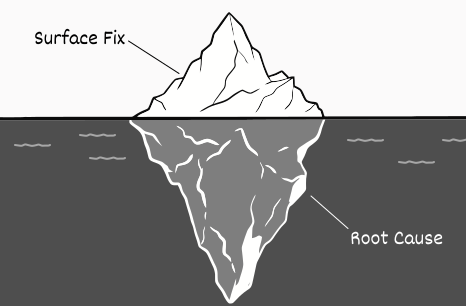
What Does It Mean to Problem-Solve and Deep Dive?
In this chapter, problem-solving is taken to mean the methodical breaking down of challenges to understand and address root causes, not just symptoms. Deep diving takes this further by pursuing a deeper understanding, even when a surface-level fix would work. Together, problem-solving and deep diving help you build knowledge that can help to prevent similar problems in the future, thus improving the effectiveness of your team.
Think about the developer who investigates why performance has degraded instead of just adding more servers. A data analyst who traces data quality issues back to their source rather than simply cleaning bad data when it appears. Or an architect who will study system failures deeply enough to prevent entire categories of problems. These professionals, recognizing that a pattern will create recurring problems, also know that a deeper analysis to address root causes is the far better option than an eternity of patches.
Tech companies value this methodical approach to diagnosing problems. Datadog emphasizes "solve problems once" in their engineering culture, favoring thorough analysis over quick patches. Twilio looks for engineers who "draw the owl", their term for diving deep into complex problems until every detail is understood. Palantir values people who can handle ambiguous problems through rigorous analysis and first-principles thinking.
The Essence of Problem-Solving and Deep Diving
Why do some engineers (quick) fix the same bug over and over, while others eliminate entire categories of problems? The answer lies in how deeply they investigate. True, quick fixes get systems running again, but deep analysis shows why they broke in the first place. This depth of understanding distinguishes those who fight fires from those who prevent them for good.
The critical tension comes from deciding when to go deep versus when to move fast. Investigating every issue thoroughly leads to analysis paralysis. You could follow every thread forever. But shipping quick patches without knowing why causes technical debt and recurring issues. Good problem-solving means recognizing which problems deserve a closer look based on their impact and likelihood of recurrence. A memory leak affecting one rarely used feature might merit a quick fix. The same leak in core infrastructure demands a thorough diagnosis. Each effort should produce knowledge that helps beyond the immediate fix through runbooks, tools, or documented patterns that prevent similar issues.
Problem-solving also requires recognizing when you're stuck and need help rather than not getting help and just spinning your wheels. Strong problem-solvers balance independence with efficiency. They know the difference between productive debugging and wasting time and effort without context or access, and they exhibit good judgment by doing some digging first, but asking for help when doing that would lead more quickly to the solution.
Cultural and Organizational Considerations
How organizations value and express problem-solving depth will vary based on their operational needs and their cultural tolerance for risk. Some companies need quick resolutions; others want you to understand the problem deeply before you fix it. Recognizing an organization’s values in this area will help you calibrate your problem-solving approach accordingly if you are seeking a role with them.
Startups and High-Growth Companies: Problem-solving in this kind of company means finding fast resolutions while building enough context to move forward. These environments value people who can quickly differentiate between what matters now and what can wait. Thorough analysis does take place, but it's targeted at problems that block growth or threaten the business. The skill is recognizing which issues need thorough attention now versus quick patches to maintain velocity.
Large Tech Companies: These companies value systematic problem-solving that scales across teams. They want people who will dig thoroughly enough to prevent problems from spreading across their massive systems. Problem-solving here includes creating tools and generating documentation to help many other people across the organization. The expectation is that your analysis will produce reusable knowledge.
Research Organizations: Thorough analysis is the default expectation in a research organization. They value people who seek to understand every aspect of a problem, even when practical, quicker fixes exist. Problem-solving means understanding not just what failed but why that failure mode exists. The culture rewards intellectual curiosity and the building of foundational knowledge that will advance the field.
Agencies and Consultancies: Problem-solving for these organizations means quickly understanding client systems you've never seen before. These environments value people who can come in and rapidly build mental models of unfamiliar codebases and then identify problems. The skill is building as much context as possible despite limited time to dig in, and then delivering actionable solutions.
Traditional Enterprises: These organizations emphasize careful, documented problem-solving. They value professionals who work within established procedures but who can still find root causes. Problem-solving in this sort of environment can entail navigating complex systems with years of accumulated changes. Success here comes from balancing thorough analysis with a respect for stability and existing processes.
Cultural Background Considerations: Problem-solving approaches reflect broader cultural values relating to risk, hierarchy, and decision-making. In companies where thorough documentation and stakeholder consensus are considered vital parts of the process, you might need to present your findings through formal channels and build agreement before implementing technical solutions. Other companies have cultures that value rapid iteration, and they will seek to empower individuals to implement solutions after quick consultation. Others will require detailed written analyses to be undertaken before discussions are held. And yet others prefer collaborative problem-solving to take place, with teams solving problems together in real time. The key is recognizing these different approaches to problem-solving depth and stakeholder involvement.
Related Competencies
Problem-Solving vs. Delivery: These competencies complement each other, but they have different focuses. Problem-solving emphasizes the depth of analysis and seeks to understand the underlying causes of problems. Shipping a quick fix to restore service is delivery, but problem-solving addresses the root cause so that the problem won’t recur.
Problem-Solving vs. Learning and Growth: Learning involves building capabilities that will create lasting value for yourself and your team. Problem-solving is about the analytical process itself, whether or not you're building new skills. You can be an excellent problem-solver who applies well-known techniques effectively, just as you can be a strong learner without deeply examining every issue. Problem-solving gets you to the answer. Learning ensures you can handle similar challenges better next time.
Problem Solving vs. Taking Initiative: Initiative shows in your decision to work on unassigned problems. Problem-solving shows how thoroughly you examine issues, regardless of whether they are assigned or self-directed. Your manager might assign you a tricky bug (problem-solving), or you might notice performance degradation and dig into the problem without being asked (initiative leading to problem-solving). Many of your stories will likely combine both competencies.
Interview Questions
Interviewers examine problem-solving abilities by asking questions that get you to show how you approach issues and pursue answers. They want you to differentiate in your answer between surface-level fixes and the deep analysis that is needed to prevent problems from recurring.
Investigation Methods
- "Tell me about a complex technical problem you solved through investigation."
- "Describe how you approached debugging an issue when the cause wasn't obvious."
- "Walk me through your process for investigating system failures."
These questions probe whether you have a structured approach to diagnosing problems. Your interviewers will want to see evidence of structured thinking rather than random troubleshooting. A strong answer will show a clear investigation phase: gathering data, forming hypotheses, testing theories, and validating conclusions.
Finding Root Causes
- "Give me an example of a time when you discovered the real problem was different from what it had initially appeared to be."
- "Tell me about a time when fixing an obvious issue wouldn't have solved the underlying problem."
- "Describe a situation where you had to dig deeper to find the actual cause of a problem."
Whereas questions about your method of investigation focus on your process for solving problems, these questions probe whether you can distinguish symptoms from root causes. Interviewers want to hear examples of situations where patches would have left the problems unresolved. Strong stories answering these questions will describe the moment you realized that what seemed like the obvious problem wasn't the real problem. Your answer should show your ability to question initial assumptions and to follow the evidence even when it differs from your expectations. And if you have a story about discovering underlying issues that explained multiple symptoms simultaneously, even better.
Testing and Validating Theories
- "Describe a situation where your initial theory about a problem proved to be incorrect."
- "Tell me about a time you had to test multiple hypotheses to solve an issue."
- "How do you validate your assumptions when debugging complex problems?"
Interviewers want to understand how you handle uncertainty and dead ends. They are trying to assess whether you can design good experiments and adjust them when your findings lead you in unexpected directions. Strong stories in answer to these questions will show you creating specific tests for each theory, interpreting the results objectively, and changing your direction of inquiry based on what you learned.
Cross-System Problem-Solving
- "Tell me about a problem that required you to understand multiple systems."
- "Have you ever had to debug an issue that crossed team boundaries?"
- "Give us an example of solving a problem where you didn't own all the components."
These sorts of questions probe your ability to solve problems beyond your immediate domain. They want to see if you can manage organizational and technical complexities to understand issues end to end. Strong responses show you mapping dependencies, working across team lines, and pulling together information from different parts of the system.
Key Signals
When evaluating your problem-solving depth, interviewers will look for evidence that you pursue actual answers rather than quick patches. The strongest candidates in this area will show the interviewers that they can investigate issues methodically and build lasting solutions.
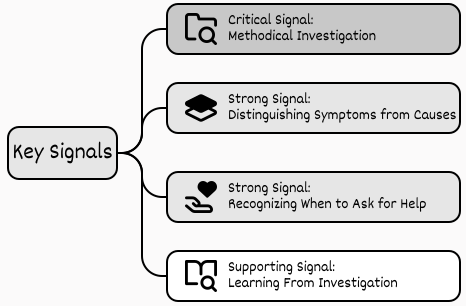
Critical Signal: Methodical Investigation
Effective problem-solving requires a repeatable approach for gathering evidence, forming theories, and testing hypotheses. Therefore, strong stories will show you using a reliable method to investigate the unknowns, for example, isolating variables, designing useful experiments, and building your picture incrementally.
Strong Signal: Distinguishing Symptoms from Causes
Solving problems requires that you understand when implementing obvious fixes would address only the symptoms. Can you trace problems to their sources (e.g., the race condition causing intermittent failures; the architectural decision that has led to performance bottlenecks; or the workflow gap that is producing data inconsistencies)? Tell your interviewers. They want to hear about your ability to do this, because that's how real fixes start.
Strong Signal: Recognizing When to Ask for Help
Effective problem-solving requires knowing the difference between productive struggle and wasted time. Good examples will show you identifying when you’ve lacked the necessary access or permissions, recognizing when you’ve needed to call on the domain expertise of others, or realizing when your current approach has hit a dead end (e.g., "After two hours debugging the legacy billing system, I realized I needed someone who understood the business logic, so I found the original developer to explain the design decisions.") A signal like this shows your maturity in balancing independence with efficiency.
Supporting Signal: Learning From Investigation
Can you turn what you learned from one problem into knowledge that the whole team can use? Increasing your problem-solving depth means that future problems will be easier to solve as a result of each deep dive. By doing deep dives and writing up your findings, building tools that will enable faster detection of similar issues, or sharing mental models that help others recognize the patterns, your insights will benefit the entire team into the future.
Red Flags
We use Red Flags for serious issues that significantly damage your candidacy and Yellow Flags for concerning patterns that weaken your examples.
Many candidates weaken their problem-solving stories by emphasizing the wrong aspects or revealing concerning patterns of analysis. Knowing these mistakes will help you show real depth in your stories.
Red Flag: Random Troubleshooting
Describing how you tried different possible solutions in a random manner until something worked shows a lack of methodical thinking. If your story sounds like "I tried X, then Y, then Z, which finally worked," you're showing persistence without intelligence (unless you can explain your reasoning for why you tried those solutions in that particular order). Therefore, focus on why you formed each hypothesis and what you learned from each experiment. Show your interviewers the logic you used that connected each step of your investigation.
Yellow Flag: Stopping at Surface Fixes
Solving immediate pain by getting the system working again without knowing why it broke shows carelessness. If your stories end with "I restarted the service, and it worked" or "I increased the timeout, and the errors stopped," it will likely suggest to your interviewers that you try to avoid hard debugging work. If you did implement quick fixes, show how they were temporary solutions that you put in place to buy time for proper investigation.
Yellow Flag: Technical Depth Without Impact
Explaining intricate debugging details without connecting that work to meaningful outcomes will weaken your story. Interviewers want you to tell them why your deep dive mattered, not just how clever your debugging was. Therefore, you need to balance technical depth with business impact. Did your root cause analysis result in the elimination of the problem that caused those outages? Can you give an estimate of the engineering hours your work is likely to have saved? Or is there evidence of improved user experience? Going deep is valuable only when it leads to meaningful improvements.
Yellow Flag: Analysis Paralysis
Investigating endlessly without reaching actionable conclusions shows poor judgment about when to stop diving. It isn’t always necessary to achieve a complete picture, and it often isn’t economical to try. Good problem-solvers know when they have gathered enough information to act. So, craft your answer to show your interviewers how you balanced your desire to conduct a thorough analysis with the constraints you faced, and how you decided when going deeper was not going to change your approach to solving the problem.
Reminder: when telling your story in the interview, presenting your headline plus three key points and a landing should take about two minutes. That focused core makes it easy for the interviewer to capture your key contributions. After those two minutes, let the conversation flow naturally, led by their follow-up questions. The examples below show this structure in action.
Example Stories by Level
Entry-Level Example: Data Import Bug
Question: "Tell me about a complex technical problem that you helped solve through investigation."
Headline: "I debugged a data import issue where customer records were mysteriously disappearing, and nobody could figure it out for weeks."
Key Point 1: "Our customer success team reported that some imported customer records were vanishing a few hours after being imported. My first instinct was to blame the import script, but I decided to trace the entire data flow step by step. I started by logging every stage when records entered our system, where they were stored, and what processes touched them. I created timestamps for each stage and discovered that the records were importing successfully but were disappearing exactly 2 hours later. This pattern pointed to something scheduled, not a random bug."
Key Point 2: "After a day of investigating scheduled jobs and finding nothing suspicious, I realized I was stuck. I'd checked all the obvious places, but I was missing something about our system architecture. Instead of spinning my wheels, I asked someone who'd been on the team longer if there were any background processes I might not know about. She immediately mentioned our data deduplication service, which ran every 2 hours. I hadn't even known this service existed. With this knowledge, I found the bug quickly. The deduplication logic was incorrectly matching records based on partial email addresses."
Key Point 3: "The surface problem was records disappearing, but the real issue was our deduplication service using fuzzy matching that was too aggressive. It was designed to catch variations like '[email protected]' and '[email protected]', but the matching threshold was set too low. It was treating '[email protected]' and '[email protected]' as duplicates because they shared enough characters. I traced through the matching algorithm and confirmed the similarity threshold was the culprit. This explained why some records vanished while others didn't. The fix was simple once I understood the actual problem."
Landing: "We fixed the deduplication logic and recovered the incorrectly deleted records from our audit logs. No customer data was permanently lost."
Mid-Level Example: Inventory Sync Failures
Question: "Give me an example of a time when you discovered the real problem was different from what it had initially seemed."
Headline: “There was one particular project where I solved inventory sync failures that seemed to be network timeouts, but they turned out to be a race condition in our distributed system."
Key Point 1: "Our inventory system was failing to sync with warehouses, showing timeout errors about 2% of the time. The obvious assumption was network issues or slow warehouse APIs. But I noticed that the failures weren't random. They clustered around busy periods but not in the way you'd expect as a result of simple load issues. After I instrumented our sync process to capture detailed timing data, I discovered something odd: the timeouts were happening on our end, not the warehouse end. Our requests weren’t even reaching the external APIs."
Key Point 2: "Thus, the timeout errors were just symptoms. By adding detailed logging, I discovered that our system was creating duplicate sync jobs for inventory items during high-traffic periods. These duplicate jobs would lock the same database rows, because each one would wait for the other. But our job timeout was 30 seconds, and our database lock timeout was 45 seconds. So the job would timeout first, issuing a 'network timeout' error message that would send everyone looking in the wrong direction. The real problem was the race condition that created duplicate jobs."
Key Point 3: "I could see the duplicate jobs, but I couldn't figure out how they were being created. After three hours of reading the code and finding nothing, I realized I needed fresh eyes. I pulled in a senior engineer who specialized in distributed systems, and within 30 minutes, he had spotted what I'd missed. Our job queue was using at-most-once delivery, but our retry logic could create duplicates during partition events. His expertise in distributed systems helped me understand a failure mode I wasn’t aware of."
Landing: "We fixed the race condition by implementing idempotency keys for sync jobs, and the timeout errors disappeared completely. Now I always question error messages that seem too generic, and I look for patterns when failures occur."
Senior-Level Example: Performance Degradation Mystery
Question: "Tell me about a technical problem you came across that required gathering information from multiple sources."
Headline: "I tracked down a gradual performance degradation that turned out to be caused by a monitoring tool that, ironically, had been designed to prevent performance problems."
Key Point 1: "Our system processing response times had been slowly increasing over a six-month period, from 200ms to nearly 800ms. The degradation was so gradual that no single deploy triggered alerts. I led the investigation across our platform, backend, and SRE teams. We ruled out the usual suspects. Database query times were stable, CPU and memory usage were normal, and no obvious code changes correlated with the slowdown. I decided to profile our entire request lifecycle, instrumenting every layer from nginx through to our application code."
Key Point 2: "The profiling revealed something bizarre: we were spending 300ms in what should have been simple logging calls. Digging deeper, I found our application monitoring agent was synchronously uploading metrics on every request. But why did this get slower over time? The culprit was feature creep in our monitoring. Over six months, different teams had added custom metrics, each adding 'just' 20-30ms. The monitoring tool was never designed for this volume of custom metrics. What seemed like a performance problem was actually a monitoring problem. The very tools meant to help us were hurting us."
Key Point 3: "Once I identified the monitoring agent issue, I realized this might be affecting other services, too. Rather than just fixing our service, I expanded the search. I worked with the platform team to audit all services using our monitoring tool. We found 8 other services with similar degradation patterns. Instead of continuing to dig alone, I formed a task force with representatives from each affected team. Together, we discovered that the vendor had changed their agent behavior in a minor version update six months ago, exactly when our problems started."
Landing: "We fixed the immediate issue by batching metric uploads and reduced response times back to 200ms across all affected services. We established a cross-team communication channel for vendor-related issues after this incident. This proved valuable when two other vendor changes affected multiple teams. One team discovered our CDN provider had changed their caching algorithm, affecting three services. Another found our database driver update caused connection pool issues across five applications. Having a way to quickly share these discoveries saved weeks of duplicated debugging."
Staff-Level Example: Order Processing Failures
Question: "Describe a time when you looked deeper into a problem and uncovered something unexpected."
Headline: "Last year, when I was investigating occasional failed customer orders at our rapidly growing e-commerce startup, I came across a fundamental flaw in how we handled transactions across our system."
Key Point 1: "We were seeing about 50 failed orders per day out of 80K total. Small enough that individual teams dismissed them as user errors or network glitches. But when I analyzed three months of failures, I found a pattern that everyone else had missed. Failures were clustered around specific user actions that touched multiple parts of our system. I built a proof-of-concept tracing tool that could follow a single order through our various services. This surfaced something unexpected: orders were failing in states that shouldn't have been possible according to our design."
Key Point 2: "The failed orders were just the visible symptom. The real problem was that our system had evolved from a monolith to multiple services without proper transaction boundaries. Each service assumed the others would succeed, but network issues and deployments created windows where partial failures rendered data inconsistent. For example, we'd charge a payment but fail to create the order, or create an order but fail to reserve inventory. Teams had built retry logic, but that had actually made things worse by creating duplicate charges. The architecture that had enabled our rapid growth was now, in fact, causing data integrity issues."
Key Point 3: "After two weeks spent documenting all the failure modes, I realized I was merely cataloging symptoms rather than solving the problem. Traditional database transactions wouldn't work across our distributed services. I needed expertise in handling consistency in distributed systems. I brought in our principal database engineer and researched how other companies handled similar challenges. Together, we designed a saga pattern with compensating transactions. But I knew that implementing this required buy-in across all teams, so I shifted from technical analysis to educating the organization on modern distributed transaction patterns."
Landing: "Over eight months, we implemented the saga pattern across all order-related services, reducing failed orders from 50 per day to fewer than 1 per day. The education campaign uncovered 8 other workflows that had similar transaction consistency issues. Ever since that project, we’ve developed a 'system health' dashboard that tracks orphaned data across services, to catch architectural issues before they can impact customers."
If Examples Don't Come Easily
Remember that bug that had everyone stumped for days until you traced it to something nobody had expected? Or the performance issue you investigated until you understood not just how to fix it but why it had occurred in the first place? These sorts of investigations, ones that have gone well beyond quick fixes, will often give you your best problem-solving stories.
Look for evidence of your problem-solving depth in how you have approached confusing situations. Did you ever track down an intermittent bug that others had given up on? That shows your persistence in investigation. Did you discover that the real issue was different from what everyone else had assumed? You were looking deeper than everybody else. Perhaps you created tools or documentation to help others solve similar problems faster? If you built lasting understanding from your debugging work, you demonstrated strong problem-solving skills.
Reflection Questions:
- When have you investigated issues that had stumped other people?
- What problems have required you to learn new tools or technologies to solve them?
- Have you discovered root causes of problems that were different from your initial assumptions?
- When have you had to coordinate across teams to fully understand a problem?
- What investigations have you done while also having to juggle other urgent work?
- Have you created debugging tools or frameworks that others now use?
- When have you had to investigate multiple related issues simultaneously?
- What problems have required you to think beyond your immediate area of expertise?
- Have you documented investigation processes that then became team standards?
- When has your persistence in investigating a problem revealed surprising sources?
Key Takeaways
Strong problem-solving centers on seeking to understand root causes rather than simply fixing symptoms. The deeper you investigate, the better you get at preventing future problems and the more valuable you become over time. The skill lies in balancing deep investigation with practical constraints and deadlines and recognizing when you're stuck and need help to make progress.
Strong Problem-Solving Stories Include:
- A clear investigation methodology rather than random troubleshooting.
- Evidence that you are adept at distinguishing symptoms from root causes.
- Appropriate balance between thorough investigation and practical solutions.
- Creation of tools, documentation, or knowledge that will help others.
- Specific examples of when your deep knowledge of a problem has prevented future problems (e.g., similar problems no longer occur, or a problem you could see developing never eventuated because your solution made sure of that).
Avoid These Traps:
- Don't describe projects in which you made random attempts at solutions until something worked.
- Don't tell stories that have you stopping at surface fixes unless you can explain why that was appropriate (e.g., to buy time for a deep dive to develop a long-term solution).
- Don't focus only on technical details without connecting to the impact that your problem-solving has had.
- Don't investigate endlessly without reaching actionable conclusions. That won’t make a good problem-solving story.
- Don't work in isolation when collaboration would accelerate solutions. That also won’t make a good problem-solving story.
Earning Trust and Dealing with Conflict
Earning Trust and Dealing with Conflict
Shortly after Raj joined the mobile team as a senior iOS engineer, he discovered that their iOS app had been randomly crashing for months. The previous tech lead had left abruptly, and the team was shipping hotfixes that introduced new bugs while supposedly fixing the existing ones. Trust between the mobile and backend teams had completely broken down. While the backend team blamed sloppy mobile code, the mobile team insisted that the APIs were fundamentally broken. Neither team would share their logs or debugging data with the other, meaning that every production issue would turn into a blame game.
Raj knew he needed to understand the technical problems, but he also realized that fixing the code wouldn't matter if the teams kept working against each other. He decided to rebuild trust through radical transparency. He began this new way of working by sharing the findings of his investigations in a public Slack channel, including posting when he discovered bugs in the mobile code. And when he found a memory management issue in the iOS networking layer, he posted, "Found a nasty bug in our connection handling. My bad for not catching this earlier. Fix going out today." This openness immediately de-escalated tensions between the teams.
He scheduled weekly "debugging together" sessions to which both teams could bring their gnarliest issues without judgment. During the first session, he sat between a mobile engineer and a backend engineer and helped them trace through logs together on his laptop. Two weeks later, the backend engineers started sharing their own debugging discoveries. Three months later, the teams were debugging production issues together. The crash rate dropped significantly. The broken relationship between the teams had healed through shared problem-solving.
What Does It Mean to Earn Trust and Deal With Conflict?
Earning trust means becoming someone that others can rely on, especially when things go wrong or there is conflict. Dealing with conflict means working through disagreements to find better solutions. While earning trust and dealing with conflict can be closely related, they represent distinct skills. Trust-building is proactive, and it takes time: delivering on commitments, communicating honestly, and behaving consistently over time. Conflict management is a reactive process, as it involves working through disagreements effectively when they arise. Strong performers excel at both. They build trust that allows them to engage in healthy conflict, and they handle conflict in ways that maintain or even strengthen trust. And sometimes, as in Raj’s case, a person may come fresh into a conflict where trust has to be built up from a starting point of zero.
Trust will develop if you exhibit the right sort of behavior consistently, for example, delivering what you promise, being quick to admit your mistakes, and helping others succeed. A trustworthy developer fixes their own bugs and helps teammates understand what went wrong.
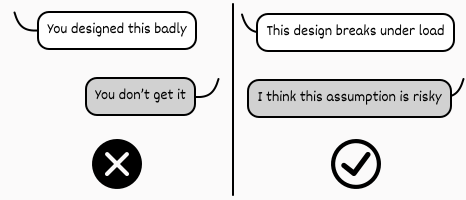
Healthy conflict happens when people challenge ideas while respecting the expertise of others. For example, a data scientist can disagree strongly about model approaches without damaging working relationships. An engineer can challenge a design decision without being insulting.
Amazon's “Earn Trust” principle states that leaders “listen attentively, speak candidly, and treat others respectfully” and are “vocally self-critical, even when doing so is awkward or embarrassing.” Slack's value of “empathy” emphasizes understanding different perspectives and building trust through genuine care for colleagues. Stripe describes “a delicate balance between rigor and trust” where “no matter how strong the disagreement, we believe firmly in the importance of trusting each other's intentions.”
The Essence of Earning Trust and Dealing with Conflict
Trust isn't built through grand gestures. It accumulates through hundreds of small moments, such as every time you admit you don't know the answer to something, or you deliver bad news promptly, or you disagree respectfully in a design review. And conflict tests that trust. Healthy teams don't avoid conflict. Rather, they engage with it productively because they know their relationships can handle the stress. In fact, once trust has been built, it will grow stronger under conditions of controlled stress.
A key skill to develop is the art of balancing honesty with diplomacy. Being trustworthy sometimes requires you to tell hard truths and always to follow through on your promises, but maintaining relationships also requires tact. A message delivered harshly, however honest, will strain a relationship. On the other hand, being excessively diplomatic but without substance will erode your credibility. If you can deliver difficult messages with clarity and empathy, you will earn trust from other people, even more so if you are consistent in doing what you say you will do. If you are good at resolving conflict, you will focus on ideas and outcomes rather than personalities, and you will find solutions that address legitimate concerns without attacking the people who raise those concerns.
Trust and conflict skills also involve knowing when to stand firm versus when to compromise. You build trust by having clear principles and boundaries, but if you are too inflexible, you will stifle collaboration. The key is to distinguish between core values that are worth defending and areas where you can adjust your approach. For example, standing firm on code quality standards but being flexible on implementation details. Effective professionals learn to pick their battles based on ethics and impact, and they build trust by making it clear to others what truly matters to them and why.
These skills require vulnerability. Admitting your mistakes before others find them will build you more trust than perfect execution. Changing your approach based on feedback is a strength. When you acknowledge your uncertainty, ask for help, or admit you’ve made a mistake or been wrong about something, you will create a sense of psychological safety around you that enables better collaboration. When you handle vulnerable moments professionally, potential conflicts become moments that build deeper trust.
Cultural and Organizational Considerations
How organizations value and express trust and conflict resolution will vary significantly based on their communication norms and hierarchical structures. Some companies encourage direct confrontation; others prefer indirect approaches. Understanding these differences will help you tailor your approach at an interview.
Startups and High-Growth Companies: In these companies, trust is built through intense collaboration and shared challenges, shipping together under pressure and maintaining relationships through rapid change. Conflict tends to be direct and immediate because there's no time for politics. They want people who can disagree in the morning and collaborate in the afternoon. The flat structure means you might feel empowered to challenge leadership decisions openly.
Large Tech Companies: A large tech company values trust built through consistent delivery across many stakeholders, through maintaining relationships across organizations and competing priorities. Conflict resolution requires more finesse as you have to work through different team incentives and organizational boundaries. The skill is finding win-win solutions that acknowledge different team goals, all while moving work forward.
Traditional Enterprises: Here, trust is built slowly through formal processes and proven reliability. Conflict often has to be resolved through management channels rather than direct confrontation. These organizations value people who respect existing relationships and work to improve them gradually. Success comes from working within the established norms while gently pushing for positive change.
Cultural Background Considerations: Different cultural backgrounds shape how people view directness, conflict, and hierarchy. In some cultures, direct disagreement shows disrespect, while in others, avoiding conflict seems dishonest. Many cultures have rigid hierarchies in which calling out the mistakes or contradictions of people above you is inappropriate. If your background values harmony and respect for authority, frame the description of your collaborative skills through the lenses of consensus-building and working within established structures. If you come from a very direct culture, emphasize how you've learned to adapt your style for different contexts.
Remote-First Organizations: Trust develops differently when you rarely meet your colleagues in person. These organizations value proactive communication and deliberate relationship-building. Conflict resolution happens through written messages and video calls rather than in person, which requires you to take extra care with your tone. It is important to overcommunicate, that is, err on the side of more rather than less, so that you can stay on the same page and avoid misunderstandings, and address tensions before they can escalate.
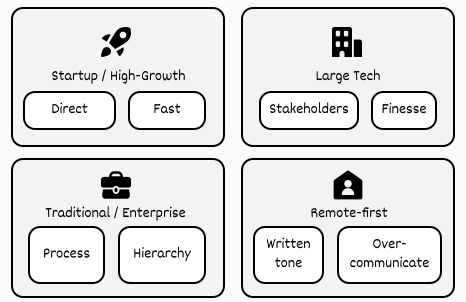
Related Competencies
Trust/Conflict vs. Developing Others: Trust forms the foundation for developing others, because people will resist being coached by someone they don't trust. The relationship works both ways: investing time in someone's growth shows you care about their success, which deepens trust. When disagreements arise during coaching, handling them respectfully strengthens the relationship rather than damaging it. Trust also creates the psychological safety that growth requires, because people need to feel secure enough to admit gaps in their knowledge.
Trust/Conflict vs. Taking Initiative: Taking initiative involves choosing to work on unassigned problems. How you handle the resulting dynamics determines your success at it. Taking initiative can create conflict if you step into areas where ownership is unclear. If you have previously built trust, that will help you handle these situations because you will have established your credibility before acting. It is easier to accept a person you trust taking initiative than someone who doesn't.
Interview Questions
Interviewers explore trust and conflict by asking questions that reveal how you build relationships and handle disagreements. They want to understand whether you can maintain productive working relationships even when things get difficult.
Working Through Disagreements
- "Tell me about a time you disagreed with a teammate or manager."
- "Describe a situation where your technical opinions conflicted with those of a colleague."
- "Can you give an example of how you handled disagreements about a technical approach?"
These sorts of questions are asked so that the interviewers can assess your ability to engage with conflict constructively. Can you disagree respectfully? Strong answers will show you standing firm on important issues when supported by data and facts, but still remaining open to other perspectives. You achieve resolution through discussion rather than by either avoiding conflict or forcing your view.
Building and Rebuilding Trust
- "Tell me about a time you had to rebuild trust with a teammate."
- "Describe a situation where you let your team down and how you recovered."
- "Give me an example of establishing credibility in a new team."
These questions are designed to examine whether or not you take ownership of relationships and can recover from setbacks. Is trust something you actively build through consistent actions? Effective examples will show specific steps you took to establish or repair trust, acknowledging your role honestly, and demonstrating how you strengthened strained relationships over time.
Managing Complex Relationships
- "Tell me about your most challenging stakeholder relationship."
- "Describe a time when you had to work with someone who was difficult to collaborate with."
- "Tell me about a time you handled competing priorities from different teams."
Interviewers also want to evaluate your ability to manage the complicated territory where trust and conflict intersect. They want to see real relationship skills, not just basic courtesy. Strong stories in response to these questions will show you understanding different perspectives held by others, finding common ground with them despite tensions, and maintaining positive working relationships through challenging projects.
High-Pressure Situations
- "Tell me about a situation where you had to deliver bad news to your team or leadership."
- "Describe a time when you had to push back on unrealistic requirements."
- "Tell me about a time you handled blame during a production incident."
These sorts of questions probe to see whether your relationship skills can hold up under stress. Pressure reveals character. Good responses will paint a picture of grace under fire and show you being direct but careful in how you convey hard messages, standing firm while respecting others, and, during crises, focusing on solutions rather than finger-pointing.
Learning From Feedback
- "What's the hardest feedback you've received, and how did you handle it?"
- "Tell me about a time when you changed your approach based on criticism you received."
- "Describe how conflict with a colleague has led to you becoming a better collaborator."
Interviewers also want to assess your capacity for growth through interpersonal challenges. These questions test whether you can take tough feedback and actually change how you work. Strong answers will show genuine reflection on your part, and they will detail specific behavioral changes that you have made. If you have become a better person to work with as a result of challenging interactions, tell them and show them how.
Key Signals
When evaluating trust and conflict skills, interviewers will look for evidence that you can maintain strong working relationships through the inevitable challenges that arise in the course of your work. The best candidates show that working through difficulties honestly is how they build stronger relationships.
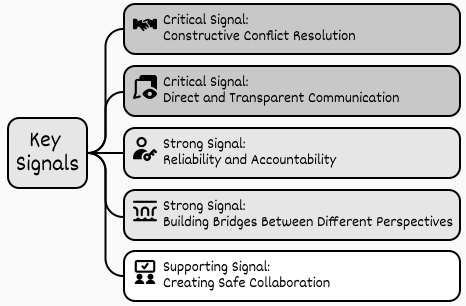
Critical Signal: Constructive Conflict Resolution
Strong collaboration requires engaging with conflict directly while maintaining your respect for those around you. Can you disagree vigorously about technical decisions while preserving team cohesion? Can you show that you seek to focus on outcomes and data rather than making it a personal matter, that you are interested in finding solutions that address legitimate concerns from multiple parties, and that you will support a final decision even if it wasn’t your preference?
Critical Signal: Direct and Transparent Communication
Communication that is direct and transparent helps to build trust. It includes doing things such as sharing bad news early, admitting your uncertainty, and raising concerns before they become crises. Strong answers will show you delivering difficult messages with clarity and empathy, being the person who says what needs to be said when others stay silent, and maintaining transparency even when it would be easier to hide problems.
Strong Signal: Reliability and Accountability
Trust is also built when you behave in a trustworthy manner consistently over time. You deliver what you promise. You communicate early when problems arise, and you own your mistakes without trying to blame others. Effective examples will show you doing these things as a reliable member of your team.
Strong Signal: Building Bridges Between Different Perspectives
Strong collaborators don't just manage their own conflicts; they also help others work through theirs. Are you good at translating between technical and non-technical viewpoints? Can you help teams to see past territorial disputes to shared goals? Can you turn adversaries into people you actually work well with? If you can show others that understanding different constraints and pressures will help everyone work better together, show your interviewers your ability in that area.
Supporting Signal: Creating Safe Collaboration
You build psychological safety around you by sharing your own uncertainties and welcoming different perspectives. You will also respond to mistakes with curiosity rather than judgment and support people through difficulties. People know that it is safe to disagree with you, and they’re not afraid to admit their problems.
Red Flags
We use Red Flags for serious issues that will significantly damage your candidacy and Yellow Flags for concerning patterns that will weaken your examples.
These patterns will hurt your candidacy.
Red Flag: Avoiding All Conflict
Healthy teams need people who can challenge ideas respectfully and push for better solutions. If your stories never mention disagreement, interviewers will wonder if you avoid necessary conflicts or lack strong technical opinions. “I've never had a significant disagreement” is not an acceptable answer. Every professional who has worked on anything meaningful has encountered situations where reasonable people saw things differently. If you genuinely can't recall disagreements, you're either not paying attention, not speaking up, or not being honest with yourself. Interviewers hear this answer as a red flag about self-awareness.
Include examples where your respectful disagreement led to better outcomes. Even mild pushback, like questioning an assumption in a design review, suggesting an alternative approach, or advocating for a different priority, counts as productive conflict.
Yellow Flag: Being Right at the Cost of a Relationship
Stories that are focused on proving others wrong show ego over collaboration. Even if you are technically correct, if you have damaged team dynamics in the process of winning a debate, that is not success. Winning arguments by making enemies shows poor judgment about what matters in the long term. If you are a work in progress in this area, you will want your stories to be about the times you found solutions together.
Yellow Flag: Blaming Others for Relationship Problems
Every relationship involves two people. Describing difficult colleagues without acknowledging your own contribution to the relationships will suggest to your interviewers that you lack self-awareness. If all your conflict stories position you as the reasonable one dealing with unreasonable people, you're missing half the picture, and they will suspect that you’re telling only half the story. Be honest, and describe what you could have done differently.
Yellow Flag: Trust Without Boundaries
Being endlessly accommodating or never pushing back creates dependency rather than professional trust. Professional trust requires healthy boundaries and the ability to say no firmly but respectfully. Stories that describe you always sacrificing your needs or never asserting important technical positions will suggest that you have a tendency to confuse being liked with being trusted. Your stories need to show balanced working relationships with healthy boundaries.
Yellow Flag: Vague Relationship Outcomes
Saying you "worked it out" or "improved the relationship" without specifics makes your impact unclear. Interviewers need to hear specifically how you turned difficult situations around. How did communication improve? What collaborative practices have you established? How did your conflict resolution lead to better team outcomes? Real trust shows in changed behavior, not just “We worked it out.”
Example Stories by Level
Entry-Level Example: Code Review Conflict
Question: "Tell me about a time you disagreed with a teammate or manager."
Headline: "A couple of years ago, I disagreed with my tech lead's approach to error handling in our data pipeline, and our debate led to a three-tier error classification that's still the team standard."
Key Point 1: “During a code review, my tech lead wanted me to configure our data processing pipeline to continue running even when individual record processing failed, logging errors but not stopping the pipeline. His reasoning was that we needed maximum uptime because downstream teams depended on timely data. I understood the stability concern, but I worried that continuing after errors could propagate corrupt data through our system, affecting customer reports.”
Key Point 2: "I was nervous about disagreeing with someone more senior, but I knew staying quiet would hurt our product quality. In our one-on-one, I said directly, ‘I understand keeping the pipeline running is critical, but I'm concerned we'll miss data corruption if we just log errors and continue. How can we maintain uptime without overlooking critical failures?’ He appreciated the directness and explained his past experience with pipelines that had crashed too often. This honest exchange, instead of each of us just defending our positions, helped us understand each other's concerns."
Key Point 3: "We worked together to categorize errors into three types: critical (stop the pipeline), warning (log but continue), and info (safe to ignore). I implemented the solution and added monitoring dashboards for each category. The tech lead was so pleased with the approach that he asked me to present it at our team meeting. What had started as a disagreement became a team standard that prevented several data quality issues from occurring."
Landing: "The error handling approach we developed is still being used by the team two years later. It has caught several data quality issues in staging before they reached production and affected customers. I have learned to always bring specific examples with me when I express disagreement with technical decisions."
Mid-Level Example: Cross-Team Deadline Conflict
Question: "Describe a situation where you had to work with a difficult colleague."
Headline: "I once had to work through a conflict with a backend engineer who kept changing API specs after we'd started frontend development."
Key Point 1: "At the time, I was leading frontend development for a new feature. When the backend engineer changed the API specification for the third time in two weeks, my team began to lose their patience with the backend engineer, because each change had meant rework. My first instinct was to escalate to management, but instead, I scheduled coffee with the backend engineer. I learned he was getting conflicting requirements from the product team and was trying to accommodate everyone. But he was making changes in isolation without seeing how they cascaded through the system. Once I understood his situation, my frustration shifted to empathy."
Key Point 2: "I proposed a new approach in our next planning meeting. I said, 'The API changes are causing significant rework for the frontend team. I understand requirements are shifting, but we need to find a way to minimize the impact on both teams.' I suggested that we implement versioning and agree on a 'freeze date' after which only critical changes would be allowed. I also offered to include him in our frontend standups so he could see how his changes affected our work. He hadn't realized we were manually updating hundreds of lines of code with each change."
Key Point 3: "We created a simple API contract document that both teams would review before any changes. If changes were necessary, we'd discuss the trade-offs together. I also started sharing our frontend sprint goals with the backend team so they understood our timeline pressures. The backend engineer began giving us advance notice of potential changes, and we started building our components more flexibly. Within a month, the 'difficult' colleague became one of my closest collaborators."
Landing: "That project shipped on time despite the rocky start, and our teams developed one of the best working relationships in the company. We formalized the API contract process, and it's now used by all teams doing cross-team development."
Senior-Level Example: Cross-Team API Migration
Question: "Tell me about a time you had to rebuild trust after having made a significant mistake."
Headline: "I had to rebuild trust with our platform team after I broke their production monitoring system during a big migration."
Key Point 1: "I was leading a migration to upgrade our internal APIs from v1 to v2. I coordinated with eight teams over three months, but I made a critical mistake. Before deprecating the v1 auth endpoints, I checked our gateway logs and confirmed zero traffic. What I missed was that the platform team's monitoring service called our endpoints directly through internal service mesh routing, bypassing the gateway entirely. Our observability didn't cover internal infrastructure traffic. I deprecated the v1 auth endpoints on schedule, confident in data that turned out to be incomplete. Within hours, their monitoring went dark across all services. The platform team then had to emergency roll out changes while blind to production health. I'd created exactly the scenario I was trying to prevent. During the incident, I acknowledged my mistake immediately in our war room channel and took ownership publicly."
Key Point 2: "After we restored monitoring, I had a tense one-on-one with the platform team lead. I didn't make excuses. I told him directly that I'd failed to verify all dependencies and should have had better rollback plans. He was frustrated, and rightfully so. I asked him what I could do to rebuild confidence. Over the next week, I personally reviewed their codebase to understand their dependencies, created documentation of every team's migration status, and implemented a verification system before any deprecations. The platform team was still cautious, which was understandable given what had happened."
Key Point 3: "I built automated tooling that detected endpoint usage across all traffic paths, including internal mesh routing. The system generated alerts when deprecated endpoints still had callers, regardless of how they connected. Before the next deprecation phase, I ran the tool and caught two services I would have missed with gateway logs alone. I shared the tooling with all teams and presented it at our engineering all-hands. Over the following months, I made sure to overcommunicate with them on anything touching shared infrastructure. Our working relationship gradually improved, but it took time. When the migration completed successfully four months later, the platform lead acknowledged that my response to the failure had made our teams stronger collaborators than before the incident."
Landing: “The deprecation scanner I built became a standard tool that the platform team now uses for their own migrations. Some team members forgave quickly; others took months to fully trust my technical judgment again. The platform team and I still work closely together, and they know I'll turn failures into improvements rather than just moving on.”
Staff-Level Example: Resolving Product-Security Conflict
Question: "Tell me about a time when you had to resolve conflict between organizations or departments."
Headline: "I resolved a year-long conflict between our security and product engineering teams that was blocking critical features."
Key Point 1: "Security and product engineering had developed an adversarial relationship where every security review turned into a battle. Product saw security as the 'Department of No' while security felt that product ignored critical vulnerabilities. Feature launches were delayed by weeks of arguing. Rather than trying to mediate individual conflicts, I spent time with both teams to understand their structural constraints. Security was measured on preventing breaches, but they had no input on feature planning. Product was measured on velocity, but security reviews came too late to incorporate feedback without massive rework. The conflict was really about misaligned incentives and process gaps."
Key Point 2: "I designed a technical framework that would change the dynamic. I created a security design pattern library with reference implementations for common scenarios like authentication flows, data encryption, and API authorization. These weren't just documentation. I built working code that teams could adopt directly or customize. I also established a security architecture review process that happened during the design phase, not after implementation. I personally led the first three reviews to model collaborative technical discussion rather than adversarial auditing. This took ongoing effort. I ran workshops teaching security engineers how to give feedback that product teams could act on, and I had to step in several times when early reviews slipped back into adversarial patterns. Gradually, security engineers started asking, 'What are you trying to protect, and from whom?' instead of 'Why didn't you implement this security control?' This reframed conversations around threat modeling together."
Key Point 3: "The technical framework enabled organizational change. Product teams could move faster by using proven patterns, and security engineers could focus their expertise on novel risks rather than reviewing the same OAuth implementation for the tenth time. I worked with both VPs to establish the shared OKRs that both organizations were evaluated on: security vulnerabilities found in design reviews versus production, and feature launch velocity for teams using the new process. Getting security leadership to care about launch velocity and product leadership to own vulnerability metrics required tough conversations, but having both VPs sign off meant the incentives finally aligned. After six months, we expanded the model with rotating security champions: senior engineers from product teams who became security advocates. I coached five champions personally, teaching them how to think about threat modeling and architecture trade-offs. The conflict transformed from 'security versus product' to 'How do we build secure products together?'"
Landing: "Feature launches stopped being delayed by security reviews, and production vulnerabilities dropped by more than half because issues were caught during design. Three other departments adopted the security champions model, and the pattern library became part of our architectural standards."
If Examples Don't Come Easily
Disagreements happen in every workplace. Maybe you pushed back on a technical decision you knew would cause problems later, or you owned up to a mistake before anyone noticed and turned it into a learning opportunity for the team. These everyday moments of professional friction and honesty often demonstrate trust and conflict skills better than dramatic confrontations.
Look for trust and conflict skills in how you handled difficult situations. Disagreements don't have to boil over into emotional conflict for you to show these skills to your interviewers. If you come from a healthy workplace, you might be searching for dramatic confrontations, but professional disagreements handled well are exactly what interviewers want to hear about. Did you ever work through a major disagreement that strengthened the relationship? That shows constructive conflict resolution. Have you rebuilt trust after a project failure or mistake? That shows accountability and relationship repair. Have you helped feuding teams to find common ground? If you’ve turned tense situations into productive outcomes, you’ve demonstrated strong trust and conflict skills.
Reflection Questions:
- When have you worked through significant disagreements to find better solutions?
- What mistakes have you owned, and, as a result of your doing so, relationships were strengthened rather than damaged?
- Have you delivered difficult feedback that helped someone improve?
- When did you mediate between conflicting perspectives to find common ground?
- What relationships have you maintained through challenging projects or failures?
- Have you changed your approach based on difficult feedback you’ve received?
- When have you stood firm on important issues while preserving relationships?
- What trust have you built by being transparent about problems early?
- Have you turned adversarial relationships into productive partnerships?
- When did admitting uncertainty or asking for help strengthen your credibility?
Key Takeaways
Earning trust and dealing with conflict centers on building reliability through consistent actions and transparent communication. Strong candidates show working through disagreements to find better solutions and stronger relationships. They show how they balance honesty with diplomacy to deliver difficult messages effectively. They also show vulnerability and growth to create psychological safety.
Strong Trust and Conflict Stories Include:
- Specific examples of working through disagreements constructively.
- Evidence of admitting mistakes or uncertainty to build credibility.
- Clear moments when you chose between standing firm and compromising.
- Showing you can deliver difficult feedback that helps others.
- Examples of turning damaged relationships into productive partnerships.
Avoid These Traps:
- Don't describe avoiding all conflict as a positive trait.
- Don't focus on being right at the expense of relationships.
- Don't blame others for relationship failures without owning your part.
- Don't describe trust without boundaries as professional behavior.
- Don't present stories where relationships never faced real challenges.
Learning and Growth
Learning and Growth
When Spencer noticed that their recommendation model's performance was degrading for the third time in two months, he felt frustrated. Each time it had happened, he'd retrained the model with fresh data and moved on. But staring at the accuracy metrics this time, he realized that he was missing something fundamental. He didn't actually understand how recommendation models behaved in production environments. His computer science coursework and online tutorials had taught him model theory, but he lacked knowledge about temporal effects and feature drift in real-world systems.
The easy path was to apply another quick retrain, update the model weights, and then move on to the next sprint task. But Spencer’s gut told him that this pattern would keep repeating until he really understood what was happening and did something about it. He decided to dig deeper. He analyzed feature drift patterns, built visualization tools to track how user behavior evolved over time, and slowly mapped out how their model's assumptions broke down under real-world conditions.
Three weeks later, when the product team asked him why conversion rates were fluctuating, Spencer had the answer: user behavior was shifting faster than the model could adapt. His investigation had given him a deep grasp of temporal effects in recommendation systems, and the framework he'd created helped three other scientists diagnose similar issues in their own models.
What Does It Mean to Learn and Grow?
Learning means developing new skills and abilities that are useful to you and your team and, often, other teams and the wider organization. Growth means using what you’ve learned to build products, improve systems, and solve real problems for your organization.
Many people can search and find quick solutions to immediate problems, but those who learn distinguish themselves from quick fixers by building insight that will help them recognize patterns and prevent future issues. An engineer studies performance optimization deeply enough to learn how to identify potential problems before they become actual problems. A developer masters a new framework to such a level that he recognizes the common pitfalls and can help his teammates avoid them. An architect becomes an expert in distributed systems principles and is called upon to guide design decisions across multiple projects.
Tech companies value continuous learning, as it is essential for staying relevant:
- Shopify's "constant curiosity" principle encourages its employees to question assumptions and learn from every experience.
- Amazon's "Learn and Be Curious" leadership principle expects employees to never stop learning and to seek ways to improve themselves.
- Duolingo looks for people who demonstrate a "learning mindset" by seeking feedback and improving continuously.
The Essence of Learning and Growth
The half-life of technical skills is constantly shrinking. What you know today might be obsolete in two years. In this environment, your ability to learn effectively is the difference between thriving and just surviving. Not only do strong learners acquire new skills, they also build conceptual models that will make the next skill easier to master. That way, today's struggle becomes tomorrow's strength.
Strong learners develop transferable conceptual models. For example, once you understand how debuggers work (i.e., setting breakpoints, inspecting state, stepping through execution), you can debug in virtually any language; the concepts apply whether you're using gdb for C++, pdb for Python, or Chrome DevTools for JavaScript. Someone who learns CPU performance profiling with pprof can apply those principles to GPU optimization using NVIDIA's profiling tools. The profiling mindset works the same way: identify bottlenecks, measure before optimizing, validate improvements. So does the debugging approach: reproduce, isolate, verify. These general principles will remain valuable even as specific technologies change. This is why effective learners focus on understanding how systems work, not just how to use them.
The challenge is knowing when to go deep. Learning effectively means focusing on transferable principles when exploring new areas, and diving deep into specific tools when they matter for your work. The challenge is knowing when to go deep. Go too narrow, and you lose versatility. Go too broad, and you never build real expertise. The skill is choosing which areas deserve your deep investment based on their long-term value.
You can't go deep on everything, so the skill is choosing where depth matters most. For some areas, surface familiarity is enough to make good decisions. For others, deep expertise creates lasting value for you and your team. A data scientist might learn the basics of several visualization libraries but invest deeply in the statistical methods that define her specialty. A developer might survey multiple cloud platforms but master the one his team relies on. The goal is to be intentional about where you invest your focus.
Learning and growth also means understanding that building real skills takes time and deliberate practice. Quick tutorials and documentation will give you surface familiarity, but expertise comes from applying the concepts you’ve learned in varied contexts. Strong learners create opportunities to apply what they’ve learned immediately, they seek feedback on how well they’ve absorbed the material, and they teach others as a way to consolidate what they’ve learned.
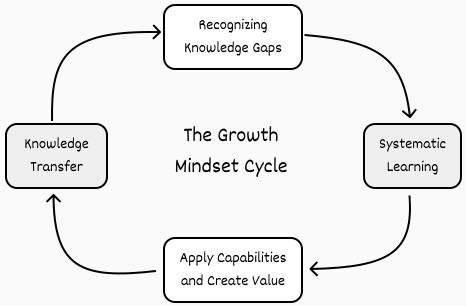
Learning starts with saying, “I don't understand this.” Admitting that you don't know something can take courage in environments where technical expertise is valued. Working through the discomfort of not understanding something shows maturity. The people who grow the fastest are the ones who are not too proud to ask clarifying questions and who work their way methodically through difficult concepts. They also view ignorance not as a personal failing but, rather, a normal part (the starting point, in fact) of the learning process.
Learning becomes growth when you apply this new knowledge to create something you previously would have been unable to. Growth occurs when you use what you've learned to land code, build new products, improve systems, or solve problems your team couldn't tackle before.
Learning expands what you know. Growth expands what you and your organization can accomplish.
Cultural and Organizational Considerations
How organizations value and express learning varies based on their typical pace of change and how invested they are in employee development. Some companies expect there to be constant skill acquisition, while others value deep specialization in specific areas. Understanding these differences can help you understand which places suit your learning style or prepare you for what to expect at a new organization.
Startups and High-Growth Companies: Learning in these places happens through immediate application and shared discovery. These sorts of work environments suit people who can quickly acquire just enough knowledge to solve pressing problems. Deep skill is developed through repeated exposure to similar challenges, not through endless study. The skill that is valued is identifying what you need to know right now, then moving on when the problem has been addressed.
Large Tech Companies: These companies value deep learning that scales across teams. They want people who learn quickly and create resources and systems that help others learn. Learning here includes contributing to internal documentation, leading knowledge-sharing sessions, and building tools that embed best practices. The expectation is that your learning will multiply through enabling others.
Research Organizations: Deep, thorough learning is the baseline expectation here. These organizations value people who pursue comprehensive mastery even when the practical applications of that knowledge aren't immediately clear. Learning means grasping not just how things work but why they work that way. Success comes from discovering new insights that advance the field, even if they don't immediately translate to products.
Traditional Enterprises: Unlike startups, where you figure things out as you go, traditional organizations often have formal training infrastructure: onboarding programs, certification paths, internal courses, and structured mentorship. Learning here means taking advantage of these resources while also recognizing that formal training can't cover every situation you'll encounter. Success means learning the established systems thoroughly before proposing improvements. The emphasis is on building depth that works within existing constraints.
Cultural Background Considerations: Different cultures have varying comfort levels when it comes to admitting knowledge gaps. In some cultures, saying, "I don't know" shows weakness. In others, it shows intellectual honesty. If your background makes you reticent to acknowledge your uncertainty, you might need to describe how you've learned to ask questions and seek help when needed. Similarly, some cultures emphasize the importance of doing things “the right way,” while others may be less rigid and open to experimentation.
Related Competencies
Learning and Growth vs. Problem-Solving: Problem-solving focuses on investigating immediate challenges, while learning builds insight for the future. Fixing a performance issue by optimizing queries is problem-solving, but growth means knowing database internals well enough to design efficient schemas from the start. Similarly, debugging distributed systems versus learning their failure patterns and patching security vulnerabilities versus understanding secure coding principles: learning builds on solved problems.
Learning and Growth vs. Innovation: Innovation involves creating new solutions. Learning and growth focuses on building the skills that enable future innovation. You can be an excellent learner who masters existing technologies without creating new approaches. Alternatively, it is possible to be innovative without deeply learning the underlying principles. Whereas learning gives you tools, innovation shows how you create new tools when the existing ones aren't sufficient.
Learning vs. Developing Others: Learning focuses on building your own capabilities. Developing others means helping them build their capabilities. Your learning becomes more valuable when you can transfer it to others. Strong learners who can't effectively pass on what they’ve learned create knowledge silos. And strong teachers have to keep learning themselves or risk becoming outdated. Strong professionals are good at both learning and teaching.
Interview Questions
Interviewers will ask you questions about learning to understand how good you are at building new skills and growing from challenges. They want to know if you try to develop lasting expertise or are more interested in just solving your immediate problems.
Learning That Didn't Go as Planned
- "Tell me about a time when learning a new technology or tool created challenges for a project."
- "Describe a situation where you underestimated a learning curve."
- "Give me an example of choosing the wrong technology to learn, or taking the wrong approach to learning it."
These questions assess your judgment about what to learn and when. Interviewers want to hear evidence that you can weigh learning trade-offs realistically and recover when you've misjudged. Strong answers show you recognizing when learning is hurting your project, adjusting your approach, and making better choices next time. Learning can hurt a project when you spend weeks mastering a framework only to discover it doesn't fit your use case, or when you go so deep into documentation that you delay actually building anything. Do you learn from your learning mistakes?
Learning New Technologies
- "Tell me about a time you had to learn something completely new to solve a problem."
- "Describe how you approached learning a technology your team hadn't used before."
- "Give me an example of quickly getting up to speed on an unfamiliar tool or framework."
These questions are designed to test how you approach the unknown while also trying to maintain productivity. Your interviewers are assessing whether you have effective methods for acquiring new skills under pressure. Good answers show you breaking complex topics into learnable pieces, combining theory with hands-on practice, and applying what you’ve learned to create real value quickly.
Recognizing Knowledge Gaps
- "Give me an example of when you identified a gap in your understanding and addressed it."
- "Tell me about realizing when you needed deeper knowledge in a specific area."
- "Describe a time when you recognized that your initial learning approach wasn't working."
The interviewers want proof that you are aware of your limitations and able to course-correct. Your answers to these questions will show whether or not you can recognize when surface understanding isn't enough and adjust your learning strategy accordingly. Strong examples will show you identifying specific gaps in knowledge, creating structured plans to address them, and changing your approach if your initial methods fail.
Teaching and Knowledge-Sharing
- "Describe a time when you helped someone else learn a technical concept."
- "Tell me about creating learning resources or documentation for your team."
- "Give an example of spreading knowledge when you were the sole expert."
Interviewers will use these sorts of questions to evaluate whether or not your learning creates value beyond your own personal growth. Can you break down complex topics for different audiences instead of keeping what you know siloed? The best stories show you creating resources that help others and teaching so that people can actually use the knowledge they gain.
Learning from Setbacks
- "Tell me about a learning approach that didn't work, and how you adjusted."
- "Describe a time your initial understanding of something proved to be wrong."
- "How do you handle getting stuck when learning something new?"
These questions aim to get you talking about your ability to be resilient when learning causes problems. Interviewers want to know that you are adaptable when you come up against obstacles. Show them that you learn from failures and seek help when appropriate, and that you persist until you achieve clarity.
Continuous Improvement
- "How do you keep your technical skills current?"
- "Tell me about something you learned recently that changed how you work."
- "What's your approach to keeping up to date with industry trends?"
With these questions, your interviewers are assessing whether or not you keep track of ongoing developments. Do you have sustainable practices for continuous learning beyond formal training? Strong answers show your regular learning habits and an ability to connect what you learn to actual work, and that you make deliberate choices about where to invest your learning time.
Key Signals
When assessing learning capabilities, interviewers look for evidence that you build expertise over time rather than just collecting surface knowledge. The strongest candidates show systematic approaches to acquiring and applying new skills.
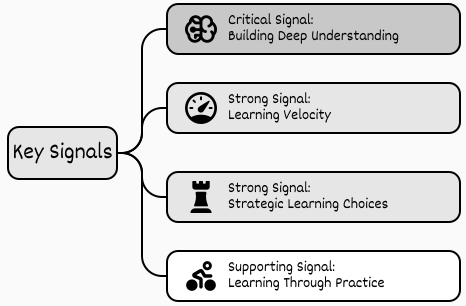
Critical Signal: Building Deep Understanding
Deep learning involves developing conceptual models that apply in different situations. Strong stories show that what you learned earlier made the next thing easier to pick up. Show them that you can connect new concepts to what you already know, that you frequently test your new understanding through application, and that you have used your new skills to help you solve new problems.
Strong Signal: Learning Velocity
Learning velocity isn't just about speed; it's also about what you choose to learn. Strong learners will focus their learning efforts where they are most needed. Good examples will show you determining the minimum viable knowledge that is needed to start contributing and using hands-on experimentation to learn faster.
Strong Signal: Strategic Learning Choices
Effective learners balance curiosity with pragmatism; they will prioritize developing the skills that will solve pressing issues or lead to new opportunities. Strong stories show you analyzing which knowledge gaps are the most important ones to address, for example, gaps whose solutions will have the biggest impacts on the team or the wider organization.
Supporting Signal: Learning Through Practice
Theory without practice stifles growth. Good examples will show you building projects to test your understanding and immediately applying new concepts to real work problems. Show your interviewers that you are skilled at adjusting your conceptual models as you learn from practice.
Red Flags
We use Red Flags for serious issues that will significantly damage your candidacy and Yellow Flags for concerning patterns that will weaken your examples.
These patterns will weaken your learning stories.
Red Flag: Learning Without Application
Discussing technologies you've studied without showing how you applied them suggests that you have been collecting information rather than building capabilities. Talking about taking courses, reading books, or understanding concepts means little without showing how you’ve used what you’ve learned in real work situations. Interviewers need evidence that you regularly translate learning into results, even if it's indirect. Show them specific problems you have solved using what you’ve learned.
Yellow Flag: Learning Only When Forced To
If you only learn when it becomes absolutely necessary, you'll always be playing catch-up. Strong learners anticipate future needs and build skills proactively. Show examples of strategic learning that positioned you well to tackle future challenges.
Yellow Flag: Solo Learning Without Knowledge Transfer
Keeping your learning to yourself limits the value of that learning and suggests that you may not be very good at collaborating. If your newfound expertise doesn't help your teammates, you've created a knowledge silo. Good stories should include how you shared your insights broadly. If you created documentation or taught others, give details.
Yellow Flag: Random Skill Collection
Learning whatever seems interesting without strategic direction shows poor prioritization. Scattered skills across unrelated areas will suggest that you chase trends rather than seek to build a solid foundation. Connect your learning choices to real needs and show how each new skill developed has been built on previous ones or has addressed specific team challenges.
Example Stories by Level
Entry-Level Example: Learning Mobile Development
Question: "Tell me about a time you had to learn something completely new to solve a problem."
Headline: "I had to learn React Native to fix our mobile app's critical bugs, even though I'd only done web development."
Key Point 1: "Our mobile developer had quit unexpectedly, leaving several critical bugs in our React Native app. My manager asked if I could help, since I knew React for web, even though they are very different things. I'd never touched mobile development, but I said yes. I spent my first day going through the React Native documentation and building a simple 'Hello World' app. By day two, I was building locally and debugging our actual codebase. I focused on trying to learn just enough to fix the bugs, rather than trying to master everything. Within a week, I'd fixed three critical issues that were blocking our release."
Key Point 2: "I realized I couldn't learn all of React Native immediately, so I prioritized based on our bugs. The first bug was about navigation, so I deep-dived into React Navigation. The second was about offline storage, so I learned AsyncStorage. I skipped things like animations and native modules because they weren't relevant to our immediate problems. This targeted approach meant I could contribute quickly while building my knowledge incrementally. I also found the React Native community forums incredibly helpful for specific issues."
Key Point 3: "As I fixed the bugs, I started understanding the differences between web and mobile development. Things like navigation, storage, and performance optimization work completely differently. I documented these differences for our team wiki, along with places where we weren’t using the framework idiomatically. When we hired a new mobile developer a month later, my documentation helped them to onboard faster. They told me it was one of the best onboarding documents they’ve seen because I had highlighted clearly where we were going off script with our usage."
Landing: "Those three weeks of intensive React Native learning opened up a whole new area for me. Since then, I've helped maintain our mobile app alongside my web responsibilities when the mobile engineers go on vacation."
Mid-Level Example: GraphQL Performance Investigation
Question: "Give me an example of when you identified and addressed a gap in your understanding."
Headline: "I solved a critical GraphQL performance bottleneck by deep-diving into its execution model and fixing the N+1 problem."
Key Point 1: "I was new to the backend engineering team responsible for our GraphQL API. We began to see response times spike above 2 seconds for certain queries. I knew the basics of GraphQL from tutorials, but I realized I didn't understand how the N+1 query problem actually manifested in production. My initial attempts at fixing it made things worse because I was guessing what the issue was. I admitted to my tech lead that I needed to learn more about GraphQL performance patterns before I could solve this properly. I proposed a one-week investigation, reasoning that a quick patch would likely fail. She approved it.”
Key Point 2: "I spent that week building an understanding of GraphQL's execution model. I read the Apollo performance guide and studied how DataLoader works under the hood. I built small test applications to reproduce different performance problems in isolation. I learned that our issue wasn't just N+1 queries but also how we were batching database calls. I could have learned GraphQL broadly, but I focused specifically on performance and query optimization, since that's what we needed. Because my learning was targeted, I could apply it immediately to our production problems."
Key Point 3: "After understanding the issue, I implemented DataLoader and restructured our resolvers to batch database queries. Response times dropped to under 150ms. Beyond the fix, I created a guide on GraphQL performance patterns for our team, covering common pitfalls and how to avoid them. I also added automated performance testing to our CI pipeline that would catch N+1 queries before they reached production. Two other engineers used my guide to optimize their services, and they reported that they caught some potential issues early."
Landing: "That week of focused learning paid off many times over and created lasting value for the entire team. The performance guide became part of our onboarding for new backend engineers."
Senior-Level Example: Cloud Migration Learning
Question: "Tell me about a time you had to lead your team in learning a critical new technology."
Headline: "I led our team's transition to Kubernetes when none of us had experience in container orchestration."
Key Point 1: "Our CTO decided we needed to move to Kubernetes to enable faster deployments and better use of resources. Our VM-based system required manual scaling and took 60 minutes to deploy. The other engineers on my team were skeptical about the learning curve. Instead of mandating training, I identified the biggest pain point that Kubernetes would solve for us, which was enabling automatic scaling. I spent two weeks learning Kubernetes myself, staying ahead of the team so I could guide them through the complex parts while they focused on applying it to our systems."
Key Point 2: "I structured our learning journey in phases. First, everyone containerized one service locally to understand the basics of Docker. Then we deployed to a test Kubernetes cluster to grasp pods and services. I held daily 15-minute 'Kubernetes wins and fails' sessions where engineers shared what they had learned. This created a culture where admitting struggles publicly and teaching and learning from others was normalized as a way to learn faster. One engineer discovered a better way to handle secrets, and another figured out pod anti-affinity rules. These peer teachings seemed to stick better than my explanations."
Key Point 3: "We couldn't bridge theory to practice until we migrated our first real service. I chose our internal admin tool as a low-risk starting point because if we made mistakes there, they wouldn't affect customers. The migration exposed gaps in our understanding around resource limits, health checks, and pod disruption budgets. We documented everything: I built a migration checklist that evolved with each service, and engineers created configuration templates and monitoring dashboards. I had each engineer lead a service migration, giving them ownership of both the process and the tooling. By the fourth migration, engineers were proposing optimizations I hadn't considered. I also recorded internal tech talks walking through our patterns, which became onboarding material for new engineers."
Landing: "Nine months later, we'd migrated 15 services to Kubernetes with zero customer-facing incidents. Deployment time dropped from 60 minutes to 5, and we could scale automatically. The team went from Kubernetes skeptics to advocates who now train other teams."
Staff-Level Example: AI Engineering Transformation
Question: "Describe a time when you transformed how your organization approached learning and knowledge-sharing."
Headline: "After unguided AI experimentation led to a security incident, I built the framework that turned our nearly 50-person engineering org into responsible AI adopters."
Key Point 1: "When ChatGPT exploded onto the scene, our developers started using AI tools independently. Within weeks, we had a security incident where someone had accidentally exposed proprietary data and IP to a public AI service. Leadership's knee-jerk reaction was to ban all AI tools, but I saw this as a learning opportunity. After spending a month understanding the AI engineering ecosystem and its associated risks, it was clear to me that we needed to develop guidelines for safe AI usage, an understanding of vector databases for internal knowledge, and clear policies on what data could be exposed to external services. The challenge was convincing leadership that responsible AI usage would give us a competitive advantage, and that turning away from AI would have competitors zoom past us."
Key Point 2: "I implemented a two-pronged approach. For developers, I established monthly AI engineering workshops that evolved in response to new developments. When RAG patterns emerged, we learned them. When local models became viable, we explored those. I also launched a weekly newsletter highlighting wins and sharing guidance on new tools and techniques. For leadership, I ran sessions demonstrating how AI could accelerate development without jeopardizing our IP. I showed them how we could use vector databases to make our internal documentation searchable without exposing it externally. This approach was key to getting both developer support and leadership buy-in."
Key Point 3: "To accelerate adoption while ensuring the safety of proprietary information, I organized a hackathon focused on AI-powered internal tools. Teams built everything from automated code reviewers to intelligent log analyzers, all using our approved patterns. The winning team created an AI system that could answer questions about our complex system architecture by ingesting our documentation, runbooks, and code comments. This became our breakthrough moment. New engineers could now onboard in days instead of weeks by conversing with our AI assistant about our systems. It was a step-change in organizational capability that convinced even the skeptics."
Landing: "Eight months later, we have 12 AI-powered internal tools in production, and our development velocity has increased by nearly a third. The AI architecture assistant alone has likely saved hundreds of hours of senior engineer time. We went from a company whose leadership feared AI to one that uses it strategically."
If Examples Don't Come Easily
Ever taught yourself a new framework over a weekend just to solve a nagging problem? Or realized that you were Googling the same concepts repeatedly and decided to properly understand the fundamentals? The learning that takes place between assigned training courses often provides the most powerful examples of growth mindset.
Look for learning and growth in how you have approached gaps in what you know. Have you ever taught yourself a technology that became critical to your team's success? That shows you were being strategic about what to learn. Have you turned a personal learning experience into team-wide improvements? That shows that you have been effective at spreading what you’ve learned. Have you changed the way you work based on new understanding? If you have built skills that have lasted beyond your immediate needs, you have shown strong learning and growth.
Reflection Questions:
- When have you learned something that later helped solve unexpected problems?
- What skills have you developed that have made your whole team more effective?
- Have you created learning resources that others still use?
- When did you recognize a knowledge gap and systematically address it?
- What learning have you pursued while managing your regular work responsibilities?
- Have you changed your fundamental approach based on new understanding?
- When have you helped spread important knowledge across teams?
- What capabilities have you built that have opened new opportunities?
- Have you turned individual learning into organizational improvements?
- When did your persistence in learning something difficult pay off later?
Key Takeaways
Learning and growth stories should show you building durable capabilities rather than just solving immediate problems. They should show your strategic choices about when to go deep versus staying broad, and how you create value for teams through knowledge-sharing. Strong stories also show you admitting what you don't know and using that honesty as a starting point.
Strong Learning and Growth Stories Include:
- Clear learning goals connected to team or organizational needs.
- Evidence of applying new knowledge to create value.
- Examples of learning persisting beyond initial confusion.
- Demonstrated knowledge transfer to benefit others.
- Strategic choices about what to learn based on impact.
Avoid These Traps:
- Don't list courses or certifications without also showing your application of what you learned from them.
- Don't describe any learning from which only you have benefited.
- Don't focus on forced learning.
- Don't present surface knowledge as if it is deep understanding.
- Don't claim to have expertise if you cannot provide evidence of practical application.
Customer and User Focus
Customer and User Focus
Pierre, a mid-level data engineer, had helped build a self-service pipeline platform that had transformed how analysts accessed data. The old process had required filing tickets and waiting days for engineering support. Now, analysts could create their own extracts in hours, and leadership even cited the platform as proof that self-service tooling worked.
Three months after the launch, Pierre was optimizing pipeline performance when he noticed something odd in the usage logs. Analysts created pipelines, they ran them successfully, then they downloaded the results, but Pierre had access to broader system logs, and he saw a pattern emerging. The same analysts who had downloaded data had immediately spun up Python jobs that transformed those extracts before using them. They weren't using the pipeline outputs directly. They were treating them as raw material for additional processing.
Pierre brought this to his tech lead, who pointed out that ticket volume was down and, thus, the analysts were happy. As far as his tech lead was concerned, the platform worked as designed. But Pierre wondered whether "working as designed" simply meant "helping analysts succeed." During his regular work, he asked various analysts what happened after they downloaded their data. Their answers were consistent: they always had to pivot and aggregate the outputs before the data was in a usable format for their analysis. Thus, the self-service platform had eliminated the ticket bottleneck, but it had created a new one that was invisible to engineering metrics.
Convincing his team to revisit a successful project wasn't easy. Pierre documented the post-download workflows he’d discovered and calculated the hours spent by analysts on repetitive transformations. He proposed adding output format options and common transformation templates, changes that fit within the existing architecture, rather than requiring a rebuild. His tech lead was skeptical at first, but the evidence of wasted analyst time made the case. After the improvements shipped, analysts started using pipeline outputs directly. The platform finally delivered on its promise of getting analysts to insights faster, not just data. Several analysts thanked Pierre directly, saying it was the first time engineering had truly understood their needs.
What Does It Mean to Focus on Customers and Users?
Customer focus means consistently turning user needs into effective technical solutions. It involves understanding why users need something and knowing how to meet that need.
Most people can implement features according to the specifications, but turning feature requests into insights about user needs is the mark of someone who is customer-focused. For frontend developers, it is someone who learns to identify potential friction points for users before they become complaints. For platform engineers, it is the one who studies how other teams use their APIs and improves the developer experience proactively. For data engineers, it's the one who understands how different teams consume data and will design pipelines that make their analyses easier.
Tech companies have made customer focus central to their cultures. Salesforce built its culture around "Customer Success," going beyond fixing problems to helping customers achieve their goals. Zoom looks for people who deliver "care," their term for deeply understanding and addressing user needs. Amazon's "Customer Obsession" principle states that leaders start with the customer and work backwards. These companies recognize that technical skills create lasting value only when they solve real problems for their customers.
The Essence of Customer and User Focus
Users rarely ask for what they actually need. They will request features based on their current pain, but they don’t typically know to ask for better solutions. Customer focus means seeing past feature requests to see what users are trying to accomplish. That deeper understanding changes how you make technical decisions, prioritize your work, and measure success.
Consider a common scenario. Users will often request an export button because they need to analyze data in spreadsheets. You could add the button, job done. But if you ask the users why they're exporting, you might discover that they want to run calculations that your system could handle directly. In that case, the export request is a symptom of the real need: better analysis tools. Simply implementing every request without asking why will lead to cluttered systems full of workarounds. And ignoring user input entirely eventually leads to useless “solutions.” Good customer focus means investigating the underlying problems behind requests and finding solutions that will address those real needs.
Customer focus also requires recognizing that users aren't a single group with uniform needs. They will have a range of technical abilities, and different segments will use your systems differently. And they will likely have conflicting priorities. Strong customer focus means deciding carefully which users to prioritize when you can't serve everyone equally. Do you optimize for power users versus beginners, internal teams versus external customers, or current users versus future growth? All these choices will have implications that you will need to understand before making a considered decision.
Customer focus includes measuring real outcomes that are often difficult to quantify. This means defining success from the user's perspective, tracking whether your solutions actually improve their outcomes, and iterating based on real use. The people who excel at customer focus want to know if their work truly helps users achieve their goals.
Cultural and Organizational Considerations
How an organization values and expresses customer focus will vary depending on its business model and user relationships. Some companies interact directly with their end users, while others build products where internal teams or business partners sit between them and the people who actually use their work. If you know these differences, you will know how to show your customer focus skills to interviewers at each type of company.
Consumer Product Companies (e.g., Meta, Netflix, Spotify): Customer focus in a consumer product company means obsessing over user experience and engagement metrics. These organizations value people who can interpret user behavior data and turn it into product improvements. Success comes from understanding mass user patterns while also understanding individual user journeys. The skill is balancing quantitative and qualitative data to create products that users will love.
Enterprise Software Companies (e.g., Salesforce, ServiceNow, Workday): These companies value people who understand complex business workflows and competing stakeholder needs. Customer focus here means managing end users who use the software daily and buyers who make purchasing decisions. Success in this sort of environment requires turning business requirements into technical solutions that enable the users of the system to work effectively.
Platform and Developer Tool Companies (e.g., AWS, MongoDB, Stripe): User focus at a platform or developer tool company means understanding technical users' workflows and accounting for the spectrum of use from occasional to power user. These companies value people who can think like their developer customers and are skilled at deciding which segments to prioritize. Success comes from recognizing that most users need only a fraction of available features, then creating tools that make common tasks simple while still providing depth for advanced use cases.
Internal Tools and Backend Teams: Customer focus here means understanding your impact on users even when you're far removed from them. Backend teams might serve frontend teams who serve customers, or build systems that affect users indirectly through performance and reliability. These teams need people who can trace how their technical decisions will affect the end users, whether they are customers or colleagues using internal tools. Success in this sort of context requires thinking beyond the immediate technical requirements and looking at the full chain of impact.
Cultural Background Considerations: Different cultures have varying approaches to learning about and serving customers. Some cultures emphasize explicit communication and direct feedback, while others rely on reading between the lines and anticipating unspoken needs. If your background emphasizes indirect communication, you might excel at noticing what users don't say. If you come from a culture that is known to favor being very direct, you might need to highlight how you've learned to probe deeper than surface requests.
Related Competencies
Customer Focus vs. Innovation: Innovation shows your ability to create new solutions. Customer focus makes sure that those solutions address real needs. You might invent an ergonomic new interface pattern (innovation), but perhaps it confuses users because it doesn't match their mental models. Customer focus keeps innovation grounded in what actually helps people succeed.
Customer Focus vs. Taking Initiative: Initiative involves identifying opportunities for improvement and taking action. Customer focus guides you to work on improvements that will actually matter to users. You could show initiative by redesigning a confusing interface, but without customer focus, that redesign might end up creating different usability problems.
Customer Focus vs. Problem-Solving: Problem-solving involves investigating issues thoroughly. Customer focus means understanding the problem from the user's perspective. Without customer focus, you might solve a speed issue (problem-solving) without realizing that the users care more about data accuracy than speed. Customer focus provides the context for deciding which problems will have the biggest impact for users.
Interview Questions
Interviewers explore your customer focus by asking questions that reveal your understanding of user needs and how to translate them into technical decisions. Do you care about what users actually need, or do you just do your job?
Understanding User Needs
- "Tell me about a time you had to understand user needs for a technical project."
- "Describe how you have approached building something when the user requirements weren't clear."
- "Give me an example of validating what users had actually needed versus what they had asked for."
These questions are asked to assess whether you will dig deeper to understand the true nature of user problems. Interviewers want to hear your description of the methods you use to uncover needs rather than just hearing you say that you accept feature requests without looking deeper. Strong answers will show you talking directly with users, observing their actual behavior when working, and distinguishing between what users say they want and what would be a more effective solution to help them succeed.
Balancing Technical and User Needs
- "Give me an example of when user needs conflicted with technical best practices."
- "Describe a time you made technical trade-offs to better serve users."
Here, they're testing your ability to make well-considered trade-offs between competing priorities. These questions probe whether you can find creative solutions that achieve both technical quality and user success. Good examples will show you protecting critical user experiences while maintaining technical integrity, or advocating for a technical approach different from what was requested because it would better serve user needs, even if it means more work.
Measuring User Success
- "Describe how you measured whether your solution actually helped users."
- "Tell me about a time when you discovered users weren't benefiting from a feature you’d built."
- "How do you validate that your technical work improves user outcomes?"
Interviewers want to evaluate your ability to measure success from the user's perspective. The best stories will show you defining what success looks like for the user, gathering feedback about usage, and adjusting your approach based on user outcomes rather than just quantitative metrics.
Advocating for Users
- "Tell me about a time when you advocated for users in a technical decision."
- "Describe a time when you pushed back on a technical approach because of user impact."
- "Give an example of you influencing technical decisions to better serve user needs."
These questions probe whether you will champion user interests even when doing so will create more work and inconvenience for you. Interviewers want to know if you help teams consider user impact in making technical choices. Strong responses will show you bringing the user's perspective to technical discussions and helping teams to consider technical and user trade-offs.
Key Signals
When evaluating customer focus, interviewers look for evidence that you can turn user needs into effective technical solutions. The strongest candidates show that they understand users deeply and make decisions that will genuinely help them succeed.
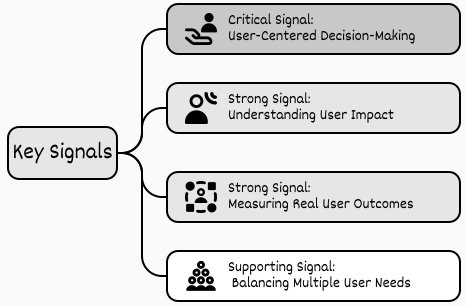
Critical Signal: User-Centered Decision-Making
Users struggle to explain their real challenges. They often don't understand how the software works, or they won't share their actual problems up front. Instead, they might request features that respond to the symptoms they're experiencing or relate to how the system has worked historically. Good stories will show that you probe deeper through questions, observation, and analysis to uncover the needs behind requests. You will show that you can turn those discoveries into solutions that will address what the users are really trying to accomplish.
For people working directly with end users, you should show that you can translate user goals into well-built software. For those working on internal tools, platform services, or backend systems, your "customer" might be other engineering teams, data scientists, or operations staff. Good examples in those areas will show you understanding those internal customers' workflows, the problems they're trying to solve using your systems, and how your technical choices can enable or hinder their success. Show the interviewers that you prioritize work based on user impact rather than your technical interests.
Strong Signal: Understanding User Impact
People with strong customer focus find ways to uncover user needs, even when they can't observe the end users directly. For customer-facing roles, this means watching users work with your systems, asking them questions that reveal their underlying needs, and testing whether your solutions will actually help.
For backend engineers, platform teams, and others removed from end users, customer focus means different things. You might have regular dialogues with customer-facing teams or product managers who interact with users daily. You might track metrics that directly connect your technical work to user outcomes, for example, API response times that affect user experience, database query performance that impacts page load, or system reliability that determines whether users can complete their tasks. Your customers might be other engineering teams who depend on your services. Strong examples will show you proactively gathering feedback from these internal customers, seeing how your technical decisions cascade to end users, and prioritizing work based on downstream impact.
Strong Signal: Measuring Real User Outcomes
User-focused people define success from the user's perspective, not just from that of the system. This separates feature-focused engineers from user-focused ones. Good stories will show you instrumenting metrics that reflect the goals of the users, monitoring how users’ behavior changes after releases, and iterating based on usage patterns. You measure task completion, goal achievement, and user efficiency, not just technical system metrics. The key is framing success in terms of what affects users.
Supporting Signal: Balancing Multiple User Needs
Strong customer focus means making thoughtful decisions about which user segments to prioritize. You can show that you understand the needs of power users versus casual users, can serve larger user segments without sacrificing smaller user segments, can balance advanced features for experts with simple tools for beginners, and can clearly articulate why you prioritized one group over another when you couldn't serve everyone equally.
Red Flags
We use Red Flags for serious issues that will significantly damage your candidacy and Yellow Flags for concerning patterns that will weaken your examples.
These patterns will weaken your customer focus stories.
Red Flag: Building Features Blindly
Implementing requested features without understanding why the users think they need them suggests a shallow customer focus. If your story jumps straight to implementation without thinking about how it will be used, you're demonstrating order-taking rather than problem-solving. Instead, show how you uncovered what the users were really trying to achieve.
Yellow Flag: Treating User Understanding as a One-Time Event
Checking user needs once at project kickoff and never revisiting them shows an incomplete customer focus. Your understanding of the users should evolve as you build and learn more. Stories that have you gathering requirements early then building a solution in isolation will suggest that you treat user research as a mere checkbox and not an ongoing practice. User needs evolve, and your initial research might have missed important use cases. Strong customer focus is shown by testing whether your solution works as you build it, not just at the beginning or end. Strong answers will show how you validated your assumptions at multiple points, adjusting your approach as you learned more about what the users needed.
Yellow Flag: Technical Optimization Without User Context
Improving technical metrics without connecting to user outcomes shows misplaced priorities. Making systems faster or more efficient only matters if it helps users accomplish their goals. If your improvements don't translate to better user experiences, you're optimizing for engineering satisfaction rather than customer success. Therefore, connect your technical improvements to specific user benefits.
Yellow Flag: One-Size-Fits-All Solutions
Treating all users the same demonstrates a shallow understanding of the diversity of users. Different user segments have different needs, workflows, and technical abilities. Stories that assume users are all the same will suggest that you don’t think deeply about who uses your systems. Show the interviewers how you identified different user groups and made careful decisions about addressing their varied needs.
Example Stories by Level
Entry-Level Example: Internal Analytics Tool
Question: "Tell me about a time when you had to understand user needs for a technical project."
Headline: "I discovered that our sales team was barely using the analytics dashboard I'd spent weeks building."
Key Point 1: "I was assigned to add new metrics to our sales analytics dashboard. The requirements listed 15 different graphs and filters that the sales directors wanted implemented. But after deploying the features, our usage logs showed that adoption was really low, at around 20%. Instead of assuming that they simply needed training, I decided to sit with a few sales reps during their morning routine. I watched three different reps, and they all did the same thing. They'd log in, screenshot one specific number (their current quarter progress), and immediately close the dashboard. They never used any of the complex filtering I'd built."
Key Point 2: "When I asked why they only looked at one number, they explained that they checked the dashboard on their phones between customer calls. Our dashboard was desktop-optimized. It had tiny buttons and required horizontal scrolling on mobile. The filters I'd built required multiple clicks to get to personal metrics. I proposed building a simple mobile view that would show each rep their key numbers immediately upon login. My manager was skeptical about spending time on mobile when the requirements didn't ask for it, but I showed her that 70% of all dashboard sessions were on mobile devices lasting under 30 seconds."
Key Point 3: "I built a mobile-first view that showed personalized metrics without any clicks. Daily active usage went from 20% of the sales team to 85% within two weeks. The sales director called out in an all-hands that reps were now actually using their dashboards instead of logging in once each morning. One rep told me she appreciated that someone had finally built something that fit with how they worked, not how management thought they worked."
Landing: "That experience taught me to always check device analytics and observe a few real usage sessions. This approach has saved me from building several desktop-optimized features for teams that primarily work from their phones."
Mid-Level Example: E-commerce Checkout Redesign
Question: "Give me an example of when user needs conflicted with technical best practices."
Headline: "I fought to implement a 'messier' checkout process that actually helped customers to complete their purchases."
Key Point 1: "Our e-commerce site had a 35% cart abandonment rate that was hurting revenue. The existing checkout followed technical best practices with clean separation between shipping, billing, and payment steps. I convinced my manager to let me spend a week investigating why customers were dropping off. I analyzed session recordings and saw a pattern. International customers would get to the billing address step and abandon when they couldn't find their country's address format. Our 'clean' multi-step process meant they had already invested time before hitting this blocker."
Key Point 2: "I proposed consolidating everything into a single page with smart defaults. The engineering team pushed back hard. Single-page checkout meant complex state management, duplicate validation logic, and messier code. They were right from a technical perspective. But I'd learned that 50% of our abandonment happened between steps, not within them. I worked with our UX designer to create a version that showed all required information upfront while progressively revealing details. This was technically clunkier, but it matched how customers thought about checkout as one action, not four."
Key Point 3: "I A/B tested the new checkout with 10% of traffic. Cart abandonment dropped from 30% to 25% in the test group. That translated to roughly $50,000 additional revenue per month. I also tracked engineering metrics. Page load time increased by 250ms. Admittedly, the code was more complex. I documented the trade-offs clearly for the team. When they saw the revenue impact, even the skeptics agreed that user needs should drive these types of decisions. We spent the next sprint cleaning up the implementation while keeping the improved checkout intact."
Landing: "That checkout redesign is still running three years later, and it has generated millions in additional revenue. This was a lesson that the 'right' technical solution isn't always the right one for the users."
Senior-Level Example: Healthcare Portal Simplification
Question: "Tell me about a time you advocated for users in a technical decision."
Headline: "I pushed to simplify our patient portal when the product team wanted to add advanced health tracking features."
Key Point 1: "I led the team modernizing our patient healthcare portal, which was used by 200K patients across several states. The product team kept pushing for advanced features such as symptom tracking, medication interaction warnings, and goal-setting. But our data showed that 65% of the patients couldn't even successfully book appointments through the portal. I spent a week analyzing user sessions and found that the patients were overwhelmed by the medical terminology and complex site navigation. Elderly patients, who made up 40% of our user base, were calling our support line instead of using the portal. I realized that the advanced features would help power users, but they would further alienate most of the other patients."
Key Point 2: "I partnered with our support team to listen to patient calls. Their frustration was heartbreaking. They just wanted to see their doctors, but they couldn't figure out our interface. I organized sessions so that engineers could watch elderly patients as they tried to book appointments. One 75-year-old patient spent 15 minutes looking for a 'schedule an appointment' button, but there was none, because we had labeled the button 'Appointment Management Portal.' Another wanted to book a video call with her doctor but didn't realize that was what we meant by 'Virtual Care Consultation.' I created a highlight reel of these sessions that showed how the terminology we had employed was impeding access to basic healthcare."
Key Point 3: "I convinced leadership to pause feature development and focus on simplification. We rewrote the entire interface using plain language. 'Appointment Management Portal' became 'Book a Visit.' We added a giant 'Need to See Your Doctor?' button on the homepage. We hid the advanced features behind a 'More Options' menu. The key was A/B testing every terminology change with real patients to ensure that our 'simpler' language was indeed clearer to them. Some surprises emerged. For example, 'Book Appointment' tested better than 'Book a Visit' with younger patients. Within six weeks, the percentage of patients who successfully booked appointments through the portal jumped from 35% to nearly 90%. Support call volume dropped by 40%."
Landing: "That portal simplification taught me that in healthcare technology, accessibility isn't optional. User advocacy sometimes means protecting users from feature creep. Now we always A/B test terminology changes with real users before rolling them out broadly."
Staff-Level Example: Cross-Platform Consistency
Question: "Describe a time when you had to fundamentally change how your organization approached user needs."
Headline: "Two years ago, our fitness app looked successful on each platform individually, but cross-platform inconsistencies were confusing users and killing retention."
Key Point 1: "Our fitness tracking application had grown to 75K active users across smartwatch, mobile, and web platforms. I noticed that the platform teams rarely talked to each other, and when I looked at the apps side by side, the user experience seemed to me to be fragmented. The watch app tracked 'Activities,' the mobile app called them 'Workouts,' and the web used 'Training Sessions.' The same fitness activity showed different calories burned on each platform due to different calculation methods. I suspected that this lack of consistency was confusing users, so I built analytics to track cross-platform user journeys. The data confirmed it: 6% of our total user base was churning because platforms didn't agree with each other, and support tickets and app reviews specifically cited inconsistent data. Our success on individual platforms had masked how badly we were failing users who expected a unified experience."
Key Point 2: "I organized research sessions where all platform teams watched the same users struggle with our inconsistencies. The siloed teams had never actually seen users try to use multiple platforms together. One marathon runner showed us three different weekly mileage totals across our platforms. She'd been maintaining her own spreadsheet because she couldn't trust our data. Another user had missed his workout streak achievement because the watch and phone apps calculated streaks differently. Engineers who'd been proud of their platform-specific features suddenly understood the trust we were breaking with our users. The confusion was so bad that users were warning each other in app store reviews to stick to just one platform."
Key Point 3: "Breaking down the silos was more than a technical challenge. I led the creation of unified data models and calculation methods, but also, with the support of the CEO, I established a new policy that measured success differently. Instead of platform-specific metrics, teams would be evaluated on cross-platform user retention. Any team that shipped a feature that broke cross-platform consistency had to make fixing it their top priority before moving to new work. No exceptions. The first time it happened, the mobile team had to delay their new social features by a week to align their calorie calculations with other platforms. Word spread quickly. Within a quarter, user retention had improved by 25%. Support tickets about data inconsistencies virtually disappeared. Reviews warning users to stick to one platform were replaced by praise for our consistent cross-device experience."
Landing: "Two years later, our consistent cross-platform experience has become our biggest competitive advantage against apps that stick to one platform. Users trust their data, whether they're checking their watch mid-run or analyzing trends on desktop. The change to our metrics of success transformed our siloed platform teams into a unified product organization."
If Examples Don't Come Easily
Look for customer focus in how you have connected your work to user outcomes. Did you ever change a technical approach because you understood how users really worked? That shows an ability to translate user needs into technical decisions. Have you ever discovered that users were struggling with something nobody had yet reported? That shows early awareness of the needs of users. Have you ever advocated for users even when it meant more work for your team? If you have made technical choices that have helped users succeed despite the inconvenience, you have shown strong customer focus skills.
Reflection Questions:
- When have you discovered user needs that have differed from stated requirements?
- What technical decisions have you made based on observing user behavior?
- Have you simplified complex features after understanding user workflows?
- When did you advocate for users even when it created more technical work?
- What user feedback have you gathered while managing regular development?
- Have you identified different user segments with conflicting needs?
- When have you measured whether your solution has actually helped users?
- What user problems have you solved that weren't stated in any requirements?
- Have you helped non-technical teams to better understand the needs of users?
- When has a deeper knowledge of users changed your entire approach?
Key Takeaways
Customer focus means understanding real user needs beyond their stated requirements and translating those needs into effective technical solutions. It requires carefully balancing the conflicting needs of different user segments. And it means measuring success from the user's perspective, not just technical completion.
Strong Customer Focus Stories Include:
- Evidence of direct user research or observation.
- Clear connection between user needs and technical decisions.
- Examples of advocating for users when it required trade-offs.
- Measurement of actual user outcomes, not just feature delivery.
- Recognition of different user segments and their varied needs.
Avoid These Traps:
- Don't assume you know what users need without investigation.
- Don't describe building features without confirming they have helped users.
- Don't treat all users as having the same needs and abilities.
- Don't focus only on technical metrics without user outcomes.
- Don't implement requests without understanding the underlying needs.
Innovation
Innovation
When Joel, a senior QA engineer, analyzed their test failures, he found that 45% of them were flaky tests that passed or failed randomly. The team had tried to solve the problem with retry logic, better timeouts, and isolated environments, but nothing worked consistently because the tests still depended on timing and external state.
Joel suspected that the retries were treating symptoms, not causes. After studying where flakiness originated, he determined that most came from tests that depended on time, network calls, or shared state between tests. He designed a test runner that made these dependencies impossible rather than just discouraging them.
The legacy test suite had grown organically over the years, with tests directly calling production services and relying on host system clocks. Joel's framework required all external calls to go through injectable interfaces that the test runner controlled. Time-based operations used a virtual clock that the tests could manipulate. Each test received a fresh isolated context that couldn't be polluted by other tests. Tests that tried to access real external resources wouldn't build.
After Joel deployed his framework, flaky test failures dropped to zero because the architecture made flakiness impossible. Other teams adopted his approach when they saw tests that ran identically whether executed once or a thousand times. The company's CI pipeline, which used to require three retry attempts before marking builds as failed, now passed or failed definitively on the first run.
What Does It Mean to Innovate?
Innovation means inventing new ways to solve problems, not just improving existing methods. It involves inventing solutions that change how problems get addressed, whether you're working around limitations in current methods or rethinking how things have always been done.
Anyone can implement known solutions or follow established processes. But consider a data analyst who builds a system in which business users can query data through natural conversation instead of having to learn SQL or dashboard tools. Or a frontend developer who designs components that make accessibility violations impossible to introduce, rather than catching them in code review. Or an infrastructure engineer who creates services that will automatically reduce in functionality under load instead of failing, thus eliminating the need for most monitoring alerts. These professionals invented approaches that hadn't previously existed, not just better versions of what came before.
Tech companies recognize innovation as being fundamental to staying competitive. Google explicitly evaluates innovation in their hiring process; they look for people who can invent novel solutions to complex challenges. Apple's culture prizes those who "think different" and are willing to challenge the status quo to create breakthrough products. For Tesla, "constantly innovate" is core to their mission of accelerating the use of sustainable energy. These companies understand that inventing new solutions and simplifying problems generates more long-term value than just applying and improving existing approaches.
This doesn't mean you must have invented revolutionary products to work there. These companies are looking for people who demonstrate innovative thinking at whatever scale their role allows, whether that's building a new tool for your immediate team or designing solutions that impact your entire organization.
Innovation vs. Optimization: Understanding the Difference
The line between optimization and innovation confuses many candidates because both things improve outcomes and require skill. Here's how to distinguish them: optimization makes existing methods work better, while innovation creates a new approach.
Consider database performance. If you add indexes to speed up queries, that's optimization; you're making the existing system work better. If you redesign your data access layer to eliminate the need for those slow queries entirely, that's innovation; you've designed a new approach that makes the original problem disappear.
The test is this: could someone else have achieved similar results by refining what already existed? If yes, it's likely optimization. If your solution required inventing a new method that others couldn't have reached by incrementally improving the old approach, it's innovation.
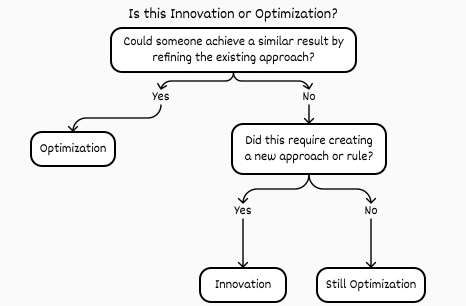
When Optimization Becomes Innovation
Sometimes, after having begun an attempt to optimize, you may realize that trying to merely improve the existing approach is not going to solve the problem. When this happens, your goal will shift from improvement to innovation.
Take query caching as an example. If you were to add a standard caching layer, that would be an optimization, because you're applying a well-known pattern to make things faster. But if you realized that traditional caching couldn't keep up with your access patterns and pivoted to invent a new caching strategy that predicted future queries based on user behavior, that would be innovation. You may have started with the goal of optimization, but you ended up inventing something new.
The story of Joel and his flaky tests at the beginning of this chapter illustrated this shift. Joel could have kept on trying to optimize by tweaking the retry logic or timeout settings. Instead, he recognized that no amount of tuning would eliminate the root cause. He made test flakiness structurally impossible, not by evolving the existing approach but by introducing a new test architecture.
Making the Distinction in Your Stories
When preparing innovation stories, ask yourself: Did I make what existed work better, or did I create something entirely different? Both are valuable skills, but for innovation questions, interviewers want to hear evidence of the latter.
If you improved performance by 10x through a better algorithm, that could be either. Did you implement a well-known algorithm (optimization) or did you make a twist on it for your situation (innovation)? If you reduced bugs by a third, did you write more tests (optimization) or introduce a new framework that prevented entire categories of bugs (innovation)?
The differentiator is usually whether you built something new that others could adopt. When teams adopt your method because it opens new possibilities rather than just making things work faster, you've likely crossed into innovation.
The Essence of Innovation
The critical tension in innovation lies in balancing novelty with practicality. Pure creativity without constraints will produce impractical solutions. On the other hand, an excessive focus on feasibility can stifle breakthrough thinking. Effective innovation produces new approaches that transform how problems get solved while working within real constraints. Fixing performance issues by adding more servers uses known solutions (horizontal scaling). Creating a new architecture that eliminates the performance bottlenecks shows innovation.
Innovation also requires distinguishing between complexity and elegance. Adding features or layers to manage problems without careful consideration often makes things worse. Innovation frequently simplifies by reconsidering fundamental assumptions. Innovators ask why problems exist in the first place and will often design solutions that eliminate rather than manage complexity. They will break problems down to their most basic truths and build solutions from there, often in radical new directions.
Innovation requires persistence despite failed attempts, because inventing new solutions rarely succeeds on the first try. The professionals who innovate effectively treat failures as data to understand why previous attempts didn't work, and they use those insights to guide their next attempts. They balance confidence in their vision with flexibility in implementation.
Cultural and Organizational Considerations
How organizations value and express innovation will vary depending on their competitive position and tolerance for risk. Some companies need constant innovation to survive, and others prefer proven approaches. Understanding these differences will help you tailor the way you show your ability to innovate depending on the type of company that is interviewing you.
Startups and Disruptive Companies: Survival in this space depends on innovation. These companies value people who can create new ways of doing things in the face of severe constraints on resources and time. The key skill is identifying which constraints to accept and which ones to challenge through innovative thinking.
Large Tech Companies: These companies value innovation that scales and integrates with existing systems. They want people who can create new solutions while considering the challenges of adoption across large organizations. Innovation here often means creating platforms or frameworks that enable others to innovate. Success requires balancing breakthrough thinking with being practical.
Research and Development Organizations: Innovation is the mission in this sort of organization. People who can push the boundaries of what's possible without immediate commercial constraints will thrive in such an environment. Innovation means exploring fundamental new approaches even when the practical applications are not yet clear. Success comes from having structured reasoning and motivations behind the research agenda.
Traditional Industries: Innovation here means bringing new approaches to established domains as they modernize. These companies value those who can respect existing processes while finding creative ways to transform operations. Success requires respecting what came before and being patient with changes, which must prove their value incrementally on the way towards a larger transformation.
Cultural Background Considerations: Different cultures view innovation and risk-taking differently. Some work cultures encourage challenging established methods and thinking differently, while others default heavily to existing approaches. If your target company favors incremental improvement, show how you've learned to temper your impulse toward innovation with consideration of the practical constraints. If you’re targeting a work culture that encourages radical thinking, highlight the times when you recognized the need for fundamental change.
Related Competencies
Innovation and Problem-Solving: These competencies work together. Problem-solving focuses on investigating and fixing issues, often using established methods. Innovation means new approaches when existing methods aren't sufficient. For example, you might debug a complex system failure through careful analysis (problem-solving), then invent a new monitoring approach that detects previously silent failures (innovation). Both approaches are valuable, and the best candidates will show interviewers their ability to do both.
Innovation and Taking Initiative: Initiative and innovation frequently appear together. Whereas taking initiative is choosing to work on unassigned problems, innovating is inventing new solutions for those problems. For example, you show initiative by deciding on your own to improve a slow mobile app launch speed that nobody else has surfaced. Innovation is inventing a novel approach to surgically lazy-load resources. The best stories combine both: you proactively identified and addressed a problem, creating a new solution.
Innovation questions appear in interviews at all experience levels, albeit with different emphases. Entry- and mid-level candidates will more commonly face questions about implementing ideas and inventing new solutions at the personal or team level. Senior candidates and above can expect to be asked questions about innovation at the inter-team and organizational levels. Be prepared for any of these questions regardless of your level, because interviewers will sometimes ask more advanced questions to see how you think, even if you haven't had those exact experiences yet.
Interview Questions
Interviewers will probe your approach to innovation by asking questions that will reveal your ability to create new solutions rather than just evolve existing ones. They want to see whether you can invent better approaches when standard methods fall short.
Creating New Solutions
- "Describe the most innovative thing you've done and why you thought it was innovative."
- "Tell me about a time when you created a completely new solution to solve a problem."
- "Have you ever built something that hadn't previously existed at your company?"
These questions directly probe your ability to innovate. Interviewers want to understand what made your solution novel. Strong answers to these questions will explain why existing approaches wouldn't have worked, describe what you invented, and show how your ideas were novel. They will describe you recognizing when incremental changes that weren’t going to work and building something completely new.
Improvement Involving Innovation
- "Tell me about a time you improved something that was already working fine."
- "Describe how you identified an opportunity to do something better at work."
These questions can be answered with either optimization or innovation examples. Interviewers will appreciate both, but answers that refer to innovation will stand out. When you hear "improved" or "better," consider whether you have an example where your improvement work involved a new approach. Did you make the existing process faster, or did you create a process that eliminated the original bottleneck entirely? The former is a solid answer, but the latter demonstrates innovation.
Implementing Novel Ideas
- "Give me an example of building something new to solve a recurring problem."
- "Tell me about turning an innovative idea into a working solution."
- "Describe a time you had to convince others to try your new approach."
Interviewers use these sorts of questions to evaluate whether you are comfortable moving from new ideas to implementing them. Can you build working solutions within real constraints? Strong stories will describe you proving that innovative approaches work in practice, designing solutions others can use, and managing organizational resistance to new ideas.
Validating and Iterating
- "Tell me about a time when your initial innovative approach didn't work out."
- "Describe how you test whether a new idea is worth pursuing."
- "Give me an example of your evolving an innovation based on feedback."
These questions probe how you balance creativity with practical validation. Interviewers want evidence of systematic thinking, not just throwing ideas at problems. Strong responses will show you designing experiments to test key assumptions, gathering data to test whether innovations lead to measurable improvements, and adapting your approach based on what you learn.
Key Signals
When evaluating your innovation abilities, interviewers will look for evidence that you create new approaches to solve problems. The strongest candidates show that when they recognize that existing methods aren't enough, they can develop effective alternatives.
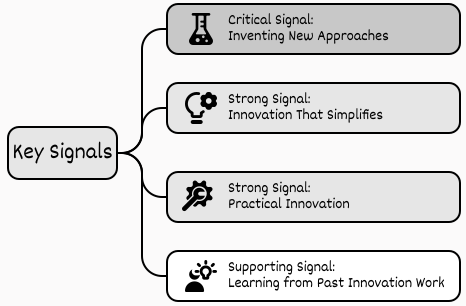
Critical Signal: Inventing New Approaches
Innovation involves developing new ways to solve problems, but newness alone isn't sufficient. Interviewers also want to hear how your new approach was the best way to solve a real problem.
Strong stories will describe you recognizing when current methods are limited in handling a problem, questioning accepted assumptions about how things should work, and creating methods that others adopt because they're more effective. It’s not enough to have invented something clever. Have you created something valuable that has changed how people work?
Strong Signal: Innovation That Simplifies
Innovators find ways to drastically simplify or eliminate complexity rather than manage it. Good examples will show you questioning why things have to be so complicated, finding clean solutions to previously messy problems, and doing things that may have felt obvious in hindsight but required creative leaps to discover.
Strong Signal: Practical Innovation
Innovation without implementation is just imagination. What’s worse, innovation that has been done but is without value is just a waste of money. Good examples of delivering practical innovations will show you considering feasibility from the start, building innovations that solve real problems for users or systems, and balancing your creative vision with practical realities such as time, resources, and organizational readiness. The best stories will describe how others adopted your solution because it genuinely improved their work.
Supporting Signal: Learning from Past Innovation Work
Strong innovators treat past projects as experiments from which to learn. Therefore, you should show early pushback on core assumptions, adapting based on preliminary results, and knowing when to persist in one direction or try completely different approaches.
Red Flags
We use Red Flags for serious issues that will significantly damage your candidacy and Yellow Flags for concerning patterns that will weaken your examples.
Many candidates confuse innovation with related activities, thus weakening their stories. Understanding the following distinctions will help you to focus your answers.
Red Flag: Optimization Masquerading as Innovation
Describing performance improvements or bug fixes as innovation will show your interviewers that you don't understand the distinction. Making something faster or more reliable is valuable, but it’s not innovative unless you used a new approach. Innovation opens new possibilities. To avoid this red flag, focus your answers on times you did new things.
Yellow Flag: Innovation Without A Problem To Solve
Jumping straight into your creative solution without first explaining why the existing approaches were inadequate misses the point. If you do this, your interviewers won't be able to fully assess your ability. Take the time to establish why existing solutions weren't sufficient and also the existing constraints that had made the problem a challenge to solve. Providing this context will transform your story from "I had a clever idea" to "I solved a big problem."
Yellow Flag: Complexity Disguised as Innovation
The creation of complicated solutions does not always make the best example. Innovation generally simplifies and leads to better solutions. If your example of innovation added multiple new components, layers, and processes and requires an extensive explanation, it may not be the best story to describe in an interview. The interviewers will likely question whether you were truly innovating. You may have been guilty of over-engineering. Therefore, give them an example that shows how the implementation of your innovation made things simpler.
Yellow Flag: Innovation Without Adoption
Building creative solutions that nobody uses suggests innovation for its own sake. Innovation delivers value only when others benefit from your new approach. Therefore, stories that focus entirely on clever solutions without adoption should be avoided, because they miss the point. Your stories need to include the effects of your approach and how others benefited from your innovation.
Yellow Flag: Ideas Without Action
Describing ideas that you have never implemented will weaken your credibility in an interview. Interviewers want to hear that you moved from concept to action. Even a story describing a failed attempt that taught you something valuable would be far stronger than talking about a theoretical idea that stayed on the whiteboard. That you had the initiative to build and test it is far more important to your interviewers than whether or not it succeeded on the first try.
Example Stories by Level
Expectations relating to innovation scale with your level across three dimensions: the scope of problems you address, how widely your solution gets adopted, and the impact it creates.
Entry-level innovation solves problems in your own work. Even though the scope is personal, by telling a story like this, you're showing that you see opportunities for innovation and act on them.
Mid-level innovation helps your immediate teammates. You create something for yourself that teammates find useful and start using. You're still solving your own problems first, but the solutions spread to others who face similar challenges.
Senior-level innovation intentionally addresses shared problems. Rather than building for yourself and sharing later, you recognize that many people struggle with the same thing, and you develop a solution for the entire group. Your solutions get adopted as team standards, and the impact shows up in team-level metrics.
Staff-level innovation crosses team boundaries. You create solutions that multiple teams adopt, or you design reusable approaches that become organizational patterns. The impact extends well beyond your immediate team.
Principal-level innovation transforms how significant parts of your organization or industry operate. You create approaches that become the new standard, changing how many teams work or influencing how the broader industry solves similar challenges.
Entry-Level Example: Automated Test Data Generation
Question: "Tell me about a time you came up with a creative solution to a technical problem."
Headline: "I created a new approach to generating test data after our manual process had become too slow for rapid development."
Key Point 1: "I joined a team where the developers had to spend 20-30 minutes before each test run manually creating test users, orders, and inventory data in our staging environment. We had database seeders, but they created the same static data, which didn't match real-world scenarios anymore because our product had evolved over time. After wasting hours each week on test setup, I realized we needed a different approach. Instead of static seeders, I built a test data generator that created realistic, randomized data based on patterns from our production analytics."
Key Point 2: "Rather than requiring the developers to specify every field for test data, I made the tool context-aware. You could request 'a user with purchase history' or 'an abandoned cart scenario' and it would generate all related data automatically. What had previously required a developer to know exact database schemas and relationships became simple one-line commands. I focused on abstracting test scenarios to match how developers actually think about testing rather than how databases store information."
Key Point 3: "I built the tool during a hackathon using our existing testing framework, so it plugged right into our current workflow. The key was making it immediately useful without any setup changes. Developers could use CLI commands or a simple web UI to generate test scenarios. I also made it extensible through YAML configs, so teams could define their own scenario templates without touching code."
Landing: "That test data generator eliminated manual setup from my workflow. I went from spending half an hour on each test scenario to generating realistic data in seconds, and I started catching edge cases I'd never thought to test. I built it to be extensible so others could add their own scenario templates."
Mid-Level Example: Dynamic API Gateway Innovation
Question: "Give me an example of when you had to invent a new technical approach."
Headline: "I invented a new approach to API gateway design when standard solutions couldn't handle our diverse client requirements efficiently."
Key Point 1: "Our platform served everyone from mobile apps needing minimal data to enterprise integrations requiring bulk exports. Standard API gateways forced us to either create dozens of endpoint variations or send excessive amounts of data. After months of fighting this complexity, I realized we needed a different approach. I invented a dynamic API gateway that could reshape responses based on the capabilities and needs of the clients, learning optimal response patterns from actual usage rather than fitting them into predefined rules."
Key Point 2: "Building a completely new gateway would have been risky, so I designed it as a proxy layer that enhanced our existing APIs. Clients could request data profiles through headers like 'mobile-low-bandwidth' or 'analytics-full-detail'. The gateway acted as a view layer, reshaping the upstream JSON before sending it downstream. The innovation here was making response-shaping declarative. Instead of maintaining dozens of rigid endpoints, we maintained a handful of data profiles that could be mixed and matched based on client needs."
Key Point 3: "The first version tried to be too smart by making optimization decisions that confused developers when responses changed unexpectedly. I added an explicit learning mode where optimizations were suggested but not applied automatically. They had to be approved first. When enterprise clients complained about inconsistent responses, I quickly created client profiles that locked in specific optimization strategies. Thus, each piece of feedback helped refine the balance between automatic optimization and predictable behavior."
Landing: "The dynamic gateway now handles millions of requests daily, and it reduces average response sizes by 60% while improving client satisfaction scores. Mobile app performance improved dramatically in low-bandwidth regions, and enterprise clients could finally get the exact data shapes they needed. Three other teams in our company have adopted the same pattern for their own API challenges."
Senior-Level Example: Real-Time Data Sync Innovation
Question: "Tell me about a time when you created a novel solution to a complex technical challenge."
Headline: "When existing sync frameworks couldn't handle our offline-first requirements, I invented a new pattern for syncing data between our mobile app and backend."
Key Point 1: "Our field service app needed to work reliably in areas with spotty connectivity, but standard sync solutions like Firebase or AWS AppSync required specific data models we couldn't adopt. They also struggled with our complex business rules around data conflicts. After evaluating five different frameworks, I realized none could handle our requirement for field technicians to complete entire workflows offline and sync them later without conflicts. So I invented a new sync pattern based on event sourcing principles, but simplified for mobile constraints."
Key Point 2: "Instead of syncing data states as per traditional approaches, I designed the system to sync user actions as immutable events. This eliminated the need for complex conflict resolution because events could be reordered and replayed to reach a consistent state. The breakthrough was realizing that we didn't need to sync the database, just the sequence of user actions. This made the mobile code much simpler since it had only to record and replay events, not manage complicated merge logic."
Key Point 3: "My first version tried to sync every user interaction, which created massive event logs. Testing with field technicians showed this to be overkill. I adapted the approach to sync only business-meaningful events, and in so doing reduced sync payload by nearly 95%. When we discovered that photo uploads were failing in very poor connectivity, I added progressive upload with automatic resume. Each iteration taught me more about striking a balance between clean design and practical field conditions."
Landing: "The event-based sync system has processed over 500K field service workflows without a single data conflict requiring manual intervention over the past two years. The approach has worked so well that our company's other mobile team adopted it for their delivery app. The pattern has even been presented at our company's architecture forum as a case study for offline-first design."
Staff-Level Example: AI-Powered Self-Healing Infrastructure
Question: "Describe a time when you invented something that transformed how your organization operates."
Headline: "I invented a self-healing infrastructure platform after it became obvious that traditional monitoring and alerting approaches couldn't scale with our engineering growth."
Key Point 1: "As we grew from 50 to 200 engineers, our on-call burden was becoming unsustainable. Standard approaches helped, for example, better monitoring, runbooks, and automation, but they didn't solve the fundamental problem. Most incidents followed predictable patterns that humans had to resolve manually. Existing 'self-healing' tools were just automated runbooks that couldn't adapt to new failure modes. I invented a different approach, an AI-powered self-healing platform that learned from how engineers resolved incidents and then applied those patterns automatically to similar future issues."
Key Point 2: "The AI component wasn't the hard part. The real innovation was the safety architecture that let it operate autonomously without risk. I built a sandboxed execution environment in which the AI would generate a remediation plan but never execute it directly. Every plan passed through deterministic guardrails that validated actions against policies: no changes to stateful data, no actions affecting more than one service at a time, and automatic rollback triggers if health metrics degraded. The AI could be creative in its suggestions, but the execution environment enforced strict boundaries on what could actually happen."
Key Point 3: "Adoption required trust, which in turn necessitated transparency. I built an audit system that showed exactly why each action passed or failed each guardrail. This allowed teams to review blocked actions to understand the safety logic and refine their policies accordingly. We started with conservative guardrails and loosened them as confidence grew. The platform also learned which engineers had authority over which systems and routed approvals appropriately when actions exceeded set thresholds. This layered approach let teams adopt it gradually, starting with suggestions only and progressing to autonomous resolution as they verified that the guardrails worked."
Landing: "After 18 months, the platform automatically resolves 30% of production incidents without human intervention. Common issues such as memory pressure, connection pool exhaustion, and cache invalidation problems no longer wake anyone up. Teams now build self-healing capabilities preemptively, teaching the platform about new features during development. Now, when engineers do get paged, they know that human judgment is genuinely needed. The platform shifted our operational culture from reactive firefighting to deliberate resilience-building. Our on-call satisfaction scores have improved from 4.2 to 8.9 out of 10."
If Examples Don't Come Easily
Most people struggle with innovation stories because they're looking for the wrong things. You don't need to have invented a groundbreaking product or built something that has made headlines. The professionals whose stories appear in this chapter didn't know they were building "innovation stories" when they did the work. They saw problems that existing solutions couldn't handle well, and they built better approaches. Here's how to find and prepare your own innovation stories.
Recognizing Innovation in Your Work
Innovation often doesn't feel innovative when you're doing it. You're just solving a problem that's frustrating you. The test data generator story? That person was just tired of spending 30 minutes setting up test data before every test run. The self-healing platform? That person was annoyed at being paged for the same issues repeatedly. They built new solutions because existing approaches weren't working, not because they purposely set out to "be innovative."
Look for times when you’ve thought, "There has to be a better way" and then built that better way. Have you created a tool because the existing ones didn't fit your needs? That's innovation. Have you combined existing technologies in ways others hadn't tried? That's innovation. Have you simplified a process everyone else simply accepted as necessarily complex? Innovation again. The key is that you built something new to solve a problem more effectively than the existing method.
Innovation doesn't require inventing entirely new concepts. Most innovations combine existing ideas in new ways or apply techniques from one domain to solve problems in another. Using event sourcing patterns for offline mobile sync isn't inventing event sourcing, but it's an example of innovative application to a different problem space. Similarly, creating a test data generator that thinks in scenarios instead of database schemas isn't inventing generators, but it's an innovative approach to test data.
Testing Whether Your Example Counts
If you're unsure whether your example is innovation or optimization, revisit the distinction from the "Innovation vs. Optimization" section earlier in this chapter. The quick test: could someone have reached your solution by refining what already existed? If not, if you had to build something new, it's innovation.
Learning from Failed Attempts at Innovation
Some of the best innovation stories involve failures that have led to better solutions. Interviewers value candidates who can show that they treat innovation as experimentation and learn from attempts that haven’t succeeded. These sorts of stories show an innovative mindset even when the approach has failed.
Consider times when you tried a new approach that didn't work as planned. Maybe you built a tool that was too complex for others to adopt. Perhaps you created an elegant solution, except for one minor detail: it didn't account for a critical constraint. Or you invented a new process that worked in testing but failed under production load. These experiences will teach you what doesn't work and why, which are insights that will guide better innovations in the future.
When discussing failed innovations in interviews, focus on:
- What you were trying to achieve and why the existing solutions were no longer adequate.
- The innovation you attempted and why you thought it would work.
- What you learned when it didn't work as expected.
- How those learnings influenced your next attempt or helped you pivot to a better solution.
- Whether your failed attempt still taught the team valuable lessons.
For example: "I created a deployment system that used AI to predict optimal deployment windows. However, the system was too unpredictable. Teams couldn't trust it for critical releases. That failure taught me that in this case, we needed to enhance human judgment, not replace it. I redesigned the system so that it would suggest optimal windows while letting teams make the final decisions. That version was widely adopted."
Failed innovation attempts that led to learning often make for stronger stories than smooth successes, because they show how you think through problems and adapt when your hypotheses are proven to be wrong.
When You Haven't Had Traditional Opportunities to Innovate
Not every role provides obvious opportunities for innovation. However, if you've been primarily maintaining existing systems or working on features designed by others, you can still find innovation stories by looking in less obvious places.
Have you created debugging approaches that others on your team now use? That's process innovation. Have you built tools that improved your team's workflow, even if they seemed simple? That's innovation if you built something that didn't exist before. Did you find creative solutions to limitations in your environment? Working around constraints through novel approaches is innovation.
Consider problems that you have solved that were outside your formal responsibilities. The person who automates a painful manual process that no one asked them to automate demonstrates innovation. The engineer who creates a better way to onboard new team members has invented a process solution. The analyst who built a dashboard that changed how teams made decisions has innovated around information access.
If you truly haven't had opportunities to create new solutions, you can prepare by identifying problems in your current work that existing solutions don't handle well. Think about what frustrates you repeatedly. Consider what tools or approaches you wish existed. This preparation helps you discuss how you would approach innovation, which is valuable even without a complete story. Interviewers understand that not every role provides equal opportunities for innovation, but they will want to know that you recognize where innovation could help and how you would approach creating better solutions if you could.
Reflection Questions:
- When have you created new solutions because existing approaches didn't work?
- What tools or processes have you built that others now use?
- Have you combined existing technologies in novel ways?
- When did you simplify complex problems through new approaches?
- What solutions have you created while managing regular work?
- Have you turned workarounds into permanent improvements?
- When have you questioned why things work a certain way and created alternatives?
- What problems have you solved by thinking outside standard approaches?
- Have you helped teams adopt new methods you've created?
- When did creating something new save significant time or resources?
The key to preparing innovation stories is applying the optimization-versus-innovation distinction to your work. Look for times when you created entirely new approaches rather than making existing ones work better. The best preparation will be to identify what made your approach different from what existed before, and to practice how to articulate that distinction clearly. When you can explain succinctly why someone couldn't have reached your solution by simply refining the old approach, you have a strong innovation story ready for interviews.
Key Takeaways
Innovation means inventing new ways to solve problems, not just improving existing methods. The key distinction is whether you made something work better or invented an entirely different way of addressing a challenge. Strong innovation stories will describe you balancing creative thinking with practical constraints, simplifying complex problems by questioning assumptions, and learning from failed attempts. You can find innovation stories in everyday work, not just big projects, and you can prepare examples even if your role hasn't presented you with obvious opportunities for innovation.
Strong Innovation Stories Include:
- Clear explanation of why existing solutions weren't sufficient.
- Evidence of creating a new approach, not just improving an existing one.
- Examples of others adopting your solution because it worked better.
- Evidence of iterating based on feedback.
- Balance between creativity and practical implementation.
Avoid These Traps:
- Confusing "I made it better" with "I created a new approach."
- Adding complexity when simplicity would have solved the problem.
- Describing innovations without explaining the problems they solved.
- Presenting ideas you never actually tried to implement (unless you work in an environment where implementing innovations is not possible).
- Claiming innovation without providing evidence that others adopted your approach (unless you are an entry-level engineer).
Developing Others
Developing Others
Ian joined Toshi's team as a senior-level engineer with several years of experience gained at traditional enterprise companies. He impressed everyone with his technical skills. But during their first production incident, Toshi noticed that Ian froze when faced with live debugging.
Toshi recognized an opportunity to help Ian develop critical troubleshooting skills. The next day, when Toshi's on-call shift started, he casually invited Ian to sit with him. "I could use a second pair of eyes on these investigations," he said, framing it as him needing help rather than Ian needing training. He showed Ian how to form hypotheses quickly, then use targeted queries to test them and eliminate dead ends efficiently. He taught him how to balance urgency and quick mitigation with the thoroughness that digging deeper requires.
Over the next few weeks, Toshi made Ian the secondary on-call, and he paired with him when incidents occurred. He'd have Ian lead the investigation, and he would prompt him by asking guiding questions (e.g., "What would confirm this theory?"; "Where else might this symptom appear?"). When Ian got stuck, Toshi shared his mental models for different failure patterns, thus helping Ian to recognize common issues more swiftly.
Three months later, Ian was leading the incident response for complex outages. He was updating their runbooks with new troubleshooting patterns and creating documentation that helped other engineers diagnose issues faster. Toshi tracked Ian's progress through the changes he observed. Ian no longer had to escalate every complex issue because he could now resolve most of them independently. He also began to field questions from his teammates when incidents occurred. The team's mean time from incident to recovery was halved in that quarter, partly because Ian could now handle the calculation failures that previously only Toshi had understood. Toshi had helped Ian transform his existing strengths into practical troubleshooting skills, and that improvement had led to the entire team becoming more resilient.
What Does It Mean to Develop Others?
Developing others means helping people build lasting skills rather than just solving their immediate problems for them. It focuses on building independent, capable teams.
Developing others means helping people build their problem-solving abilities and, consequently, their confidence over time. This is done by senior engineers who review code in ways that help their teammates understand design principles that they can apply to future projects. Architects who create learning opportunities to help others develop judgment about system trade-offs. Team leads who structure projects to stretch people's capabilities and build new skills rather than always only completing tasks efficiently.
Microsoft builds "contributing to the success of others" into its core expectations. Your own performance isn't enough if you're not helping your teammates grow. Google embeds peer development into its engineering culture through readability reviews, design doc feedback, and a norm that senior engineers teach through code review; they don’t just approve it. Meta wants engineers who build team skills alongside individual excellence. These companies understand that people who help others grow create more long-term value than people who focus only on their own output.
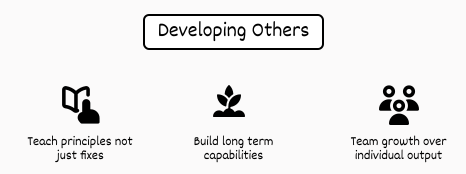
The Essence of Developing Others
Watch what happens when someone asks an expert a question. Some experts will solve the problem and move on, but some will pause, recognize a teaching moment, and help the group understand the thinking behind the answer they give. That pause, that choice to invest in someone else's growth, multiplies significantly the expert’s impact.
The core challenge with developing others is balancing immediate needs with the benefit of long-term growth in others. An approach focusing purely on efficiency means doing tasks yourself or giving quick answers. At the other end of the spectrum, treating everything as a teaching opportunity can slow teams down when deadlines loom. Effectively developing others happens somewhere between those extremes. There is a time for quick guidance and a time to teach thoroughly; a time to step in and a time to let teammates wrestle with a problem; and a time to push people beyond their comfort zones.
Developing others also means recognizing that people learn differently and need different kinds of support. Some people thrive when granted independence; others need structured help. Some learn through documentation; others need hands-on pairing. Some people are cautious when accepting help from other people, especially peers or those with fewer years of experience; others will take any help they can get, regardless of level. A person who excels at developing others adapts their approach based on the needs, current skill levels, and learning styles of the individuals being developed. This often starts with asking how someone prefers to learn, but it also means staying flexible when that approach isn't working.
To be effective at developing others, one must be comfortable and patient with people’s different rates of learning, and it is important to celebrate incremental progress. People who excel at developing others recognize small wins. They know that growth isn't always linear, and they will persist through periods when their investment doesn't seem to be paying off. They focus on trajectory rather than absolute performance because they understand that helping someone grow from struggling to being competent will create more value than the far easier job of polishing someone who is already strong. This patience has limits, though. When someone shows no movement at all despite varied approaches and genuine effort on both sides, the issue may not be the pace of learning but, rather, the fit between people.
Attempting to develop others can sometimes backfire. For example, your feedback may trigger a defensive roadblock, or a person’s confidence might crumble during a stretch assignment. When your approach isn't working, vary your methods. If progress still stalls after genuine effort from both sides, the problem may be fit rather than ability. Sometimes you are not the right person to help someone, and recognizing that fact isn't failure. The section "When Developing Others Gets Difficult" covers these challenges in depth.
Cultural and Organizational Considerations
Organizations have differing views on talent development, and the way they value and express it will also vary based on their growth stage. Some companies see it as everyone's responsibility, and others delegate it solely to managers. Understanding these differences will help you demonstrate this competency appropriately for your target company.
High-Growth Companies: At startups and scale-ups, speed is everything. There simply isn't time to wait for people to catch up on their own. These companies want to see that you can up-level the people around you without slowing down. The best stories show you teaching through the work itself: onboarding a new hire by pairing on a real feature rather than pointing them at docs, or helping a junior engineer with a production issue while shipping the fix on time. Success means the team gets faster because you invested in people, not despite it.
Large Tech Companies: These companies value more systematic talent development that scales across organizations. They want people who can both mentor individuals and create resources and frameworks that aid in the development of many people simultaneously. Talent development here includes building onboarding programs, creating technical workshops, and establishing learning cultures. Success requires balancing individual mentoring with scalable systems.
Consulting and Professional Services: Developing others directly impacts business success. Therefore, these organizations need people who can quickly upskill team members for new client engagements. Development happens through apprenticeship models where junior members learn by doing. Success means building skills that will increase the team's ability to take on more complex engagements.
Traditional Organizations: Development in a traditional organization often follows formal structures and defined career paths. These companies value people who work within established mentoring programs while also identifying additional growth opportunities.
Cultural Background Considerations: Companies differ in how they expect talent development to happen. Some value formal mentorship structures with clear senior-to-junior teaching relationships. Others expect peer-to-peer growth through code review, pairing, and shared ownership. Before your interview, learn which model the company favors. Job postings, engineering blogs, and Glassdoor reviews often signal this. Frame your stories to match. For example, if the company values collaborative development, emphasize how you helped peers grow through shared work. If they value structured mentoring, highlight how you created clear learning paths and tracked progress. The goal is to show that your approach to growing others fits how the company already operates.
Related Competencies
Developing Others vs. Learning: Your learning becomes more valuable when you can pass it on to others. A person with a lot of knowledge but an inability to teach effectively becomes a knowledge silo. The best professionals constantly learn to stay up to date while also helping others grow alongside them.
Developing Others vs. Earning Trust: Trust forms the foundation for effective development. Most people resist coaching from someone they don't trust. You build it by showing them that you care about their success, and then you can invest in their growth. Trust enables the admission of vulnerability that is needed for growth and development to occur. People need to feel safe admitting what they don't know and making mistakes while learning.
Mentoring People You Don’t Manage
What if most of your talent development is with people you don't manage? For example, you help peers improve their skills, you teach cross-functional partners about technical constraints, or you guide teammates who report to someone else. This sort of talent development requires a different approach from that used when growing direct reports, since you can't formally assign learning or mandate improvement.
Growing others without authority becomes increasingly important at senior levels, where you are expected to help others through influence rather than control. Knowing how to help people grow when you have no formal power over them will distinguish you as a strong individual contributor who can up-level people without authority.
Five specific strategies will help in these scenarios: asking permission before offering guidance, establishing credibility through usefulness, translating concepts for different audiences, building mutual learning relationships, and creating scalable resources.
Ask Permission First
Many peers resist unsolicited advice. If a colleague mentions they're having trouble with their database migrations, your instinct might be to walk them through everything you know about schema versioning. But unsolicited teaching, however well-intentioned, usually gets a polite nod and no behavior change. You can actually damage a relationship by assuming someone wants your input.
The permission-first approach changes this. Before offering guidance, say, "I noticed you're wrestling with that migration. Want me to share what burned me last time I tried something similar?" Or "Would it be useful to think through that together?" Or simply, "Would you like a second opinion on that?"
This simple step respects their agency and can disarm any defensiveness they may have. When you give people a choice to accept your help, they're more open to learning from it. The framing matters, too. For example, whereas "What worked for me" sounds like sharing experience, "You should do it this way" sounds like criticism.
Watch for situations where someone hasn't asked for help but they clearly need it. You still need their permission, but you can initiate the conversation and make it easier for them to accept it. For example, "I noticed X happening. Would it be useful to have someone to talk through some approaches?" They can decline your offer, and that's fine, because forcing yourself on an unwilling recipient rarely works.
Be Useful Before You Try to Teach
Say you've noticed a teammate on the search team struggling with their relevance scoring. They keep shipping ranking changes that degrade other results. But you barely know them because you've only worked together in standups. Starting with "Let me teach you about information retrieval" will come across as condescending. They won't trust your expertise if they don't know you.
Help them solve a real problem first. If they're stuck on a ranking bug that's affecting their team's metrics, offer to dig into it with them. Now you've shown your value through the work. Later, when you ask if they'd like to go through how to evaluate ranking changes more methodically, they're far more likely to say yes.
This approach builds teaching into the actual work. As you pair on their problem, you explain your thinking: "I'm checking recall and precision separately because overall accuracy can hide problems" or "Here's why I'd test this against long-tail queries first." You're solving their immediate problem while transferring knowledge. The teaching happens naturally because you're already collaborating.
Product managers, designers, and other cross-functional partners respond well to this approach. They rarely want technical lectures. But if you teach them relevant concepts while helping them ship their features, they're eager to learn.
Translate Technical Concepts for Different Audiences
Your product counterpart asks about why the recommendation engine is slow. Without thinking, you start explaining cache eviction policies, index selectivity, and query plan analysis. Their eyes glaze over within 30 seconds. You've lost them with implementation details when all they needed was, "The system gets slower as users add more items to their history, and we need two weeks to fix it."
Cross-functional partners need different explanations from what you would give engineers. They don't need to understand how something works; all they need to understand is why that “something” matters for their decisions. In the example above, the PM needed to hear "The system gets slower as users add more items, and we need two weeks to fix it," not "Here's how cache eviction and index selectivity interact with our query planner."
Use their domain language. For a designer asking about rate limiting, don't explain token bucket algorithms. They need to know that "users can only perform this action 10 times per minute, so your design needs an error state for when they hit the limit." If a sales engineer asks about latency, translate milliseconds into user experience: "Customers on mobile will notice a half-second delay on that screen." Give people just enough technical context to improve their decisions.
Focus on the practical implications. What decisions can they make more effectively with the knowledge you give them? What constraints will they need to design around? What trade-offs will affect their work? Give them just enough technical understanding to improve their judgment in their domain.
This translation skill becomes critical at senior levels when you work across many teams. You need to build only a certain level of technical understanding in people who will never write code but whose decisions will affect system quality.
Build Mutual Learning Relationships
One-way teaching can often feel condescending to peers because it positions you as "the expert" teaching them, which corresponds to them being less knowledgeable. This can lead to resistance even if you are the expert in the matter and your guidance is solid.
Frame mentoring as collaborative learning. Instead of "Let me teach you about system design," try "Want to work through this design together? I'm curious how you're thinking about state management." You're pitching it as both of you exploring the problem together. Humility helps enormously here. Share your own mistakes openly: "I got this wrong on my last project because…" or "I'm still figuring out the best approach for…"
Ask them for their expertise in something they are strong at. For example, the mid-level engineer you're helping with architecture might know the product domain far better than you. You could take the opportunity to learn from them about user workflows while teaching them about technical patterns. Similarly, the designer you're helping to understand system constraints could teach you about user research and interaction patterns.
Reciprocal teaching/learning relationships such as these will preserve peer status while allowing both people to grow. Neither of you is "the mentor" or "the mentee"; you're colleagues helping each other improve. This approach works especially well in flat organizations with many people at a similar level to you.
Scale Through Resources, Not Just Time
You can't help everyone who could benefit from your expertise. One-to-one support doesn't scale. If you help five engineers improve their observability practices through pairing and code review, that's great for those five people. But the thirty other people across adjacent teams could have used the same guidance.
You could try to mentor thirty more people, but it would be more effective and more practical if you were to create resources based on your work with those five engineers that would help others to learn without requiring your time. For example, you could write documentation on observability patterns and provide examples from your codebase. You could record a tech talk or make a video and share it widely. You could build guides that answer the common questions that the engineers asked you, so that more people can learn independently. Or you could create code reference examples that demonstrate good patterns.
Resources like these will scale your impact. If the guide you spend four hours writing can help fifty engineers over the next year, that's far more effective than spending four hours each with the individual engineers.
And then, once you’ve created the resource, keep it up to date. Add in answers to questions you hear repeatedly. If three people ask about the same topic, document it.
Build communities that encourage people to learn from each other. Start a weekly discussion in which engineers can share their war stories. Create a Slack channel for architecture questions. Run code review sessions that enable the team to learn together. Implement these sorts of things, and you will facilitate learning without being the bottleneck.
At senior and staff levels, this scalable approach is required. You can't have sufficient impact through one-on-one mentoring alone. You need to build systems and resources that will help many people grow simultaneously.
Building Growth Relationships Across Distance
Remote and distributed work removes the casual interactions and connections that happen naturally with proximity. For example, you can't observe someone struggling at their desk and offer them help. People don't overhear sessions between other teammates and learn from them. Therefore, growing others from a distance requires intentional structure.
Rather than simply trying to teach, start by building connections. Schedule regular one-on-ones focused on the remote workers themselves, not just the status of their projects. Learn how they prefer to communicate and when they're most available. Trust develops more slowly in the absence of in-person interaction, so you will need to invest more time upfront.
Create async learning opportunities that can work across time zones. Record explanations of complex topics that they can review on their schedules. Write detailed code review comments that start conversations where you can teach principles and not just point out issues. You can write shared documentation that captures your thinking processes. These sorts of artifacts help when you can't be available in real time.
Watch for signals that indicate someone needs more support. Remote team members may tend to struggle through problems without admitting it because they don't want to make it seem like they can't handle remote work. Check in on how they're doing, not just what they're delivering.
The Core Challenge
The common thread across all five of these strategies is that you have to earn the right to help someone grow. You earn it by being useful first, by asking rather than assuming, and by making the learning mutual. You can't require anyone to learn from you when you don't manage them. You can only create conditions where they want to. At senior and staff levels, this skill becomes essential because most of your impact comes through helping people you don't manage. Engineers who can only develop others through formal authority will hit a ceiling. Those who can grow peers, cross-functional partners, and people across teams through influence and shared resources will multiply their impact across the organization.
When Developing Others Gets Difficult
Even experienced people will encounter situations where their well-intentioned help doesn't go as planned, because growing others rarely follows a straight path. Understanding the common challenges will help you recognize problems early, so that you can adjust your approach. Interviewers will view favorably candidates who can describe both their successes and the times they had to recover when things went awry.
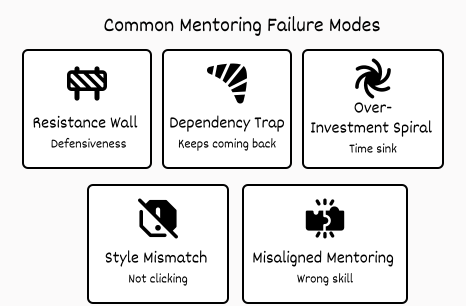
The Resistance Wall
Your colleague becomes defensive when you try to coach them. They shut down, they make excuses, and they dismiss any feedback you offer them. The relationship begins to fray because you try to initiate conversations to help them build new skills. Then the person you're trying to help starts avoiding you.
These sorts of responses happen when you haven't “earned the right” to offer to mentor a person, when your timing is off, or when your delivery feels like criticism to them rather than support. Sometimes the problem is that they don’t yet trust you. Other times, it might be their ego or fear of looking incompetent. Cultural differences in how people give and receive feedback can also create resistance.
Recovery starts with stopping. Don't try to fix the relationship by mentoring harder, because that's what broke it. Step back entirely and let the tension dissipate. Then rebuild through low-stakes helpfulness: answer a question in Slack, share a useful article, offer to pair on something they're stuck on. You're re-earning trust, not re-establishing a teaching relationship. Only after they're comfortable working with you again should you cautiously revisit any kind of coaching dynamic; and even then, ask first.
In interviews, showing that you know how to recover from setbacks to your mentoring attempts will show your emotional intelligence and adaptability. Strong candidates will show that they recognize when their approach isn't working and will adjust it rather than simply pushing harder.
The Dependency Trap
If the person you're helping keeps coming back for the same type of help, they're not developing independence; rather, they've developed a dependency on you. You answer their questions, they complete the task, then return with a nearly identical question the next day. This happens when you solve problems for people instead of teaching them how to approach problems. Maybe you give answers because it's faster. Sometimes you remove the productive struggle too early, preventing them from building their own problem-solving ability.
Shift from giving specific answers to teaching general frameworks. When they ask how to investigate an issue, respond with "What's your hypothesis?" and "How would you test that?" Teach the approach, not the solution. Gradually increase the space between check-ins so they have room to struggle productively. Celebrate their independent attempts, even when they’re imperfect. Document the frameworks you teach so they can reference them without coming back to you. The goal, and what interviewers want to hear, is that you understand that independence is the measure of success, not how often people seek your help.
The Over-Investment Spiral
You realize that you’ve been spending a disproportionate amount of time helping one person while the rest of your team has languished. The time investment has grown gradually, making it hard to notice until the imbalance has become problematic. Team members notice you're always busy with this person and wonder if their growth matters less to you. Other priorities have slipped because you've been too invested in helping this one individual. Even your own deliverables have begun to fall behind.
The sunk cost fallacy drives this damaging pattern. You've already invested significant time, so you reason that investing more will finally make it pay off. It becomes personal, and your judgment about the success of your efforts is clouded. You avoid the hard conversation about whether this person can succeed in their role.
To avoid falling into the over-investment spiral, set timelines with clear milestones. If someone doesn’t exhibit progress after reasonable investment, that's data. Involve others to create a support network so you're not the single point of dependency. Track the return on time spent compared to other ways you could build skills. Know when to escalate to management for performance conversations that may be needed. Remember that helping just one person well helps one person, but creating scalable talent development systems helps many people.
Structuring your support in this way shows judgment about resource allocation. Strong candidates will describe how they balance the needs of individuals with broader team and organizational needs.
The Style Mismatch
Your natural teaching method isn't working. You're putting in the effort, and your teammate is trying to learn, but they're not improving. Your go-to methods that have worked for others aren't clicking for this individual.
Different people have different learning styles. Some are visual learners; others learn through conversation. Some want theory first, and others need hands-on practice before concepts make sense to them. Cultural differences in communication affect how people process information. If you’re not sensitive to the differences of the people you’re teaching, you may find yourself teaching them in a manner that does not suit them.
Ask the people you are helping directly how they learn best. If your initial attempt does not seem to work, try a different approach. Find others who might connect better with this person. Be honest if you think you might not be the best fit for them. Sometimes the right move is to connect them with someone else.
Interviewers like to see evidence of your self-awareness and creativity and that you can adapt your methods to suit individuals rather than expecting everyone to learn your way.
Recognizing Problems Early
Watch for these warning signs that your talent development isn't working: repeated questions about the same topics, decreasing engagement in conversations, lack of observable changes in behavior, increasing time investment without progress, or the person seeming to humor you rather than genuinely learning.
When you notice any of these signs, pause and diagnose before investing more time. Ask the person if they think your involvement is helping. The best recovery may be admitting that your current approach isn't working, and regrouping.
The best stories include examples of both successes and thoughtful recoveries. Describing how you recognized a problem and adjusted your approach will show your maturity and adaptability, both qualities that interviewers value highly.
Interview Questions
Interviewers will explore your ability to develop others by asking questions that probe how you help others build skills. They want to know if you help grow independent, capable colleagues or you just answer their questions when asked.
Supporting Underperformers
- "Tell me about a time you helped an underperforming team member improve."
- "Describe a situation where someone on your team wasn't meeting expectations. What did you do?"
- "Give me an example of turning around someone's performance."
These questions test your ability to have difficult conversations and support improvement when it matters most. Interviewers want to see diagnosis before action. Do you seek first to understand the root causes of underperformance, rather than assuming there is a problem with motivation? Strong answers will show you giving clear feedback delivered with empathy, implementing tailored improvement plans with measurable milestones, and being patient with the person’s rate of improvement. Also, do you know when performance issues require management escalation, and do you appreciate that underperformance often signals missing skills, unclear expectations, or personal challenges rather than merely a lack of effort?
Helping People Grow
- "Tell me about a time you helped someone advance their career."
- "Describe how you've helped a team member build technical skills."
- "Give me an example of investing in someone's long-term growth."
These questions assess whether you understand the development needs of others and can create real growth opportunities. Interviewers want to see structured approaches to helping others advance, rather than ad-hoc mentoring. Strong answers will show you identifying specific growth areas in others, creating learning opportunities for them that will stretch their capabilities, and tracking their progress over time. This will show your willingness to invest in other people’s success beyond immediate project needs.
Giving Helpful Feedback
- "Give me an example of providing feedback that helped someone improve."
- "Tell me about a coaching relationship you've had with a team member."
- "Describe a time when you had to deliver difficult feedback to help someone grow."
When interviewers ask questions like these, they seek to evaluate your ability to give guidance that changes behavior. Your answers to these questions will show whether you can deliver constructive feedback effectively and adapt your approach to how people learn. Good examples will show you providing specific, actionable feedback, adjusting your coaching style to individual needs, and following through to ensure that there is improvement.
Cross-Functional Development
- "Tell me about a time you developed someone outside your direct technical domain."
- "Describe how you've helped non-engineers develop technical understanding."
- "Give me an example of mentoring someone in a different role than yours."
Strong answers to these questions will show your skill at translating complex details. For example, you can explain technical concepts without using jargon, you can employ relevant analogies, and you focus on practical application over textbook understanding. Good examples will show your patience with different learning styles and recognition that non-technical colleagues need different onboarding than engineers. You might describe helping a product manager understand why certain machine learning features need weeks of training data before they're useful, so they can set realistic launch timelines. Or teaching a designer that real-time notifications have a cost per user, so they can weigh notification frequency against infrastructure budget. Or showing an ops team how to read deployment dashboards so they can triage customer issues without escalating to engineering.
Remote and Distributed Development
- "How have you developed team members working remotely or across time zones?"
- "Tell me about adapting your mentoring approach for distributed teams."
- "Describe challenges you've faced developing people you don't see in person daily."
These questions assess whether you can build productive relationships without physical proximity. Strong answers will show intentional communication practices such as scheduled check-ins, written documentation, and async tools for knowledge-sharing. Good examples will show your creativity in providing teaching moments through recorded videos, async pair programming sessions, or written technical discussions. You might describe establishing a weekly technical blog on which remote team members shared their learnings, or creating a mentorship matchmaking tool to connect people across time zones. Interviewers want to see that you build relationships and trust before trying to develop people remotely, and that you understand the challenges that remote team members face relating to isolation, beyond just their technical work.
Building Stronger Teams
- "Tell me about building a team with complementary skills."
- "Describe how you've raised the technical bar on your team."
- "Give an example of creating systems that help everyone improve."
With these questions typically targeted at seniors and above, interviewers want to assess whether you think strategically about collective growth. They want to see if you build environments where people develop others through working together. The best stories will show you designing team structures that promote learning, creating practices that spread knowledge naturally, and helping teams become stronger than merely the sum of their individual members.
When Developing Others Gets Hard
- "Tell me about a time when developing someone didn't go as planned."
- "Describe helping someone who was struggling to improve."
- "Give an example of adapting your approach to developing someone when it wasn't working."
These questions are designed to assess your persistence and creativity when developing others gets difficult. Interviewers want to see you trying multiple approaches rather than giving up when your standard methods fail. Strong responses will show you diagnosing why an approach has stalled, trying different teaching methods, and sometimes accepting when someone might need support from someone other than you.
Key Signals
When evaluating your development skills, interviewers look for evidence that you build skills through structured approaches and that you don’t just share knowledge occasionally. The strongest candidates will show that they create lasting growth in individuals and teams.
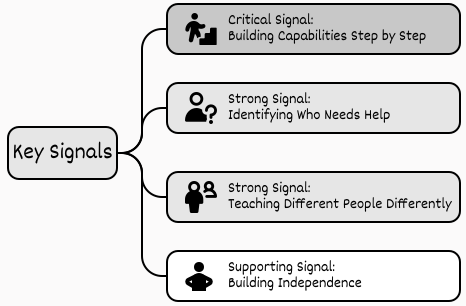
Critical Signal: Building Capabilities Step by Step
Effective development requires breaking complex skills into learnable pieces and creating experiences that build confidence alongside competence. Strong stories will show you identifying where a person is starting from, designing challenges appropriate to their level, and helping them progress through increasing complexity. Can you show an ability to turn struggling team members into independent problem-solvers?
Strong Signal: Identifying Who Needs Help
People who excel at developing others notice patterns in questions, gaps in approaches, and unrealized potential. Good examples will show you initiating conversations, identifying the need for growth before it becomes a limitation, and helping people see possibilities they hadn't considered for themselves.
Strong Signal: Teaching Different People Differently
Effective mentors and coaches adjust their methods based on each person's background, learning style, and motivations. Strong examples will show you recognizing when your default approach isn't working, trying different explanations when someone doesn't understand, and creating varied learning experiences to suit different personalities.
Supporting Signal: Building Independence
Success is achieved when people can solve new problems without you, not just repeat what you taught them. You should be able to show that you teach people how to think about problems rather than merely provide them solutions, and that you gradually reduce your support as they become more capable and confident.
Red Flags
We use Red Flags to describe serious issues that will significantly damage your candidacy and Yellow Flags for concerning patterns that will weaken your examples.
Many candidates confuse simply helping people with developing talent, thus undermining their stories. Understanding the following differences will help you focus your answers on examples of up-leveling others.
Red Flag: Giving Answers Instead of Building Skills
Solving problems for people is helpfulness, not talent development. If someone repeatedly comes to you with the same type of question, that is an indication that you're creating dependence. Success means people are able to handle subsequent similar challenges on their own. Focus on telling stories that describe your teaching approaches and frameworks, not just meting out solutions.
Yellow Flag: Development Without Business Context
Teaching skills that are unrelated to a person’s actual work needs suggests that you prioritize learning for learning’s sake over results. Talent development bandwidth is limited, so it should be applied to address the real challenges that teams face. Connect your efforts to specific problems that the team needed to solve or capabilities that the organization sought to develop.
Yellow Flag: Surface Teaching Without Depth
Running training sessions or sharing documentation without confirming that there was a subsequent growth in capability suggests incomplete development. Exposure to information isn't the same as developing skills. Include in your stories evidence that people improved. Were they now able to solve new problems? Did they take on new responsibilities? How did the quality of their work increase?
Yellow Flag: Taking Credit for Natural Growth
Claiming responsibility for growth that would have happened anyway weakens your credibility. People naturally improve with experience, so you need to demonstrate that your specific contribution went beyond what would have happened naturally. Therefore, focus your stories on breakthrough moments that you facilitated or the abilities that people developed as a consequence of your specific intervention.
Example Stories by Level
Developing others becomes a significant expectation for roles starting at the senior level. While junior and mid-level engineers might help their teammates informally, companies will typically look for evidence of talent development capabilities when evaluating for senior-plus roles. This competency is also especially important for promotion to staff and principal levels, where your impact increasingly comes via scaling through others rather than just your individual contribution.
Senior-Level Example: Building Technical Investigation Skills
Question: "Tell me about a time you helped someone develop their technical skills."
Headline: "Earlier this year, I helped a mid-level engineer get up to speed in record time for our complex financial calculation engine."
Key Point 1: "A new engineer joined our team working on high-frequency trading software. He had strong coding skills but struggled when bugs appeared in our concurrent calculation engine. I noticed he kept asking the same types of questions about race conditions and precision errors. He'd stare at thread dumps without knowing where to start. Rather than just answering each question each time, I saw he needed to learn how to debug concurrent systems, not just fix individual bugs."
Key Point 2: "I started by having him shadow me while I debugged a race condition in our order matching logic. I explained my thought process out loud as I used debuggers to examine thread states and trace execution paths. Next, we paired on simpler issues. I got him to do the debugging while I asked guiding questions. We progressed from single-threaded calculation errors to race conditions to complex state corruption problems. Each session built on the last, gradually increasing in complexity as his confidence grew."
Key Point 3: "Instead of solving problems for him, I taught him patterns. When he hit issues, I'd ask 'What's your hypothesis?' and 'How would you test that?' I showed him how to use thread sanitizers, interpret stack traces, and recognize common concurrent programming bugs. By month three, he was debugging complex issues independently and had created an onboarding guide for future team members."
Landing: "He went from being overwhelmed to becoming our team's go-to person for tricky issues. Five months later, he diagnosed a subtle race condition that had been causing intermittent trading discrepancies for weeks."
Staff-Level Example: Data Engineering Capability-Building
Question: "Describe how you helped build capabilities across your organization."
Headline: "I helped our product teams develop data engineering skills when our company’s data needs exploded but we couldn't double the size of that team."
Key Point 1: "As a staff data engineer, I saw that our product teams were waiting for weeks for data pipeline changes while our team was busy handling critical infrastructure migrations and real-time analytics for critical business metrics. We couldn't hire our way out of this problem. The data team needed to focus on this high-impact platform work, not routine, but still important, pipeline requests. Our product engineers had the technical skills to write code, but they lacked knowledge about modeling, pipeline reliability, and analytics patterns. Each team was making the same basic mistakes with schemas and data quality. I realized we needed to enable them to meet their own data needs."
Key Point 2: "I created the Data Engineering Toolkit, a resource with different learning paths tailored to the needs of different teams. Backend teams who understood distributed systems learned through building streaming pipelines using familiar patterns. Teams dealing with transactional data started with dimensional modeling before moving to pipeline concepts. For teams that learned best through problems, I created data quality challenges based on real incidents. Some engineers preferred theory first, so I ran sessions on slowly changing dimensions and data warehouse patterns. Thus, each team developed the same capabilities through methods that matched their existing systems."
Key Point 3: "The program built skills progressively over four months. Month one covered SQL optimization and window functions using their actual data. Month two introduced data modeling through redesigning their team's schemas with proper fact and dimension tables. Month three taught pipeline building, starting with simple batch jobs and progressing to handling late-arriving data. The final month covered data quality monitoring and debugging pipeline failures. Each stage included real work on their team's data problems, with peer reviews to share learnings across teams."
Landing: "Eight product teams developed strong data engineering capabilities through the program I had developed. Data request backlogs dropped by 65% as teams built their own pipelines for their standard needs. This meant that the data team could focus on platform improvements and complex analytics that drove business decisions. The product teams now catch data quality issues during development rather than in production reports. The peer review network continues today, with teams sharing data modeling patterns and pipeline solutions. "
Principal-Level Example: Building Organizational Talent Development
Question: "Tell me about how you transformed how your organization develops technical talent."
Headline: "I convinced leadership to invest in technical leadership development and built a program that enabled us to scale our organization from 60 to 300 engineers."
Key Point 1: "As we scaled rapidly, I noticed a pattern developing. We had excellent individual contributors, but few could lead complex technical initiatives or develop others effectively. Senior engineers struggled with architectural decisions affecting multiple teams. They solved problems well in their domain, but they didn't know how to build consensus or teach strategic thinking. I documented the impact through failed cross-team projects, repeated architectural mistakes, and senior engineers leaving because they didn't see pathways for growth. I presented this data to our VP of Engineering, making the case that developing technical leadership was as critical as hiring."
Key Point 2: "With VP sponsorship and budget secured, I assembled partners to design the Technical Leadership Fellowship. I brought in our most effective principal engineers to define core technical leadership competencies. I partnered with an external leadership coach who specialized in engineering organizations. My contribution was analyzing our past technical successes and failures to identify the specific leadership capabilities we'd need for upcoming challenges, for example, scaling internationally and building new product lines. I ran the case study sessions myself, using our actual technical decisions as teaching materials. The six-month program selected twelve high-potential senior engineers as fellows. They presented technical decisions to senior audiences, led cross-team initiatives without formal authority, and developed others through complex projects."
Key Point 3: "We designed multiple learning approaches into the program. I ran architecture case study sessions for systems thinkers using our company's real technical decisions. The external coach provided one-on-one sessions for engineers struggling to develop influencing skills. We created peer learning cohorts where fellows would share their experiences and challenges. When fellows had specific gaps, we connected them with leaders who had previously overcome similar challenges. For example, when an infrastructure engineer struggled with product thinking, we paired them with a leader who'd made that transition in the past. The program adapted to the needs of individuals while maintaining consistent outcomes."
Landing: "The fellowship has developed 24 technical leaders across six engineering domains, with 18 taking on significant leadership roles. The VP who sponsored the program credits it with enabling our growth from 60 to 300 engineers while maintaining our technical excellence. Return on investment was evident through a reduction in the number of project failures, faster architectural decisions, and improved retention of senior engineers. Fellowship alumni now run scaled-down versions of the program within their sub-organizations, thus multiplying the impact."
If Examples Don't Come Easily
You don't need "manager" in your title to have great talent development stories. Think about when you helped a struggling teammate finally understand a concept they'd been fighting with. Or when you created documentation that became the team's primary resource for onboarding. The patience you showed to explain something differently for the fifth time before it clicked might be exactly the example you need.
Have you ever taught someone a skill that made them independent in an area where they had previously needed help? That shows you can build lasting skills. Have you created learning opportunities that have stretched people beyond their comfort zones? That shows thoughtful development. Have you helped someone transform from struggling to a strong contributor? If you have invested in the growth of other people and seen them succeed, you have demonstrated strong talent development skills.
Reflection Questions:
- When have you helped someone master a skill they initially struggled with?
- What systems or resources have you created that have helped multiple people learn?
- Have you adapted your teaching approach for different learning styles?
- When did you identify opportunities for growth that others hadn't recognized in themselves?
- What development have you provided while managing your own deliverables?
- Have you helped people work through confidence issues or imposter syndrome?
- When have you turned your expertise into teachable frameworks?
- What lasting skills have you built in team members?
- Have you developed others informally without formal mentoring relationships?
- When did investing in someone's growth pay off in unexpected ways?
Key Takeaways
Developing others means building lasting abilities rather than creating dependencies. Your goal is independence, not helpfulness. Effective talent development requires you to adapt your approaches to individual learning styles and needs and understand that what works for one person may confuse another. You must balance immediate efficiency with long-term team growth, discerning when to solve problems quickly and when to invest in teaching. At senior levels, your impact comes through creating systems and resources that can develop many people simultaneously, not just through one-on-one mentoring.
Strong Developing Others Stories Include:
- Evidence of helping people become independent in areas in which they had previously struggled.
- Examples of adapting approaches for different people.
- Clear progression, showing how people grew over time.
- Creation of reusable learning resources or systems.
- Balance between individual mentoring and scaling through others.
Avoid These Traps:
- Don't describe merely giving answers without building skills.
- Don't use one-size-fits-all approaches to growing others.
- Don't focus only on star performers while ignoring struggling team members.
- Don't claim credit for natural growth that would have happened anyway.
- Don't develop others at the expense of your own deliverables.
Strategic Leadership and Thinking Big
Strategic Leadership and Thinking Big
As a staff engineer, Ethan noticed that three different teams across his organization had each built their own infrastructure for the same purpose. The mobile team had a feature flagging system. The web team had A/B testing infrastructure. The data team had an experimentation platform. The names were different, but all three systems largely did the same thing. They controlled which users saw which version of a feature, and they tracked how those users responded. Each solution worked well for its own domain, but the company was solving the same core problem three different ways.
Ethan analyzed the situation more deeply. He discovered that while the implementations looked different on the surface, all three teams were trying to answer the same question: How do you safely test changes and measure their impacts? The teams had valid reasons for their custom solutions, especially since they had each been built at different times in the past, but they were making incompatible architectural decisions that would prevent them from running experiments across products or sharing learnings between teams.
Over the next eight months, Ethan worked with engineering leadership and team leads to build a unified experimentation platform. Rather than forcing teams to abandon their existing solutions, he created an architecture that could absorb the best ideas from each team's approach while providing consistent capabilities across the company. He focused on showing teams how shared infrastructure would help them move faster.
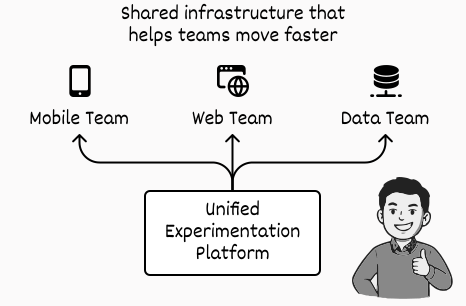
The unified platform changed how the company made product decisions. For the first time, teams could run experiments that spanned mobile, web, and data products simultaneously. A pricing test that used to take three teams two weeks to coordinate now took one team a single day. Within a year, cross-product experiments had become the norm, and the data they produced drove two major product pivots that leadership credited for the company's strongest growth quarter. Ethan hadn't just consolidated three tools; instead, he'd given the company a capability it didn't know it lacked.
What Does It Mean to Lead Strategically and Think Big?
Strategic leadership is the ability to see how separate problems connect and then get people working together to solve them. Thinking big is about the size of what you aim for, for example, choosing to rebuild a system instead of patching it, or creating a new capability instead of optimizing an existing one. Strategic leadership is how you lead change. Thinking big is how ambitious that change is. You need both: thinking big without strategic leadership produces big ideas that never ship. Strategic leadership without thinking big produces well-executed work that doesn't move the needle.
These two skills often appear together, but they're distinct. Say you notice that every team in your organization has built its own flavor of deployment pipeline, five teams, five different pipelines, all doing roughly the same thing. Recognizing that pattern and understanding why it's costing the company is strategic leadership. Proposing that the company invest in a shared deployment platform that replaces all five, and then getting buy-in from each team lead, is thinking big. The strategic leadership is seeing the problem. The thinking big is choosing the ambitious path instead of the safe one.
Tech companies treat these as make-or-break skills for senior roles. Amazon's "Think Big" leadership principle explicitly asks whether leaders can see opportunities beyond their immediate scope. Stripe's engineering culture rewards people who find leverage points, which are places where one change improves multiple systems at once. Google's promotion criteria at staff level and above expect candidates to show they've driven technical direction that shaped work well beyond their own teams. These companies know that the people who spot cross-cutting problems and rally others to solve them will create far more value than those who optimize only within their own areas.
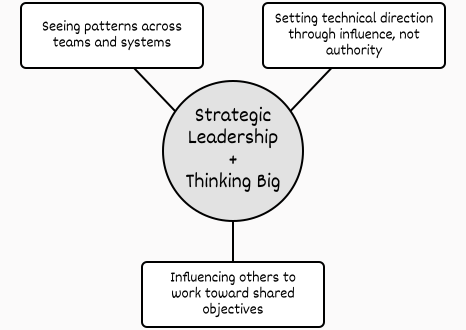
The Essence of Strategic Leadership and Thinking Big
Most people solve the problem in front of them. Strategic leaders see that the problem in front of them is connected to four others across the organization, and that all five share a root cause that nobody has spotted because each team sees only its own symptom. They know that fixing symptoms is a waste of energy because the real problem is somewhere deeper. Thinking big is what happens next. Instead of making things 10% better, they propose a different approach, and then they get other people excited enough to help build it. The best strategic leaders don't just have the vision. They're catalysts who make the vision feel urgent and achievable to everyone around them.
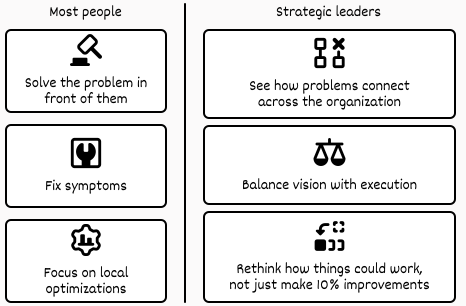
Vision without execution is just daydreaming. But playing it safe and doing only what you're sure will work means you never change anything important. The best strategic leaders do both. They paint a clear picture of where things should go, and they know how to get there. That "getting there" part is the hard skill. It means seeing the dependencies between teams that nobody else has mapped, knowing which team to convince first, understanding what blockers will kill momentum, and managing the politics that come with any cross-org change. People who can do this are rare, and companies know it.
The other skill that separates strategic leaders is sequencing. Seeing the right destination isn't enough, because you need to know what changes to make, in the right order. Which team do you bring on board first? What early win will build momentum for the harder changes later? What's the one thing that will fail loudly if you don't address it before everything else? Strategic leaders think several moves ahead. They pick the order that maximizes adoption and minimizes resistance, and they know which fights matter and which ones to skip.
Every big change hits resistance. People are comfortable with the way things work, and they have real reasons to push back. For example, your initiative threatens their roadmap, or adds migration work, or forces them to learn something new. Strategic leaders expect this. They don't take resistance personally, and they don't try to bulldoze through it. Instead, they find the one team that's hurting enough to try something different. Then they help that team succeed visibly and use that success story to bring the next team along. This is how cross-org change works: not as a single announcement that everyone adopts, but as a chain of proof points that builds momentum until opting in becomes the obvious choice.
Cultural and Organizational Considerations
How companies value and express strategic leadership varies based on their market position and appetite for change. While some companies thrive on constant change, others place greater value on stability. Understanding these differences between companies will help you show these skills appropriately at interviews.
Tech Giants and Platform Companies: Strategic thinking at these places means identifying opportunities that will affect millions of users and billions of dollars in revenue. These companies value leaders who can think at a massive scale while understanding the complexities of implementation. Success requires balancing bold ambition with the realities of coordinating across huge organizations. The skill is creating strategies that individual teams can execute while maintaining coherent company-wide direction.
Startups Scaling Up: Strategic leadership at a startup entails building foundational systems while maintaining agility. A startup values people who can envision what the company needs at 10x scale as they solve today's problems. Success comes from creating structures that enable growth without constricting innovation. The challenge is knowing which processes to formalize and which areas of flexibility to preserve.
Traditional Companies Transforming: Strategic leadership here respects what works while driving necessary change. These organizations value people who understand their existing strengths and can build change plans that will bring along even the skeptics. Success requires patient leadership that proves value incrementally while maintaining a clear picture for larger change.
Mission-Driven Organizations: A strategic leader at a mission-driven organization needs to be able to connect technical work to broader impact. These companies value people who can articulate how strategic changes will promote the mission. Success in these environments comes from inspiring others with possibility while building practical paths forward, maintaining idealism while navigating real constraints.
Cultural Background Considerations: Companies differ in how they expect strategic change to happen. Some value consensus-building and careful sequencing, for example, big changes get proposed gradually, with broad buy-in at each step. Others reward bold proposals and expect leaders to move fast, even before everyone agrees. Research your target company before the interview. If they value consensus, frame your stories around how you built alignment. If they value speed and boldness, emphasize the ambition of your vision and how quickly you drove adoption. The goal is to match your stories to how the company operates, not to change who you are.
Related Competencies
Strategic Leadership vs. Innovation: Innovation focuses on creating novel solutions to specific problems. Strategic leadership recognizes which innovations will reshape how organizations work and builds support for their adoption. You might innovate by creating a new technical approach, but strategic leadership sees how that approach could change how your entire company works, and it drives that change.
Strategic Leadership vs. Delivery: Delivery emphasizes shipping work despite the presence of obstacles. Strategic leadership ensures teams deliver the right things in the right sequence to achieve meaningful change. You need delivery skills to complete projects, but strategic leadership determines which projects will move the company toward its vision. Leaders who can't deliver are dreamers, and delivery without strategy creates motion without progress.
Interview Questions
Interviewers assess strategic thinking by asking you questions that probe your ability to see big-picture opportunities and drive meaningful change. They want to assess whether you can identify and lead their organizations toward big-picture visions.
Seeing the Big Picture
- "Tell me about a time you identified an opportunity to transform how your organization approached a major problem."
- "Describe identifying a pattern across teams that suggested a bigger opportunity."
- "Give me an example of connecting separate problems across different teams to find a larger solution."
These questions test whether you are able to see when individual issues reveal bigger opportunities. Interviewers want to see evidence of pattern recognition that goes beyond you or your team’s immediate scope. Strong answers will show you identifying connections that others miss, understanding how different parts of the company interact, and identifying leverage points where changes would create widespread impact.
Leading Change
- “Give me an example of aligning multiple teams around a new technical direction."
- "Tell me about driving a significant change across your organization."
- "Describe setting a technical direction that shaped how teams outside your own built their systems."
These questions are designed to probe your ability to turn vision into reality through effective leadership. They assess whether you can build support for new directions and implement them successfully. Good examples show you understanding what different teams and leaders care about, building strong cases for change, and creating and sustaining momentum through challenging implementations.
Creating Broad Impact
- "Describe a technical decision of yours that had organization-wide effects."
- "Tell me about your work changing how others approached similar problems."
- "Give an example of establishing practices that spread beyond your team."
Interviewers want to evaluate whether your strategic thinking creates lasting company-wide value. They want to see evidence of impact that scales beyond individual projects. Effective stories will describe transformation that outlasts your direct involvement, capabilities that multiply across teams, and approaches that are adopted because they work better than those that preceded them.
Making Strategic Trade-offs
- "Tell me about a time when you had to choose between two valuable initiatives when you could only implement one of them."
- "Describe a time when you decided not to pursue a potentially valuable transformation because the timing or approach wasn't right."
- "Give me an example of balancing short-term needs with long-term vision."
These questions are used to probe your judgment about what and when things are worth pursuing. Interviewers are assessing whether you can make realistic decisions about change efforts. Strong responses will show your ability to weigh up company readiness, resource constraints, and competing priorities.
Key Signals
When evaluating strategic leadership, interviewers look for evidence that you can spot big opportunities and get others to pursue them. The strongest candidates will show that they think beyond immediate problems to bigger improvements.
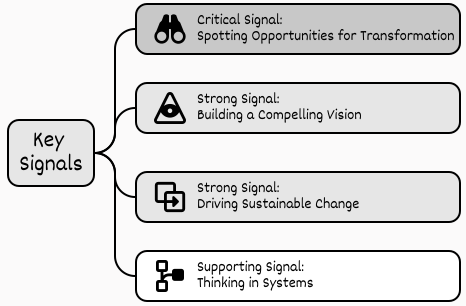
Critical Signal: Spotting Opportunities for Transformation
Strategic leaders spot problems that cut across teams, problems that nobody owns because they live in the gaps between groups. They connect what look like unrelated issues to a shared root cause, and they make the case that fixing the root cause is worth more than patching each symptom separately. Your credibility here comes from showing you understand both the technical details and the business stakes. In your story, show that you saw something that others had missed, that you convinced teams you didn't control to work toward your direction, and that the result was a real change in how the organization worked, not just a proposal or a presentation.
Strong Signal: Building a Compelling Vision
Strategic leaders translate complex system understanding into a clear direction that others can follow. Good examples will describe you creating narratives that connect current pain to future possibilities, building coalitions around a shared vision, and maintaining clarity as details evolve. You make the big picture concrete enough to work toward.
Strong Signal: Driving Sustainable Change
Vision without execution isn't strategic leadership. Effective examples will show you sequencing changes for maximum adoption, building systems that reinforce new approaches, and building things that keep working after you move on. You show an ability to turn bold ideas into real results.
Supporting Signal: Thinking in Systems
Strategic thinkers are skilled at seeing the second- and third-order effects of changes. You show mapping dependencies before making changes, anticipating ripple effects across teams, and providing solutions that improve the whole system rather than optimizing locally.
Red Flags
We use Red Flags for serious issues that will significantly damage your candidacy and Yellow Flags for concerning patterns that weaken your examples.
Many candidates confuse tactical improvements with strategic leadership, thus weakening their stories. Understanding these differences will help you show genuine big-picture thinking in your interviews.
Red Flag: Local Optimization Disguised as Strategy
Improving your own team's process is good work, but it's not strategic leadership. Calling it that in an interview will hurt you. The red flag isn't that local improvements are bad; it's that candidates sometimes dress them up as something bigger than they are. If your change affected only your team, own that honestly and use a different example for the strategic leadership question. Strategic leadership stories need to show impact across multiple teams or systems. A change that stayed within your team's boundaries, even if it’s a great one, doesn't demonstrate this competency.
Yellow Flag: Vision Without Implementation
Describing big ideas that were never realized shows incomplete strategic leadership. Anyone can imagine better futures, but strategic leaders make them happen. If your stories end with proposals or presentations rather than implemented changes, you're showing strategic thinking without leadership. You need to tell the interviewers how you turned your vision into organizational reality.
Yellow Flag: Change Through Authority Rather Than Influence
Forcing changes because of your position rather than through building genuine buy-in reveals shallow leadership. Sustainable transformation requires people to believe in new approaches, not just comply with directives. Stories that focus on mandating changes will suggest to your interviewers that you may not be able to create real alignment. Therefore, show them how you have helped others to see the value of moving in new directions.
Yellow Flag: Complexity Without Clarity
Using elaborate frameworks or jargon to describe your strategic thinking will obscure rather than illuminate your vision. If you require extensive background or multiple diagrams to explain your strategy, you haven't achieved strategic clarity. Great leaders make complex changes feel simple and intuitive. Show your interviewers how you communicated your direction in ways that everyone could understand and act on.
Yellow Flag: Putting Strategic Labels on Tactical Work
Calling every improvement "strategic" dilutes the meaning of the word. Not all good work is strategic. Interviewers can tell the difference between team-level improvements and organizational change. Therefore, focus your strategic leadership stories on the times you truly changed how your organization worked.
Example Stories by Level
Senior-Level Example: Transforming Design Review Process
Question: "Tell me about a time you saw an opportunity to fundamentally improve something."
Headline: "I transformed our design review process after I realized that our late-stage architecture discussions were jeopardizing our project deadlines."
Key Point 1: "Our team kept hitting the same problem. Developers would code for days, submit pull requests, then discover fundamental design issues during code review. I saw engineers rewriting entire features after lengthy review discussions about architecture choices. When I analyzed our recent projects, over half had required significant rework due to design feedback during code review. The issue wasn't the quality of the code or decisions; it was timing. We were having architecture discussions after implementation instead of before. This pattern was wasting weeks of effort every month."
Key Point 2: "Therefore, I proposed separating design reviews from code reviews entirely. Before writing any code, developers would share a brief design document outlining their approach. This wasn't heavy documentation, just key decisions and trade-offs in a page or two. I showed the team how our three most painful recent rewrites could have been avoided with a light upfront design discussion. The junior developers were especially excited because they would now get feedback early, before potentially spending days working on the wrong approach. The senior developers saw how this would reduce their review burden since they'd only need to check the quality of implementation, not question the fundamental design choices."
Key Point 3: "We started with a one-month experiment on my team. I quickly identified which engineers struggled with written communication and paired them with stronger writers for their first few design docs. Some needed templates, others needed examples of good design docs from past projects. This strategic investment in writing skills paid off as the engineers became better at articulating their technical decisions. Adjacent teams noticed our improved velocity and started asking about our process. I helped three neighboring teams adopt similar practices, each adapting the format to their needs. Within a quarter, design reviews had spread to five teams across our organization."
Landing: "Rework and lengthy code review conversations due to architectural issues have now nearly disappeared across all teams using these early design reviews. Junior developers have grown their skills faster because they got architectural guidance early and improved their technical writing skills. The practice continues to spread organically as other teams see the benefits and begin to adopt the same approach."
Staff-Level Example: Standardizing Developer Experience Across Teams
Question: "Describe a technical decision that you made that had a broad organizational impact."
Headline: "I standardized how every team at our company built and exposed their services, which was a painful process, but it unlocked our entire partner program."
Key Point 1: "Every product team had developed their own API patterns over the years. We supported multiple protocols, which was fine, but the real mess was in the details. Error codes meant different things across services. Some APIs used snake_case, others camelCase. Rate limiting worked differently everywhere. Authentication had four different patterns. New developers needed weeks just to learn and understand our integration surface. I mapped out these inconsistencies and realized they would eventually become critical blockers, as we planned to double our API traffic and launch partner integrations. We needed consistency in API behavior, regardless of protocol."
Key Point 2: "I recognized that forcing sudden standardization would disrupt every team's roadmap. Instead, I designed a phased consistency campaign. Phase one focused on ensuring that new APIs followed consistent patterns. Phase two would gradually migrate existing APIs, prioritizing those used by multiple consumers. I created clear standards for error handling, pagination, rate limiting, and versioning that worked across REST, GraphQL, and gRPC. The standards focused on behavior and developer experience, not forcing technical uniformity. I mapped how this would reduce integration time, improve partner adoption, and enable future API gateway features."
Key Point 3: "The campaign started rough. Teams resisted changing their working APIs, and I understood why. They had full roadmaps and no reason to prioritize my initiative over their own goals. I needed to make standardization count for them, so I worked with engineering leadership to get API consistency recognized in quarterly planning, so participating teams could point to cross-org impact. I built migration tools that automated the tedious work. And I started with teams already drowning in integration support questions, since standardization would directly reduce their burden. Thus, those early adopters became champions. When our mobile team cut their error-handling code in half, other teams started asking to join the next wave of implementation. I established API review checkpoints during the design phase to catch any new inconsistencies. The real breakthrough came when our first external partner integrated without asking a single question."
Landing: "The 18-month consistency campaign standardized behavior across 200+ APIs. Several partners achieved completely self-service onboarding, something unthinkable before the project, when every integration would require weeks of support. The upfront investment in consistency paid off massively when we launched our public API program the following year."
Principal-Level Example: An Engineering Tool Revolution
Question: "Tell me about a time when you drove a significant change in your organization."
Headline: "I led our migration from proprietary tools to industry standards after I recognized that our ten-year-old infrastructure had been holding back our engineering organization."
Key Point 1: "With 400 engineers, we had built extensive in-house development tools over the past ten years. Our custom build system, testing framework, deployment tools, and dependency management had been innovative when they were created, but they were now seriously outdated. Our proprietary stack created a talent problem on both ends. New hires took months to learn our unique tools and become productive. And our experienced engineers had to weigh whether investing years in non-transferable skills was worth it, and some had decided to leave. Our tools required constant maintenance just to keep running, while comparable industry tools had advanced two generations ahead. I realized that we needed to migrate to modern, standard tools to remain competitive in hiring and productivity."
Key Point 2: "I developed a vision for adopting industry-standard tools while preserving our unique development workflows. I showed the engineers how using widely adopted tools would accelerate their career growth and learning. I demonstrated to leadership how we could innovate faster by leveraging community-driven tools rather than maintaining everything ourselves. To team leads, I explained how standard tools would reduce onboarding time from three months to three weeks. The vision resonated because everyone saw personal benefits as well as technical improvements."
Key Point 3: "I knew our teams would resist migration unless someone tackled the hardest technical challenges first. I personally led the effort to migrate our most complex build system components, dealing with the gnarliest edge cases and performance optimizations. When the teams saw me debugging build cache issues at midnight and creating migration tools that preserved their custom workflows, they trusted that this transformation would succeed. My hands-on involvement with the difficult problems enabled other senior engineers to confidently take ownership of their team's migrations. This divide-and-conquer approach worked because I'd built credibility by solving the scariest technical challenges myself."
Landing: "The migration to industry-standard tools took a year, but it transformed our engineering culture. Build, test, and deploy cycles dropped from 45 minutes to 10 minutes on average. New hire productivity increased dramatically in their first month. We redirected 15 engineers from tools maintenance to product development. Engineering attrition dropped by nearly half, and exit interviews with those who did leave showed that none cited the legacy toolchain as a factor anymore. The transformation succeeded because addressing the hardest technical problems first built the trust that was needed for widespread change."
If Examples Don't Come Easily
Strategic thinking doesn't require a C-suite position or company-wide initiatives. Perhaps you noticed three teams solving the same problem differently and proposed a shared solution. Or you saw how a small technical decision would cascade into bigger problems months later and convinced others to take a different path. Moments like these, of seeing beyond immediate concerns to larger patterns, often provide strong strategic leadership examples.
Look for evidence of strategic leadership in how you've influenced beyond your immediate scope. Have you ever recognized patterns across teams that suggested better ways of working? That shows systems thinking. Have you built consensus for changes that have affected multiple groups? That shows leadership without authority. Have you envisioned possibilities that others couldn't see and helped make them real? If you've driven meaningful improvements by thinking beyond just the immediate problems, you have demonstrated strong strategic leadership.
Reflection Questions:
- When have you identified patterns that have revealed larger opportunities for improvement?
- What changes have you driven that have affected multiple teams or systems?
- Have you built coalitions to implement ideas that others had initially resisted?
- When did you envision a better future state and create a path to reach it?
- What strategic improvements have you championed while managing your regular work?
- Have you connected separate initiatives to create a bigger impact?
- When have you influenced technical direction beyond your immediate team?
- What organizational capabilities have you helped to build?
- Have you turned small improvements into broader transformations?
- When did thinking systemically reveal opportunities that others had missed?
Key Takeaways
Strategic leadership stories should show you spotting problems that cut across teams, building a vision for how to fix them, and getting people on board to make it happen. Strong stories demonstrate that you think beyond your immediate scope and you see how separate issues connect. You know the right order to make changes, and you can get buy-in from teams you don't control. Thinking big means choosing the ambitious path when the safe, incremental option would have been easier. The best candidates show that they had a bold vision, and they knew how to turn it into reality.
Strong Strategic Leadership and Thinking Big Stories Include:
- Clear vision of a better future state and why it mattered.
- Evidence of building consensus and getting support across multiple stakeholders.
- Examples of sequencing changes for successful adoption.
- Evidence of systems thinking and understanding ripple effects.
- Balance between ambitious vision and practical implementation.
Avoid These Traps:
- Don't confuse local optimization with strategic thinking.
- Don't present vision without showing the path to implementation.
- Don't describe forcing change through authority alone.
- Don't focus only on technical strategy without organizational impact.
- Don't claim lasting change without giving evidence to back it up.
Nailing the Interview
Nailing the Interview
You've built strong stories using the High-Signal Storytelling (HSS) framework from Chapter 3. You've matched them to the level you're targeting. Now comes the critical moment: the interview itself.
You're not going to perform a rehearsed monologue at the interview. You'll be having a genuine dialogue with your interviewers, and you will need to present to them your capable, authentic, professional self.
It is possible to sabotage months of preparation with an hour of poor delivery. Many candidates recite memorized scripts that sound robotic. They panic if they’re interrupted. And they miss the signals from the interviewers about what matters most to them.
This chapter will teach you to deliver your stories smoothly while maintaining the structure that makes them powerful. You'll learn how to be fully present in the conversation, handle whatever comes your way, and communicate effectively under pressure.
This chapter covers three phases: before, during, and after the interview.
Before the Interview
The work you do before stepping into an interview determines how well you'll perform during it. This preparation is more than putting together stories and memorizing them. You also need to prepare your mind and body, think about logistics, and plan to arrive with time to spare.
Preparing Your Mind and Body
Your brain needs the right conditions to perform well in high-stakes conversations. Technical interviews demand quick thinking, clear communication, and sustained focus. You can't achieve this with poor sleep and three cups of coffee.
The Night Before
Aim for seven to eight hours of sleep. Your ability to think clearly, recall details, and adapt to unexpected questions degrades significantly if you’ve had insufficient sleep. (If poor sleep is a chronic issue for you, consider addressing your sleep quality in the weeks and months leading into interviews as a core aspect of your preparation.) The night before your interview, wind down earlier than usual. Avoid looking at any screen for an hour before you go to bed. Consider meditation to calm your mind. If you know you won't hit the full seven to eight hours, don't stress about it. Do the best you can, and focus on the other aspects of your preparation that you can control.
Set up everything the night before to avoid unnecessary stress in the morning. Lay out what you are going to wear. Test your technology, if it’s a video interview. If it’s in person, plan your route. There is a detailed checklist later in this chapter (see Final Logistics and Setup).
These small preparations will free your mind to focus on the conversation itself.
The Day Of
Stick to your normal eating routine. If you're a breakfast eater, include protein and complex carbohydrates to maintain your energy through the interview. If you typically skip breakfast and function well without it, don't force yourself to eat just because it's interview day. Your goal is to avoid a dramatic change to your routine.
Time your caffeine intake and hydration carefully. You want to be alert but not jittery. If you normally drink coffee, have your normal amount at your normal time. Interview day isn't the time to experiment with triple espressos or energy drinks. Drink water steadily throughout the morning, but not so much that it makes you want to use the bathroom all the time.
Light physical activity helps many people think more clearly. Take a short walk before your interview. Do some gentle stretches. The purpose is to get your body and mind connected. Movement helps dissipate nervous energy and improves focus.
Being Present
The difference between good and great interviews often comes down to presence. When you're fully engaged in the conversation, you can more easily pick up on what matters to the interviewers. You find it easier to adapt your stories to their interests, and you’re able to think more clearly about your answers to follow-up questions.
Presence starts with breathing. When we're nervous, we breathe shallowly, from our chest. This reduces the quantity of oxygen flowing to the brain, which can amplify any anxiety we may have. Before the interview, take five deep belly breaths. During the interview, use transitions between questions to take a deep breath. This simple practice will help to keep you grounded.
Listen with your whole attention. When the interviewer asks a question, resist the urge to immediately start formulating your answer. When they finish, take a beat to make sure you have understood what they're asking. This pause may feel long to you, but it suggests to them that you’re being thoughtful. Better to take three seconds to process the question and prepare your answer than to misinterpret the question or answer the wrong one entirely.
Be curious about the interviewers and the role. If you know the names of your interviewers beforehand, review their LinkedIn profiles or any public information about their work. This helps you to ask them informed questions and find points of connection with them. Real curiosity about their work comes through naturally. Good questions make for better conversations because you're not trying to pass a test; you're figuring out whether this role fits your career goals. Even if you leave the interview knowing that the role and the company would not be a good fit for you, you can consider it to have been a successful interview for that reason.
Making a Strong First Impression
People form judgments within seconds of meeting you. That might seem unfair, but first impressions shape how interviewers hear everything that follows. A strong first impression is a good starting point, and it will create a positive lens through which they evaluate your stories. Give a weak first impression, and you’ll be working uphill to change their initial assessment.
Your intent should not be to manipulate or deceive. You want to show up as your genuine professional self in a way that helps the interviewers see you in a positive light from the start.
Three elements help to influence and build upon first impressions in interviews: appearing sharp, being enthusiastic, and projecting a sense of expertise.
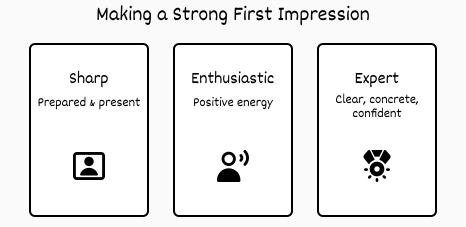
Sharp: Preparation and Presence
"Sharp" means you look well put together and well prepared. You’re well-groomed and wearing the appropriate attire. For video interviews, this means the lighting is good, and there is a clean background. You’ve checked that the audio quality is good, and the camera has been set at your eye level. For in-person interviews, arrive before time (but not excessively early), bring relevant materials with you, and project confidence.
Just as important, you need to be mentally present from the first moment. Make eye contact when you greet the interviewer. Offer them a firm handshake (if it’s an in-person interview). Sit up straight, because that signals you're ready to engage. These small signals communicate that you will be taking this conversation seriously.
Enthusiastic: Energy and Engagement
By projecting enthusiasm, you are signaling that you want to be there and are actually interested in the role. This doesn't mean forced cheerfulness or over-the-top excitement. Approach the conversation with positive energy and show the interviewer that you are interested in what they have to say.
Your tone of voice matters more than you might think. Speaking in a monotone will suggest that you are disengaged. On the other hand, if you speak in a varied tone with the right level of intensity, you’ll show that you're present and engaged. Watch for uptalk (i.e., your sentences ending with rising inflection, as if asking a question), as this can suggest uncertainty. Make your statements sound like statements.
Don't sit on your hands or fold your arms in front of you. Place your hands on your lap or on the table, and be ready to use them. Using gestures to explain concepts will change your vocal energy and make you seem more lively and less scripted. Smile naturally at appropriate times. Signal active listening by leaning in slightly when the interviewer speaks, and repeat what they say to you in your own words if you need to buy time to think. These subtle behaviors will make the conversation more engaging for both of you.
Be enthusiastic when talking about your work, the way you would with a friend who's in the same field. If you're proud of a project, that'll come through. Authentic enthusiasm about your work is contagious, and it will give your stories more impact.
Expert: Confidence and Competence
"Expert" doesn't mean you know everything or never admit to any uncertainty. It means you communicate with the confidence that comes from competence. You've got the experience, you understand your domain, and with the help of this book, you can explain complex topics clearly. This expertise should be evident in how you carry yourself and structure your responses.
Expertise shows up in specific ways: you give real details instead of generalities, you explain the trade-offs behind your decisions, you're honest about what you don't know, and you connect ideas across different experiences.
Avoid undermining your expertise with excessive hedging. It is far better to say, "We reduced latency by 40%" instead of "I think we may have improved performance by around 40% or so." State your contributions clearly without minimizing or exaggerating them. Let your work speak for itself through your clear, confident communication.
The Opening Thirty Seconds
At the beginning of your conversation with an interviewer, you will set the tone for everything that follows by how you project those three elements in the opening greeting, your brief introduction, and your engagement with their first question.
When the interviewer greets you, listen actively and remember their name. When they ask you to introduce yourself, deliver a crisp, well-structured response (see Chapter 4, The Essential Questions). And when they ask their first question, pause briefly to show you're thinking, then deliver a clear response. Used well, these opening moments will establish you as someone who is sharp, enthusiastic, and expert.
The Right Mindset
Most candidates treat the interview like a performance where every word matters. This mindset creates anxiety and makes you self-conscious. There's a better way to think about it.
Conversation, Not Performance
A behavioral interview is a conversation between professionals about work experiences, and that’s how you should treat it. You're not performing a one-person show. You're discussing your experience with someone who understands your field. They're not judging you like a critic reviews a play. Rather, they're trying to understand how you think and work and how you might be able to contribute to their company.
This distinction is important, because conversation has different rules. When candidates treat interviews like scripted performances, they focus on not messing up. Small mistakes in your speech get magnified in your mind. But conversations are fluid. Authenticity matters more than polish. Interruptions are just a part of natural engagement rather than disruptions.
Once you accept that interviews are conversations and that everyone stumbles over words sometimes, you can relax. You'll listen better, and you'll adjust your stories to what the interviewer actually cares about. You'll ask questions when something's unclear. It stops being a performance and starts being a real conversation.
Exploring Mutual Fit
You're not just trying to impress them, because you're also figuring out whether you'd actually want this job. Taking a role that's wrong for you wastes everyone's time.
Yes, they're evaluating you. But you're also evaluating them, and having this mindset will reduce any anxiety you might have by equalizing the power dynamic. Their questions will tell you what they value, and their responses to your questions will reveal their priorities and culture. Just as your interviewers are doing, you're gathering information to make an informed decision. If they offer me this role, would it be right for me, and should I accept it?
This shift is visible. You ask better questions when you actually want to know the answers. You're more relaxed when you're not desperate for approval. And you will make better decisions about which offers to accept. Companies respect candidates who show thoughtful evaluation of fit.
Transforming Anxiety into Curiosity
Interview anxiety usually comes from one place: worrying about being judged. Curiosity pulls you in the opposite direction because instead of thinking about how you're being evaluated, you're thinking about the role, the team, and the problems they're working on. You can feel both at once, but leaning into the curiosity will serve you much better.
Before each interview, think of something specific that you want to learn about the role or the company. Maybe you're curious about their technical architecture, or you want to understand how they approach a specific type of problem. Perhaps you're interested in their team dynamics or growth opportunities. Be curious throughout the interview.
During the interview, if you feel anxiety rising within you, shift your attention back to curiosity. What is this interviewer telling you about the key requirements for the role? What can you learn from their questions? What interesting challenges does their team face? This redirection will keep you present and engaged, whereas feeding your anxiety could send you spiraling into self-judgment.
The Preparation Hierarchy
Preparing well for an interview entails preparing the right things in the right way. You want to go in there with a structure in your mind that is ready to use, not a memorized script on your tongue.
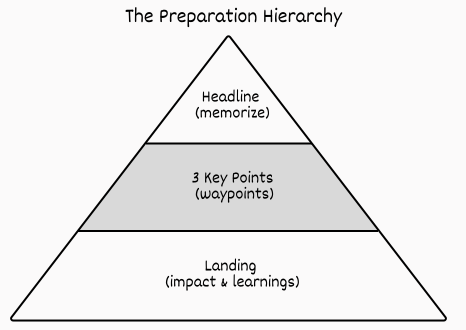
What to Memorize
There are some things you will need to memorize. Three elements per story, but let the exact words vary each time:
The Headline: Know your opening sentence cold. This will ground you, and starting with a headline will confirm to the interviewer right from the start that you have understood the question. Practice it enough that you can deliver it smoothly while making eye contact. But even here, small variations from the memorized headline will help to keep it conversational. Sometimes you might say, "Last year, when I was working on..." and, other times, "My best example of that was when..." or "I helped our team to..." That way, the words will feel fresh to you and the interviewer, while the core message stays consistent.
Your Key Points: Remember the behavioral moments that form the backbone of your story. Think of these as waypoints on a journey. You know you need to hit them, but the path between them can vary based on the conversation. If you have three key points about investigating a bug, designing a solution, and implementing it, those waypoints stay fixed. But the way you describe each one can be adapted to the interviewer's interest level and follow-up questions.
The Landing: Know your numbers and what you took away from the experience. These are what make the story stick. Practice describing the impact of your work in different ways. For example, "We reduced errors by 90%" or "Customer complaints about this issue essentially disappeared." Working this sort of flexibility into your landing helps you to emphasize what matters most to each interviewer.
Everything else should flow from the conversation. The supporting details, technical explanations, and context should all emerge organically. If you've practiced enough, these details will come without having to be forced.
Finding Your Natural Language
Corporate speak kills authenticity, and it makes you sound like everyone else. Compare these versions:
Corporate speak: "I leveraged cross-functional stakeholder alignment to drive operational excellence initiatives that yielded substantial productivity gains."
Natural language: "I got three teams to agree on a new process that saved everyone about five hours a week."
The second version is clearer, more credible, and it’s easier to deliver naturally. It also invites follow-up questions because the interviewer knows what you actually did.
Speaking plainly takes practice, because we absorb corporate jargon from job descriptions, meetings, and company decks without realizing it. You have to actively strip it out. As you practice, think about how you would explain technical concepts to friends or family. That is the language you want to use in interviews.
Technical precision is important, but it shouldn't come at the cost of clarity. You can be accurate without being difficult to comprehend. For example, "We made the app load twice as fast by storing frequently used data in memory" is both precise and clear.
Practice Conversing
Traditional methods of practicing for interviews, for example, recording yourself delivering word-for-word monologues, create the wrong sort of muscle memory because it trains you to perform rather than converse. Therefore, it should never be your only mode of practice. Instead, try these approaches that build real conversational skills in an interview setting:
Story Interruption Drills: Have a practice partner interrupt you randomly with clarifying questions. Mid-sentence, they might ask, "Wait, how many people were on the team?" or "What made you choose that approach?" Learn to pause, answer them clearly, and then smoothly continue with your narrative. Practicing this will build comfort with the natural flow of a technical conversation, because engaged interviewers are likely to interrupt you with questions.
Key Point Shuffle: Practice telling your stories with the key points in different orders. For example, instead of explaining the problem, then your investigation, then the solution you applied, try starting with the solution and working backwards. Or lead with the most interesting technical challenge. Developing this level of flexibility will enable you to show that you understand the content deeply, and you will easily be able to adapt your story to what interests the interviewer most. It will also prevent you from getting thrown off if an interviewer asks you to skip ahead or go back.
Conversational Paraphrasing: Start by confirming you understand what the interviewer is really asking for, then adapt your story to emphasize the most relevant aspects. Next, practice telling the same story three times using completely different words each time. Building a repertoire of ways to express the same ideas will help to break any reliance you might have on a script. For example, you might describe a performance issue as being "painfully slow," or "taking 30 seconds when it should have taken 3," or that it "made users think the app had frozen." Different ways of phrasing the problem will suit different contexts. If you can vary your language freely in response to the situation, you won’t sound rehearsed.
Your goal is to be so comfortable with your material that you can deliver it naturally without thinking too hard. When you know your stories this well, you can focus on the conversation instead of trying to remember what comes next.
Truthfulness is Non-Negotiable
Everything in this book assumes you're telling true stories about real experiences. This is not negotiable. Even small lies or exaggerations in behavioral interviews are dangerous, and they are likely to be exposed.
Behavioral interviews employ deep-dive questioning. When you share a story, the interviewers will probe specific details: your exact role, the team dynamics, the technical decisions you made, the obstacles you faced, and the outcomes you achieved. If you've fabricated or significantly embellished any part of your story, your answers to these questions will likely expose inconsistencies. You might remember the broad strokes of a fabricated story, but you are not likely to be able to think of (and memorize) detailed made-up answers to all the possible questions that you could be asked.
Interviewers who have conducted a large number of behavioral interviews will have strongly developed instincts for lies. They will notice when a candidate’s answers become vague under pressure. They will catch contradictions between the different parts of a story. They will recognize the difference between genuine recall and fabricated detail. Once they suspect dishonesty, they will probe harder, and the interview will essentially end there.
Beyond the practical risk of getting caught, dishonesty undermines the entire purpose of behavioral interviews. Companies use them to understand how you think and work. If they want to hire you, they want to hire the real you, not a fictional character that you've created. If your stories can't show the capabilities they’re looking for, the role may not be the right fit for you.
If you lack the perfect story for a specific question, use the strategies set out in the section "Handling the Unexpected" that comes later in this chapter. You can adapt related stories, explain what your hypothetical approach would be, or reach back to earlier experiences. All of these options will maintain your integrity while still providing value to the interviewer. There's never a good reason to lie.
Progressive Practice
Build your interview skills by practicing deliberately at progressively increasing levels of difficulty. Move to the next milestone only when you feel comfortable at the current one, not based on any fixed schedule. Some people may need a week between milestones, others a month. Proceed at your own pace.
Milestone 1: Solo Recording – Record yourself telling stories to build a baseline comfort with hearing your own voice. Don't worry about being perfect; just get used to telling your stories out loud. This builds self-awareness about your pacing, clarity, and verbal tics. Watch these recordings and take notes on how you can improve.
Milestone 2: Practice with Non-Technical Friends – Practice with friends or family, and get them to ask you basic follow-up questions. Answering their naive questions from outside your field will help you eliminate jargon and provide clear explanations. If your friend doesn't understand why something was challenging, you need to use simpler language. Working on this milestone will build your ability to explain complex work to diverse audiences. This is an important skill to work on because not all interviewers will be deep technical experts.
Milestone 3: Mock Interviews with Professionals – Carry out mock interviews with tech professionals who understand your domain. They can probe your technical decisions realistically and ask the kinds of follow-up questions you'll likely face in real interviews. This will give you practice defending your decisions under scrutiny and help you build technical depth in your storytelling.
Milestone 4: Lower-Stakes Real Interviews – If possible, schedule your first interviews with companies you're less excited about but from which you would still consider accepting an offer. Real stakes change the dynamic entirely, and these experiences will teach you what to expect. The pressure of a real interview can't be fully simulated. You will learn to manage your nerves, maintain your presence under pressure, and recover from any mistakes you make.
Each milestone targets a different skill. Recording builds self-awareness. Friends force you to drop jargon. Mock interviews sharpen your technical depth. And nothing replaces the real thing.
Final Logistics and Setup
The logistics matter more than you'd think. Getting the small stuff right means you can focus on the conversation.
Your Pre-Interview Checklist
Create a checklist and run through it both the night before and 30 minutes before the interview (or before you leave the house for it).
The Night Before: For all interviews:
- Prepare what you’re going to wear, and sort out the materials you’ll bring with you, including copies of your resume, your story bullet points, and your portfolio.
- Review the profiles of your interviewer(s) if you know their name(s).
- Check the backup contact information for the interviewer.
For video interviews:
- Test the video platform, camera, microphone, and internet connection.
- Set up your interview space with a clean desk, good lighting, and minimal distractions.
For in-person interviews:
- Plan your route, parking, and timing.
- Confirm building access instructions if needed.
Getting There (In-Person Interviews):
- Before you leave, review the role description and your research notes on the company.
- Leave early enough to give yourself a buffer for unexpected delays.
- Find a quiet spot nearby to take five deep breaths and center yourself before entering the building.
- Arrive at the building 15 minutes early, and check in 5 minutes before the interview time.
30 Minutes Before (Video Interviews):
- Review the role description and your research notes on the company.
- Close all applications that could generate notifications.
- Do a final tech check on camera angle, lighting, and audio.
- Place water within reach.
- Take five deep breaths to center yourself.
- Join the meeting 2-3 minutes early.
- For coding interviews, make sure your laptop is charged and your IDE is open.
Video Interview Setup
Camera Position: Place your camera at eye level. Looking down at a laptop camera creates psychological distance and makes you appear less engaged. Prop your laptop on books or use an external webcam to achieve the ideal camera position. Ensure your face is centered and your eyes are on the top third of the frame. Look at the camera when speaking, not at the interviewer's face on your screen. This will feel unnatural at first, but if you are looking at the screen, it will make you appear to be looking down. Practice this before interview day, so it becomes more comfortable.
Background: Keep it simple and professional. A blank wall or neutral bookshelf works well. A messy room is distracting. Virtual backgrounds can often glitch and distract from your message. However, if you must use one, test it thoroughly with different lighting conditions and movements. Some interviewers like seeing a bit of personality in your background. Others prefer neutral. If you're not sure, keep it clean and simple.
Audio Quality: Use headphones with a good microphone. Poor audio makes it harder for interviewers to understand you, and it will exhaust them. Built-in laptop microphones pick up room echo and background noise. Even basic earbuds with a microphone will dramatically improve audio quality. For the best audio quality, use a separate microphone. Test your setup with a friend to ensure you sound clear.
Lighting: Face a window or place a lamp in front of you to ensure there is even light on your face. Backlighting could turn you into a silhouette. Side lighting will create dramatic shadows. If you are interviewing at night, point a simple desk lamp at the wall behind your monitor to create a soft, flattering light.
Notification Management: Close all browser tabs and applications from which you could receive notifications. This includes email, Slack, Discord, WhatsApp, text messages, and any social media. Put your phone on Do Not Disturb mode. An unexpected notification sound or pop-up could distract both you and the interviewer and disrupt your flow.
Note Placement: Put bullet points for your story headlines near your camera or on paper notes on your desk. This lets you glance at reminders. But don't read from notes. Your bullet points are a safety net, not a script. Be aware that companies are increasingly alert to candidates who appear to be reading from AI tools or getting outside help during interviews. If an interviewer asks, be upfront that you have a few bullet points with your story headlines and show them your papers, as handwritten notes are acceptable. Transparency about brief personal notes is far better than appearing evasive or looking like you're using AI assistance.
Hydration: Keep a water bottle within reach in case your mouth gets dry. Taking a small sip during a natural pause is perfectly acceptable.
Technical Backup: Have your phone ready as a hotspot in case the internet connection fails. Test this backup connection before the interview. Keep the interviewer's contact information accessible on a different device. If the video fails completely, being able to quickly switch to the phone will show your professionalism under pressure.
Technical Readiness: If the interview involves coding or technical demonstrations, ensure your laptop is fully charged and plugged in if you’re using one. Have your preferred IDE or development environment already open. Test that you can share your screen if needed. Don't wait until the interview starts to discover your battery is at 5% or your coding environment needs updates.
In-Person Interview Preparation
Arrival: Arrive 15 minutes early, but don't announce yourself until 5 minutes before. Use the extra time to find the bathroom, check your appearance, and take a few calming breaths. Walking in flustered from rushing will undermine your presence.
What to Bring: Carry a portfolio with copies of your resume and a page of bullet points for your stories. Include a pen and paper for notes. Even if you never reference these materials, having them near reduces any anxiety. Bring breath mints and tissues. (Small comforts matter when you're nervous.)
Managing Wait Time: Long waits in reception areas can drain your energy. Stay off your phone except for quick time checks. Instead, review your story headlines mentally. Observe the office environment for conversation starters. Stay alert with good posture and occasional movement.
During the Interview
With the preparation work done, you can now engage in the conversation. Your task during the interview is to be present, responsive, and real, while ensuring your key messages come through clearly.
Create Real Conversations
The best behavioral interviews feel like engaging technical discussions. Your role is to keep this conversation moving while ensuring your key messages come through.
Why Interruptions Signal Engagement
Many candidates panic when interviewers interrupt their stories, but this reaction misses the point, because only engaged interviewers will ask you questions. They're not judging your story to be inadequate. Rather, they want to explore the areas that interest them or connect to the challenges their teams face.
When you are interrupted, resist the urge to rush through your answer and then race back to resuming your story. The interruption is the conversation. Give the question your full attention, and answer it thoroughly. Then ask if they want more detail on that specific point before continuing your story.
Here's how to handle interruptions smoothly:
- Pause immediately and make eye contact.
- Answer their specific question completely.
- Confirm with them that you've answered their question to their satisfaction (e.g., "Does that answer your question?" or "Did that address what you were asking about?").
- If no, ask them to clarify exactly what they were after, and give your answer accordingly.
- If yes, check if they want more detail ("Should I elaborate on that?").
- Bridge back to your story: "So, after solving the database issue, I..."
This keeps the conversation flowing. The interviewer gets their question answered, and you still hit your key points.
Sometimes interruptions reveal the things that really matter for this role. For example, if they dig deep into how you handled stakeholder communication during your technical project, that likely signals that the role will involve significant cross-functional work. Therefore, take the cue and adapt your remaining stories to emphasize collaboration.
Follow the Interviewer's Lead
Your story might be about performance optimization, but if the interviewer keeps asking about team dynamics, follow their interest. They're telling you what matters for this role and what they’re curious about.
This doesn't mean you have to abandon your structure. Hit your key points, but lean into whatever they're most interested in. If they keep asking about how you got people on board, spend more time on that. If they probe the technical design, go deeper there.
Active following looks like this:
Note their questions: Pay attention to patterns in their follow-up questions, because that will tell you what matters most for the role. For example, if they ask two questions about testing, they probably value quality engineering. Respond by weaving testing considerations into your next story. You should pull details from your prepared base layer up into your behavioral core preemptively when you recognize what matters to the interviewer.
Build on their comments: If they say, “We've struggled with that, too,” you can briefly ask about their experience. But keep it short; you still need to hit your key points, and going off track is the biggest risk here. Don't let it derail you. Keep it brief, and stay aware of the time.
Match their energy: Some interviewers want rapid-fire exchanges. Others prefer thoughtful, detailed discussions. If you can, try to mirror them and match their pace. However, this can be challenging to pull off during an actual interview while also managing your stories, so don't force it if it feels unnatural.
The Power of Check-Ins
Allay any anxiety that you may have about whether or not you're on track with simple check-ins. These are brief questions to keep the conversation collaborative:
- "Should I go into more technical detail on the dynamic caching strategy?"
- "Would it be helpful to explain the team dynamics first?"
- "I can share more about the rollout process if that's useful."
Check-ins serve multiple purposes. They show respect for the interviewer's time. They prevent you from overexplaining topics they don't care about. They create natural breakpoints in your stories. Best of all, they convert monologues into dialogues.
Use check-ins strategically. After explaining a complex technical concept, check understanding. Before diving into implementation details, check interest. When you see the interviewer taking notes, pause and check to see if they need clarification. Chapter 3 introduced check-ins when preparing your base layer for follow-up questions. Later in this chapter, "The Pyramid Method for Follow-Ups" shows how to structure check-ins between levels of detail.
But don't overdo it. Checking in after every sentence will make you appear uncertain. Use them at natural transition points between major sections of your story.
Handling the Unexpected
Despite thorough preparation, you should still expect to field unexpected questions. Having a response strategy will keep you confident when this happens. You have four main options, and you can choose whichever fits the situation best.
Option 1: The Related Story
Your first option is to adapt a story from a related competency. Consider a situation where you have been asked about conflict with your manager, but you had only prepared a story covering conflict with team members. You might say something like this:
"I haven't had a situation with true conflict with my manager, but I can share a time when my team and I strongly disagreed on a technical approach. The discussion got pretty heated because we all cared deeply about the decision..."
An answer like this shows self-awareness while still showing relevant skills. You have acknowledged the slight mismatch but are still able to provide value. Most interviewers will appreciate the honesty and will either accept the related story or adjust what they're looking for.
When using related stories, explicitly connect them to the original question. Explain why you think the example you’re providing shows related skills. Forcing an unrelated story never works, because interviewers can tell. If you can clearly explain why your example shows the same skills they're looking for, most interviewers will accept it.
Option 2: The Hypothetical Approach
If you truly lack relevant experience that can be connected to their question, share how you would approach the situation your interviewer has asked about. An approach like the following will show your judgment even in the absence of a perfect example:
"I haven't faced that specific scenario, but based on similar challenges, I would start by understanding my manager's underlying concerns. In my experience with technical disagreements, I've found that apparent conflicts can often come from a mismatch in priorities. I'd probably set up a one-on-one conversation first to understand their perspective..."
This works best when you have some related experience to draw from. You're not inventing a story because you're walking the interviewer through how you'd actually handle it based on what you've done before. Be specific about the steps. “I would communicate clearly” tells the interviewer nothing. But “I would document the trade-offs in a shared doc and ask each person to rank their priorities” shows real thinking.
Option 3: Distant Examples
Sometimes you need to reach beyond your recent professional experience. It is important to frame these examples appropriately:
"This takes me back to college when I led our robotics team. We had an intense disagreement about our competition strategy. While it's not recent professional experience, the way I handled it shows how I approach conflict. Half the team wanted to focus on speed, while the other half wanted precision. The debate got personal because we'd all invested months into the project..."
Or you could refer to volunteer work that you’ve done:
"I haven't dealt with this at work, but I ran into something close when I organized a hackathon. The organizing committee couldn't agree on the event's focus. Some wanted to emphasize learning for beginners, while others pushed for judging things based solely on innovation. Here's how I helped us find a middle ground..."
When using distant examples, quickly establish their relevance and then focus on showing the competency that the question has asked about. The context matters less than showing that you possess the skill in question.
Option 4: Honest Acknowledgment
Sometimes, ‘I have nothing’ is the best answer you can give:
"I don't have an example of that situation. In my roles so far, I've been fortunate to work with amazing managers where disagreements have remained professional."
This protects your credibility and shows curiosity about how they do things. It's far better than proffering an obviously made-up story or stumbling your way through a weak example.
Follow your acknowledgment by expressing a real interest in their experience. By doing this, you can turn the moment into a real conversation about how they handle similar situations. Interviewers respect that.
The Pyramid Method for Follow-Ups
When an interviewer asks follow-up questions, structure your response like a pyramid. Start with a direct answer (the peak), then expand downward through additional layers only if the interviewer wants more detail.
This mirrors the HSS pyramid from Chapter 3. There, you structured your initial story with a headline at the peak. Here, you're applying the same principle to follow-up questions: lead with your answer, then expand only as needed.
The Structure
Level 1 - Direct Answer: Give a clear, one-sentence response that directly addresses their question.
Check: "Would you like more detail on that?"
Level 2 - Brief Expansion: If they want more, provide three or four sentences with additional context.
Check: "Should I go deeper into the technical aspects?"
Level 3 - Full Detail: If they're still engaged, share complete technical details, implementation specifics, or broader context.
Example in Practice
Interviewer: "How did you handle rollback for this deployment?"
Level 1: "We used feature flags so we could disable the new code without redeploying."
Check: "Would you like more detail on our approach?"
Level 2 (if yes): "We wrapped all new functionality in feature flags that could be toggled without deployment. We also kept the old code paths active for two weeks. Our monitoring automatically disabled flags if error rates spiked above 2%."
Check: "Should I explain the technical implementation?"
Level 3 (if yes): "We used LaunchDarkly for flag management. Our monitoring system tracked error rates per feature, and we set up alerts to flag any spikes so the on-call engineer could disable the feature within minutes. We also built a dashboard showing flag status and error rates for each feature."
Why This Works
Employing the pyramid method respects the interviewer's time while also making sure they get the level of detail they’re after. It prevents the common mistake of overexplaining when a simple answer would suffice. It also helps you gauge their interest level and technical depth.
Most follow-up questions need only one or two levels. If an interviewer nods and moves on after your Level 1 answer, they got what they needed. If Level 2 satisfies their curiosity, stop there. Don't mechanically offer all three levels every time. An interviewer who leans back and says "Got it, thanks" is signaling they're ready to move on. An interviewer who leans forward and asks, "How did that actually work?" wants more depth. Match your responses to their engagement.
Starting with the conclusion feels unnatural at first, because we're trained to build up to our point. But interviewers appreciate getting the answer immediately, then being able to choose whether to dig deeper. This approach also helps when time runs short. That way, you've communicated the essential point even if there's no time for elaboration.
Use this method for any follow-up question, not just technical ones. Questions about team dynamics, project outcomes, or your decision-making process will all benefit from this structured approach.
Stop Reading Faces, Start Listening
One of the biggest interview mistakes is trying to read the interviewer's facial expressions. This misguided effort will often distract you from the conversation, and it will often lead to wrong conclusions.
Stop Reading Faces
Research consistently shows humans are terrible at accurately interpreting facial expressions, especially across cultures and in stressful situations. A serious expression might mean:
- They're deeply engaged in your story.
- They're thinking about follow-up questions.
- They're connecting your experience to their challenges.
- They’ve had a bad day.
- They want to hide their enthusiasm.
- That's just how their face looks when concentrating.
That smile might indicate:
- They appreciate your solution.
- They don’t want to discourage you after a poor answer.
- They're being polite.
- They're thinking about lunch.
- That's just their resting expression.
Trying to decode these signals wastes mental energy that would be better spent on the conversation. Worse, you might misinterpret neutral concentration as disapproval and start second-guessing yourself.
Cultural differences make face-reading even more unreliable. What might seem like disengagement in one culture could signal respect in another. Some interviewers maintain a poker face by design to avoid biasing candidates. If you try to interpret expressions, you're playing a guessing game you can't win.
What Actually Signals Engagement
Instead of reading faces, listen to their questions and responses. These provide real information:
Engagement signals:
- Asking follow-up questions.
- Connecting your story to their work: "We had a similar challenge..."
- Taking detailed notes.
- Asking for more specifics.
- Losing track of time because they're interested.
Potential disengagement signals:
- "Let's move to the next question," without any follow-ups.
- Rushing through their question list without probing.
Even these aren't perfect indicators. Some interviewers maintain consistent behavior regardless of their assessments. What seems like a generic response might not be a judgment on your answer, but just a reflection of their interview style. And if an interviewer keeps checking the time, they might simply be worried about fitting in all their required questions, not signaling disinterest in you. Your best strategy remains the same: tell clear, concise stories, and check in about the desired level of detail.
Focus on What You Can Control
You control your preparation, your delivery, and your energy. You don't control the interviewer's mood, their facial expressions, or their interviewing style. Focusing on what you can't control creates anxiety that will undermine your performance.
Your best move is always the same: use a check-in. Instead of guessing, ask if they want more depth. These check-ins will get you information you can use. They will also allow you to demonstrate professional communication skills that matter in real work environments.
Managing Energy Across Multiple Interviews
Back-to-back interviews will test your stamina. Your sixth interviewer deserves the same energy as your first. This requires active management.
Physical Energy: If you have multiple interviews, use the transition time between sessions wisely. Stand and stretch between sessions. Eat something small, like nuts or a bar, to keep your energy steady. If there's a break, use it to step away and reset for a minute.
Mental Energy: Reset your mind between interviews. Each interviewer is meeting you fresh, so don’t let your previous conversations cloud your thinking. Take 30 seconds to remind yourself what's interesting about this role. That helps you walk into the next session with fresh energy instead of carrying residue from the last one. Avoid the temptation to debrief the last interview in your head. Stay present for what's next.
Story Variety and Freshness: Using different stories with different interviewers keeps your delivery energetic, and it serves another practical purpose. Most companies hold panel meetings after all interviews, where the interviewers share what they heard from you. Telling every interviewer the same story gives the hiring panel a narrow picture of what you can do. Aim to showcase different experiences and competencies across your interview day. If you must repeat a story, find a new angle or emphasis. For example, the second telling of your migration story might focus on stakeholder management instead of technical details. Variety keeps you engaged and gives the hiring panel a broader view of what you can do.
Managing Difficult Moments: If one interview goes poorly, don't let it contaminate the ones that follow. Let it go. One bad round doesn't sink you; plenty of people get offers despite bombing one interview. Each interviewer is forming their own assessment, so give the next one your full effort. A difficult moment with one person doesn't determine your outcome. Give the next interviewer your best effort.
After the Interview
The interview day is over, but you're not done. What you capture now will make your next interview better.
Learning From Each Interview
Immediately after the interview day ends, while the details are still fresh in your mind, capture your observations. Don't wait until the next day or until you hear back from the company. Memories fade quickly, and specific details are the best for improvement.
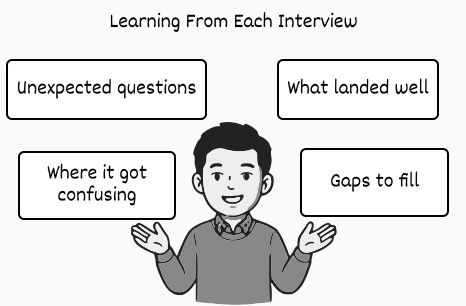
Questions you weren't prepared for: Write these down verbatim. Prepare stories for next time or practice your framework for handling unexpected questions. If you weren’t able to answer well in the moment, develop a strong response now so you're ready if it comes up again.
Stories that landed well: Note which examples resonated and why. Did the interviewer connect with the technical challenge? The team dynamics? The business impact? Understanding what worked helps you select stories strategically for future interviews.
Moments of confusion: Where did communication break down? Did you use unclear terminology? Skip important context? Assume too much knowledge? Use those moments to teach you where to improve clarity. Be specific about what went wrong and how you'll prevent it from occurring in a future interview.
Follow-ups that revealed gaps: What did interviewers probe that you couldn't answer well? These questions show what matters for the role and where to deepen your preparation. If multiple interviewers from the same company asked about the same capability, that was a clear signal about their priorities.
Don't dwell on mistakes or replay the interview endlessly in your head. Focus on extracting patterns that you can use to improve your interviewing skills. For example, if multiple interviewers across different companies have pressed you on how you handle ambiguity in technical decisions, that's a gap in your story bank worth addressing.
Building Interview Stamina
Your first interview will feel exhausting. That's normal. Each one after that gets easier as you learn what works for you.
Each interview teaches you something about performing under pressure. You learn which preparation techniques are most helpful to you. You discover which stories work best. You get comfortable with the uncertainty and can adapt more quickly to different interviewer styles.
As you sit through more interviews, focus on maintaining your authenticity rather than perfecting a performance. Before each interview, remember why your work mattered. Not just the metrics, but the real impact. That performance optimization didn't just improve numbers; it made the app usable for people with older phones.
When you talk about work you're proud of, don't hold back. That energy is contagious, and it makes the interview better for everyone. You're not trying to be a polished performer; you're trying to be yourself, at your best.
The Path to Natural Delivery
Nailing behavioral interviews requires you to balance structure with flexibility. You need your HSS framework as a foundation, but you must build genuine conversations on top of it.
Your stories are vehicles for describing your experience. The best delivery feels like sharing stories with an interested colleague, not presenting to an evaluation committee. When your delivery feels like a real conversation but still hits the key points, you're giving your interviewers exactly what they need to fight for you in the debrief.
The investment in mastering your delivery will pay off immediately. Each interview gets easier. Your confidence grows. Your stories become more natural. You start enjoying the opportunity to discuss your work with people who understand it. This positive energy becomes part of what makes you a really great hire.
Trust the process. You've done interesting work, and you've prepared strong stories. Now show up rested, present, and ready to share what you've accomplished. When you nail the delivery, your experiences will speak for themselves.